- Waqas Buneri
- November 22, 2026
Lahore’s AQI surges past 500, making it world’s most polluted city
-

- Talha Saeed
- November 22, 2026
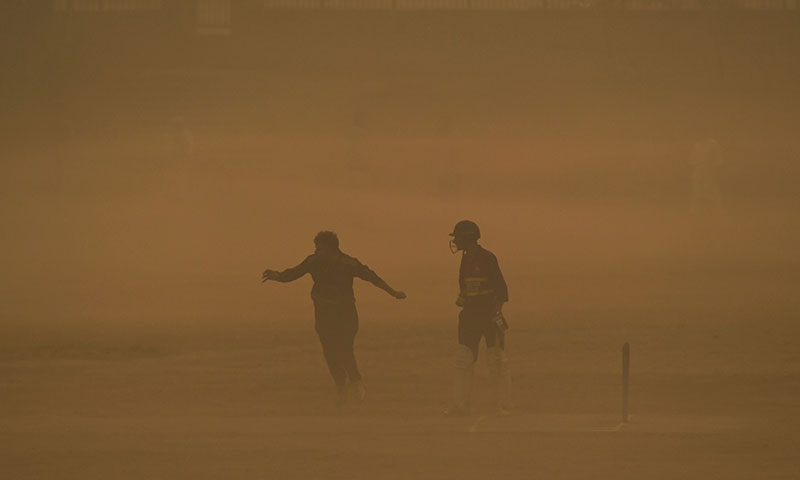
LAHORE: Lahore ranked as the world’s most polluted major city on Sunday morning as its Air Quality Index (AQI) climbed above 500, with several neighbourhoods recording extremely hazardous pollution levels.
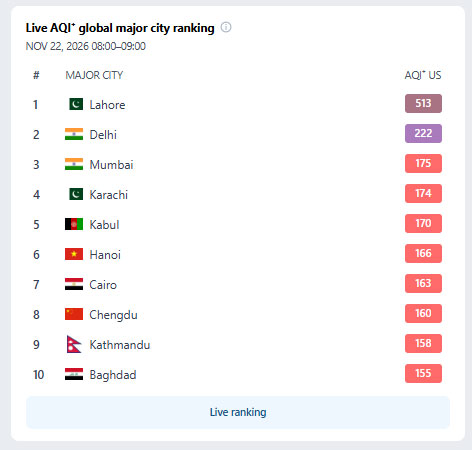
According to Swiss air quality monitoring platform IQAir, the Punjab capital topped the live global major city ranking with an AQI of 513 during the 8am to 9am today. India’s capital Delhi ranked second with an AQI of 222, followed by Mumbai at 175 and Sindh capital Karachi at 174.
Afghanistan’s Kabul ranked fifth with an AQI of 170, followed by Vietnam’s Hanoi at 166 and Egypt’s Cairo at 163. China’s Chengdu, Nepal’s Kathmandu and Iraq’s Baghdad occupied the eighth, ninth and tenth positions with readings of 160, 158 and 155, respectively.
— IQAir
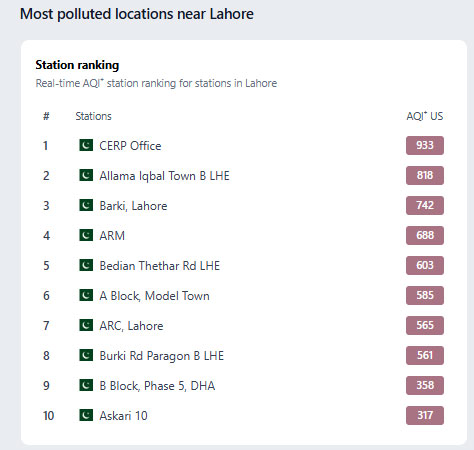
Air pollution levels were particularly severe in several parts of Lahore. According to IQAir’s monitoring data, Gulberg College Road recorded the highest AQI of 927, followed by Mushtaq Ali Gurmani Road at 810 and Maulana Shaukat Ali Road at 778.
Other areas also reported dangerously high readings, with Multan Road, Shahdara, Safari Park, Egerton Road, Kahna Nau and GT Road recording AQI levels of around 500.
Barki Road recorded an AQI of 458, while DHA Phase VI registered 386, the Punjab University area 377 and the Wagah border 376.
— IQAir
IQAir’s live ranking compares air quality in around 120 major cities, using data from government monitoring stations and low-cost sensors operated by research institutions, companies and citizen scientists.
It calculates each city’s AQI using the median of readings from monitoring stations within its boundaries, with measurements aggregated into hourly averages.
The ranking is updated at least once an hour, allowing cities to move up or down as pollution levels fluctuate. Under the US AQI scale used by IQAir, readings above 300 fall in the hazardous category, indicating serious health risks.
Punjab expands anti-smog operations
Meanwhile, Punjab Senior Minister Marriyum Aurangzeb said Lahore’s air quality had been temporarily affected during the morning because of weak winds and falling temperatures.
Aurangzeb, who also holds the environment protection and climate change portfolio, said wind speed in Lahore was around one kilometre per hour, blowing from north to south, adding that air quality was expected to improve during the afternoon as winds picked up.
On the instructions of Chief Minister Maryam Nawaz, anti-smog operations involving smog guns and water sprinkling were continuing in high-AQI areas and had been extended to neighbouring Nankana Sahib and Sheikhupura.
Drone, night and field surveillance squads were also monitoring pollution sources and taking action against violators.
During the previous 24 hours, authorities inspected 275 industrial units, sealing three and imposing Rs400,000 in fines. Inspections of 499 brick kilns resulted in seven being sealed, one demolished, seven cases registered and Rs1.4 million in fines imposed.
The provincial authorities also confiscated 390 kilogrammes of substandard plastic and took action against commercial kitchens emitting smoke.
The minister said 440 crop-burning incidents had been documented across the province, resulting in 248 cases and legal complaints and fines totalling Rs3.465 million.
The government was promoting alternatives through 187 balers and 1,259 Kubota machines to help farmers manage crop residue without burning it.
Smog poses serious health risks
Smog contains harmful pollutants and fine particles that can irritate the eyes, nose and throat, cause coughing and breathing difficulties, and aggravate asthma and other respiratory conditions.
Prolonged exposure can also increase cardiovascular risks, particularly among children, older people and those with existing illnesses.
Authorities have advised residents to avoid unnecessary outdoor activities, wear well-fitting N95 masks when going outside and keep doors and windows closed during periods of severe pollution. Children and older people have also been advised against exercising outdoors.
People experiencing breathing difficulties or chest pain should seek immediate medical attention.
You May Also Like