
- Reuters
- September 15, 2026
Marka-i-Haq: Pakistan military warns India against ‘strategic miscalculations’ on conflict anniversary
-

- Sadia Basharat
- May 8, 2026
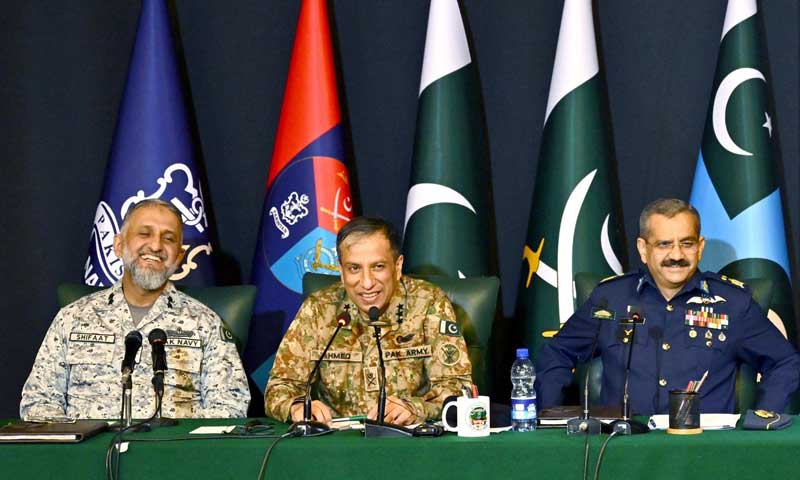
WEB DESK: In a comprehensive press briefing marking the first anniversary of ‘Marka-i-Haq’, Pakistan’s military leadership on Thursday reaffirmed its operational readiness, warning India that any future aggression would be met with a response “in a matter of minutes.”
Inter-Services Public Relations (ISPR) Director General, Lt Gen Ahmed Sharif Chaudhry, alongside senior officials from the Navy and Air Force, detailed the strategic consequences of the 2025 conflict, ranging from the Pahalgam incident to the conclusion of Operation Bunyanum Marsoos.
The ‘Strategic Consequences’ of Marka-i-Haq
Lt Gen Chaudhry outlined ten “strategic consequences” arising from the year-long period following the conflict. He asserted that India’s narrative of painting Pakistan as a source of terrorism has been “buried,” noting that New Delhi has failed to provide evidence regarding the Pahalgam attack.
The DG ISPR further criticised the “politicisation” of the Indian military and the “militarisation” of its political leadership. “Why are you trying to make jokers out of your admirals, and generals and marshals?” he asked, referring to contradictory statements made by Indian officials regarding aerial losses. He claimed the conflict solidified Pakistan’s role as a “net security stabiliser” in the region, capable of dominating the escalation ladder against a numerically larger adversary.
PAF Claims ‘8-0’ Victory in Aerial Combat
Providing details on the air war, Air Vice Marshal Tariq Ghazi reported a “spectacular performance” by the Pakistan Air Force (PAF). He stated that the “kill tally” currently stands at 8-0 in favour of Pakistan, asserting that confirmed kills included four Rafale fighter jets, one Su-30, one MiG-29, and one Mirage 2000.
AVM Ghazi revealed that indigenously manufactured JF-17 Block III aircraft successfully neutralised two of India’s “prized” S-400 missile batteries. “The IAF was not to be seen in the air for the rest of the conflict,” he claimed, adding that the PAF is currently pursuing 160 advanced projects to maintain a qualitative edge in future warfare.
Naval Deterrence and Indigenous Prowess
Rear Admiral Shifaat Ali, Deputy Chief of Naval Staff, noted that despite India’s significant naval budget, its fleet failed to “muster the courage” to move beyond sanctuaries. He stated that the Pakistan Navy remained prepared to destroy the Indian aircraft carrier Vikrant had it attempted to disrupt maritime trade routes.
The military showcased a range of “homegrown” capabilities during the briefing, including cruise missiles, the Army Rocket Force Command, loitering munitions, and electro-optical satellites. Lt Gen Chaudhry emphasised that while Pakistan does not seek war, its technical prowess is backed by a “strategic clarity” that India continues to miscalculate due to a “hubristic mindset.”
Kashmir, Water, and Regional Alliances
Reiterating Pakistan’s “constant stance” on the Kashmir dispute, the military spokesperson quoted Field Marshal Asim Munir, describing the region as Pakistan’s “jugular vein.” He maintained that the final resolution must be reached through a UN-mandated plebiscite and the right of self-determination.
Addressing other regional concerns, the DG ISPR touched upon the Indus Water Treaty, labelling water an “inalienable right” and warning that the military remains the “final instrument of violence” should the destiny of 250 million people be threatened. He also reaffirmed the mutual defence pact with Saudi Arabia, stating that “any threat to Saudi Arabia is a threat to us.”
Stance on Afghanistan and Internal Politics
On the western front, Lt Gen Chaudhry described Afghanistan as a “non-rational player” and confirmed that Operation Ghazab lil-Haq remains ongoing against terrorist proxies. He accused India of using Afghan soil to launch attacks in Pakistan following their defeat on the battlefield.
Concluding the session, the DG ISPR addressed domestic concerns, clarifying that the military is “not a stakeholder in the politics of Pakistan.” He urged political entities to resolve their issues through dialogue, stating that the army’s primary focus remains the “Bunyanum Marsoos effect” the synergy between the people, the government, and the armed forces.
You May Also Like

- WEB DESK
- September 15, 2026
Petrol price rises by Rs4.10, diesel by Rs6.41 per litre
- Reuters
- September 15, 2026
Samson, Reddy lead India to series-clinching win over Afghanistan

- WEB DESK
- September 15, 2026