- Farah Mehjabeen
- October 26, 2026
Matthew Perry assistant sentenced to 41 months in ketamine overdose case
-

- Zoya Anwer
- May 28, 2026
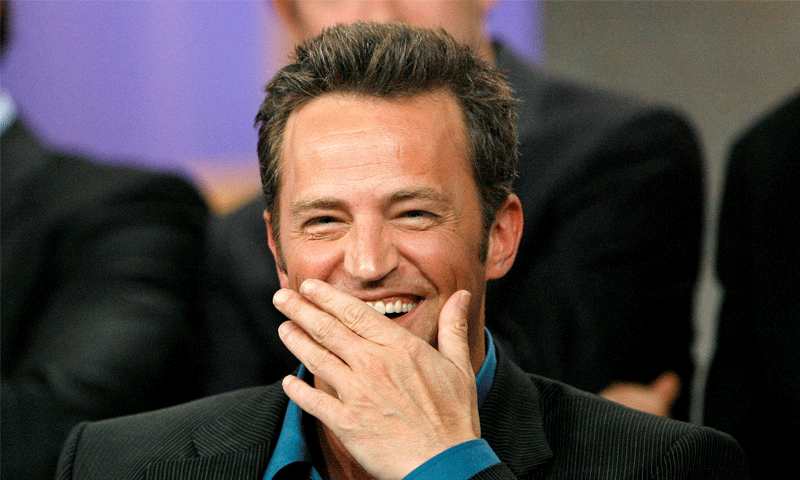
The live-in assistant of late Hollywood actor Matthew Perry has been sentenced to 41 months in prison for his role in the ketamine overdose death of the Friends star, bringing another chapter of the high-profile investigation to a close.
Kenneth Iwamasa, 60, appeared before a Los Angeles federal court on Wednesday where Judge Sherilyn Peace Garnett handed down the sentence after finding that he knowingly enabled Perry’s drug use despite being aware of the actor’s long battle with addiction.
Perry, best known for playing Chandler Bing in the hit TV show Friends, was found dead in the hot tub of his Los Angeles home in October 2023. Medical authorities later ruled that he died from the acute effects of ketamine, with drowning listed as a contributing factor.
Iwamasa had pleaded guilty in August 2024 to conspiracy to distribute ketamine causing death. Prosecutors said he helped obtain more than $50,000 worth of the drug through two doctors and repeatedly injected Perry despite having no medical qualifications.
The court also ordered Iwamasa to serve two years of supervised release and pay a $10,000 fine. He is expected to report to prison on July 17.
Family condemns assistant’s role
During the hearing, Iwamasa addressed Perry’s family directly and apologised for his actions.
“I’m so sorry to all of you,” he said in court, adding that he regretted the “illegal acts” and hoped his case would serve as a warning to others in similar situations.
However, Perry’s family members submitted strongly worded victim statements ahead of the sentencing, accusing Iwamasa of failing to protect the actor during a vulnerable period in his life.
Perry’s sister Caitlin Morrison wrote that she had “no sympathy” for the assistant, arguing that he either abandoned the actor despite recognising the danger or knowingly fled the scene after contributing to it.
His mother, Suzanne Morrison, said Iwamasa’s primary responsibility had been to support Perry in maintaining sobriety. Instead, she wrote, he facilitated the actor’s drug use and actively sought new suppliers for ketamine.
“We trusted a man without a conscience, and my son paid the price,” she said in her statement to the court.
Judge Garnett echoed those concerns, telling Iwamasa that he was fully aware of Perry’s addiction struggles and continued supplying him with ketamine regardless of the obvious risks.
Wider investigation into drug network
Federal prosecutors said Perry’s death exposed a broader network of individuals who allegedly exploited the actor’s dependency for profit.
Authorities stated that Iwamasa administered several injections to Perry on the day he died before leaving him alone. The judge also criticised him for attempting to conceal evidence and misleading investigators following the actor’s death.
Outside court, Iwamasa again apologised publicly, saying he wished he could “turn back time”.
His lawyer, Alan Eisner, argued that Perry himself had requested the injections and described the relationship between the actor and his assistant as one shaped by an uneven power dynamic. While acknowledging Iwamasa should have resisted, the defence maintained that responsibility did not rest solely with him.
All five defendants charged in the case eventually pleaded guilty.
Among them was Jasveen Sangha, dubbed the “Ketamine Queen” by prosecutors, who received a 15-year prison sentence earlier this year for supplying the drugs linked to Perry’s death.
Doctors Salvador Plasencia and Mark Chavez also received prison and supervised release sentences for their involvement in supplying ketamine to the actor, while another defendant, Erik Fleming, was sentenced earlier this month.
You May Also Like