
- Web
- 1 Hour ago
Middle East conflict tests Dubai aviation hub’s dominance
-

- Web Desk
- Mar 05, 2026
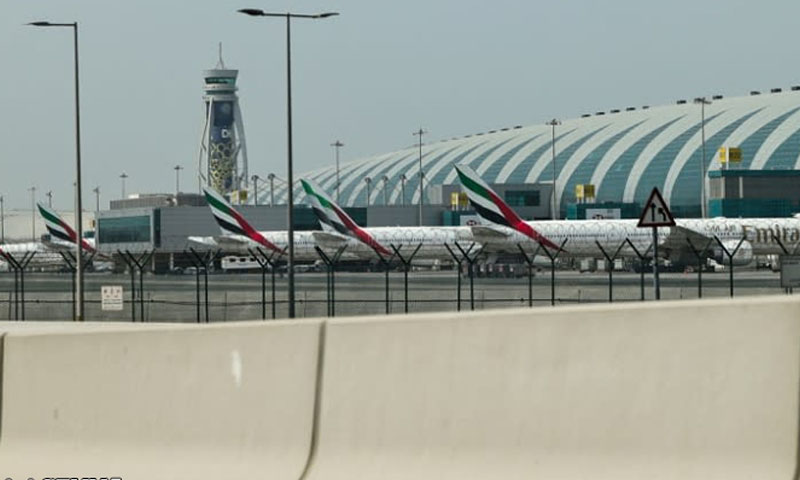
DUBAI/PARIS: Escalating conflict in the Middle East has exposed how heavily global air travel depends on a small group of Gulf hubs led by Dubai, the world’s busiest international airport, after the shutdown of regional airspace disrupted airline networks worldwide.
Dubai, which handles about 454,000 flights annually and connects travellers across 110 countries, has grown over four decades into the centre of a vast global aviation network.
The crisis intensified after US and Israeli strikes on Iran triggered wider regional tensions, bringing the conflict closer to the Gulf and including an attack targeting Dubai airport.
Dubai now faces the challenge of managing tens of thousands of stranded passengers and restoring disrupted flight networks, while trying to limit the impact on inbound travellers who account for roughly half of the airport’s total passenger traffic.
Aviation analysts say that unless the region slips into a prolonged war, the Gulf’s main aviation hubs — Dubai, Abu Dhabi and Doha — are likely to recover due to the strength and scale of their global networks.
“These hubs have faced major disruptions before and recovered quickly because of their importance in global aviation,” said UK-based travel consultant Paul Charles.
However, some experts warn that the disruption could still weaken the hub-and-spoke model that has powered Gulf aviation for decades.
Independent aviation adviser Bertrand Grabowski said travellers may increasingly favour direct flights instead of transiting through hubs such as Dubai or Doha, potentially reducing transfer traffic.
Despite these concerns, industry leaders argue that geography remains a major advantage for Gulf hubs.
Dubai Airports chief executive Paul Griffiths previously noted that one-third of the world’s population lives within four hours’ flying time of Dubai and two-thirds within eight hours, giving the hub strong connectivity advantages.
Still, competition is intensifying. Airlines and airports in Turkey, Saudi Arabia and India are expanding rapidly and seeking to capture market share while Gulf operations face disruption.
Some analysts say Turkish Airlines could benefit in the short term due to its large hub outside the conflict zone.
At the same time, advances in aircraft technology are enabling airlines to operate more ultra-long-range direct flights, potentially bypassing traditional transit hubs. Aircraft manufacturer Airbus recently began assembling a second ultra-long-range A350 jet to support plans by Australia’s Qantas to launch direct flights between Sydney and London.
Dubai’s aviation rise began in 1985 with the launch of Emirates during the Iran-Iraq war. The airline’s rapid expansion later helped reshape Gulf aviation, prompting Qatar and Abu Dhabi to establish their own national carriers and create the region’s three major aviation hubs.
Analysts say the greatest uncertainty now surrounds travel demand to Dubai itself after Iranian attacks and falling missile debris rattled the city’s reputation for stability.
While experts expect the destination market to eventually recover, some warn that the crisis could cause lasting damage.
For Emirates and its sister airline flydubai, restoring confidence may involve using their market strength to quickly rebuild passenger traffic.
“People have short memories and could be encouraged to return through attractive fares,” said Eddy Pieniazek, head of advisory at aviation consultancy Ishka. “But those incentives may not be needed for long.”
You May Also Like