- WEB DESK
- October 6, 2026
Millions join Ayatollah Ali Khamenei’s funeral procession as Iran mourns slain supreme leader
-

- WEB DESK
- July 6, 2026
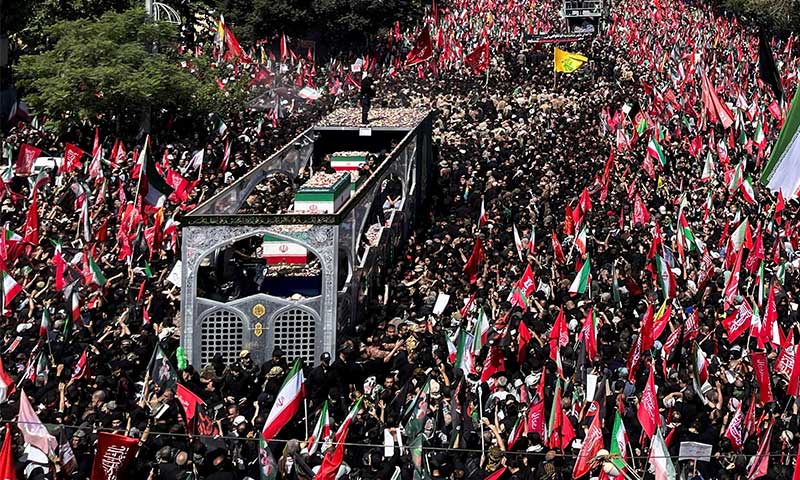
WEB DESK: Millions of mourners poured onto the streets of Tehran on Monday for the funeral procession of Iran’s slain Supreme Leader Ayatollah Ali Khamenei, with state media describing the event as the largest public gathering in the country’s modern history.
Iranian state broadcaster Press TV and the Tasnim news agency reported that vast crowds lined a 10-kilometre route through the capital as the procession began after Khamenei’s body had lain in state for two days at Tehran’s Grand Mosalla religious complex.
Khamenei, who was assassinated on February 28 in Israeli airstrikes carried out with US intelligence support during the Middle East conflict, is being honoured with several days of nationwide mourning before his burial later this week.
Thousands carrying Iranian flags and portraits of the late leader gathered from the early hours of Monday, while state television broadcast images of mourners filling major roads and public squares. Officials described the turnout as unprecedented, reflecting the significance of the ceremony for the Islamic Republic.
The funeral procession also included the coffins of Khamenei’s daughter, son-in-law, daughter-in-law and young granddaughter, who were killed in the same airstrikes. Their remains were carried in a separate ceremonial vehicle accompanying the cortege.
The procession is travelling from Imam Hussein Square through Enghelab Street, Enghelab Square, Azadi Square and Shahid Lashgari Highway before concluding near Mehrabad International Airport.
Massive security operation as procession spans Tehran
Authorities mounted an extensive security operation across the capital to manage the enormous crowds expected for the funeral.
Major roads were closed, while special traffic diversions and public transport arrangements were introduced to facilitate the movement of mourners. Emergency services were deployed along the route, and officials also implemented measures to protect participants from the intense summer heat.
The heightened precautions reflect lessons learned from the funeral of Ayatollah Ruhollah Khomeini in 1989, when millions of mourners overwhelmed security arrangements. That ceremony descended into chaos after crowd surges reportedly left several people dead and thousands injured, forcing authorities to use a helicopter to transport Khomeini’s body for burial after mourners surrounded the funeral vehicle.
To minimise the risk of similar incidents, reinforced concrete barriers had surrounded Khamenei’s coffin during the public viewing at the Grand Mosalla over the previous two days.
Funeral prayers for Khamenei and his family members were held on Sunday at the Grand Mosalla, attended by President Masoud Pezeshkian, Parliament Speaker Mohammad Bagher Ghalibaf, senior military commanders, government officials and hundreds of thousands of mourners. Iranian media reported that Grand Ayatollah Jafar Sobhani led the prayers.
Parliament Speaker Ghalibaf later praised what he described as the Iranian nation’s united tribute to its slain leader.
Nationwide mourning continues as focus remains on new leadership
Monday’s procession marks only the first stage of a series of commemorative events planned across Iran and neighbouring Iraq. Khamenei’s body will be transferred to the holy city of Qom on Tuesday before mourning ceremonies and public viewings are held in the Iraqi shrine cities of Najaf and Karbala on Wednesday. His remains are scheduled to be buried on Thursday in Mashhad, his hometown, within the precincts of the Imam Reza shrine.
The ceremonies have also renewed attention on Iran’s new Supreme Leader, Ayatollah Mojtaba Khamenei, who has yet to make a public appearance since assuming office following his father’s assassination.
Although three of Ali Khamenei’s sons attended Sunday’s funeral prayers, Mojtaba remained absent. Iranian officials have said he was wounded in the February airstrikes but have not disclosed the extent of his injuries.
Several senior military figures attended the ceremonies, including Revolutionary Guards commander Ahmad Vahidi and Quds Force chief Esmail Qaani, while a number of Iran’s former presidents remained absent. Calls for retaliation against those responsible for Khamenei’s killing featured prominently throughout the ceremonies. Iran’s army chief warned that those behind the assassination “would not escape their fate”, while many mourners interviewed by state media demanded justice and vowed continued support for the country’s leadership.
Delegations from Iran-backed groups, including Hamas and Hezbollah, also attended the funeral, underscoring Tehran’s longstanding alliances across the region.
The funeral comes at a delicate moment for Iran, which is seeking to project unity following months of domestic unrest and a fragile ceasefire with the United States after the recent regional conflict. Although fighting has paused under a preliminary agreement, both Tehran and Washington have warned they remain prepared to resume military action if negotiations collapse.
Political and religious observers described the funeral as one of the largest public mourning ceremonies in Iran’s contemporary history, highlighting both the symbolic importance of Khamenei’s legacy and the government’s effort to demonstrate national solidarity during a period of political transition.