- WEB DESK
- October 24, 2026
Mir Raza case: SHC forms judicial commission, issues notices on family’s plea
-

- Atif Hussain | Ghayas Uddin
- August 24, 2026
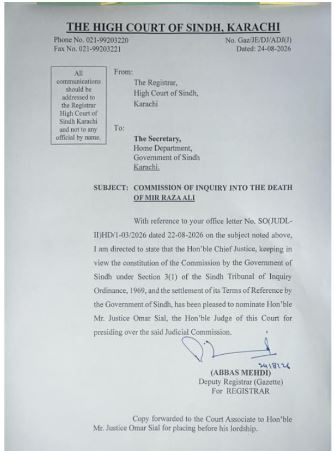
KARACHI: The Sindh High Court (SHC) on Monday constituted a judicial commission to investigate the death of young businessman Mir Raza Ali, with Justice Omar Sial appointed as its head.
The SHC chief justice appointed Justice Omar Sial as chairman of the commission on the request of the Sindh government.
The high court’s directorate has formally conveyed the decision to the Sindh Home Department through a letter.
The development comes after the Sindh government requested the high court to constitute a judicial commission to conduct an impartial and transparent inquiry into the circumstances surrounding Mir Raza’s death and the handling of the investigation.
A while ago on Monday, the SHC heard an urgent petition filed by the family of the slain businessman challenging the formation of the judicial commission.
The court had issued notices to all respondents for August 31, advocate Mir Hussain, counsel for Mir Raza’s parents, said earlier.
A total of 19 respondents have been made parties to the petition, the lawyer said.
The parents have challenged the proposed judicial commission and sought the formation of a joint investigation team (JIT) to investigate the circumstances surrounding Mir Raza’s death.
The family maintained that the matter requires a fresh investigation by a JIT comprising officials from different institutions rather than a judicial commission.
The Sindh government had announced on Sunday that it would seek the SHC chief justice’s approval for the constitution of a judicial commission to conduct an impartial and transparent inquiry into Mir Raza’s death.
The judicial commission is also expected to examine alleged investigative lapses, including possible negligence, misconduct and issues relating to evidence.
The family has opposed the government’s decision, saying it was not consulted before the commission was proposed and had instead sought a JIT to investigate the case.
The family has contended that the case required a fresh and empowered joint JIT rather than an inquiry limited to making findings.
The family, however, has rejected the move, saying it was neither consulted nor provided a copy of the decision despite more than 24 hours having passed since the government announcement.
Earlier in the day, speaking to reporters outside the high court, family counsel Advocate Jibran Nasir said that the family learnt about the judicial commission through the media.
“Even after 24 hours, the family has not been provided a copy,” Nasir said, adding that the terms of reference of the commission were also not clear to them.
He said that the family was not opposed to accountability but believed that the actual investigation into Mir Raza’s death had to be conducted by law-enforcement agencies.
According to Nasir, a judicial commission could give findings, but those findings would not substitute the investigation required in a criminal case.
“The work that needs to be done has to be done through investigation,” he said, arguing that a JIT involving officers from different institutions would be better placed to examine the evidence and determine what happened.
The lawyer questioned why the authorities had not addressed the alleged destruction or loss of evidence and why no action had apparently been taken against officials responsible for investigative lapses.
“There should be a question as to why the evidence was destroyed,” Nasir said.
He also questioned why the family had not been provided with all the relevant CCTV footage and raised concerns over the changing position regarding surveillance cameras.
Nasir alleged that a “suicide” narrative had earlier been promoted through selective release of CCTV footage, while the family maintained from the outset that Mir Raza had been murdered.
He questioned why authorities were now describing some cameras as faulty after several weeks and why vehicles visible in available footage had not been properly investigated.
The lawyer said the family had raised 24 questions concerning the investigation but had not received satisfactory answers to any of them.
“We have not received an answer to even one of our 24 questions,” he said.
The family has also questioned the handling of digital and forensic evidence, including Mir Raza’s smartwatch, mobile phone and other belongings, besides raising questions about his communications shortly before his death and the role and conduct of people around him.
Nasir further questioned whether any action had been initiated against members of the earlier investigation team.
“If action is being taken against the previous investigation team, tell us about that as well,” he said, adding that the family had no information about whether officers from the previous team had been questioned or proceeded against.
Sindh govt’s judicial commission proposal
The Sindh government decided on Sunday to constite a judicial commission after the family had expressed serious concerns about the handling of the investigation.
The decision followed a letter sent by Mir Raza’s parents, Mir Hussain and Mariam Hussain, to Sindh Chief Minister Murad Ali Shah, seeking his direct supervision of the investigation.
According to the Sindh Chief Minister’s Office, the government had taken the family’s concerns “with utmost seriousness” and decided to request the chief justice to establish a commission.
The commission is intended to examine whether the investigation into Mir Raza’s death was conducted impartially and in accordance with the law. It would also examine investigative angles and evidence that may require further scrutiny.
The government had said that the commission would be able to examine the role of police officers, medico-legal officials and other relevant authorities and determine whether there had been negligence, dereliction of duty, professional misconduct, suppression or manipulation of evidence, or any other unlawful act or cover-up.
It could also recommend further investigation, forensic examination and legal or departmental action where warranted.
Under the Sindh Tribunals of Inquiry Ordinance, 1969, such a commission can exercise powers similar to those of a civil court, including summoning witnesses, recording statements on oath and requiring the production of relevant documents and records.
The Sindh government had directed departments, agencies and officials to cooperate with the commission, while the home department would provide secretariat support.
The commission is expected to submit its findings and recommendations within 30 days of its constitution, subject to extension if required.
However, the family maintains that the priority should be a criminal investigation rather than a judicial inquiry into the manner in which the earlier investigation was conducted.
Family had earlier raised concerns over probe
Mir Raza, an IBA graduate and businessman, reportedly went missing on July 28 before his body was found in bushes in Karachi’s Gulistan-e-Jauhar on July 29.
His parents have consistently rejected the suggestion that he died by suicide and have maintained that their son was murdered.
The investigation initially followed a suicide angle, which became a major source of contention between the family and the authorities.
The family later sought a fresh probe and raised questions over the collection and preservation of forensic and digital evidence, the medico-legal examination and the handling of CCTV footage.
A new police investigation team headed by DIG Amir Farooqui was subsequently constituted and began examining the case.
The team also met the family and obtained the record of the earlier investigation.
The family had initially welcomed the new investigation team and, at that stage, said it had confidence in the new police team, resulting in the Sindh government deferring an earlier plan for a judicial inquiry.
The government’s latest decision to again seek a judicial commission has now triggered a fresh dispute, with the family insisting that it never requested such a commission.
Police report delayed until September 7
Separately, a judicial magistrate in Karachi’s East district on Monday granted the investigating officer further time to submit a report in the case.
The investigating officer sought additional time, telling the court that forensic reports concerning Mir Raza’s mobile phone and other belongings were still awaited.
The court accepted the request and directed the officer to submit the report by September 7.
Nasir said the investigating officer had so far neither nominated anyone in the case nor indicated that a supplementary challan would be submitted.
The lawyer also questioned the timing of the government’s decision to seek a judicial commission when the police investigation report had yet to be finalised.
Business partner’s interim bail extended
In another development, a Karachi court extended the interim bail of Mir Raza’s business partner Muhammad Ahmed.
During the hearing, the partner’s lawyer argued that his client had sought bail because he was Mir Raza’s business partner and had become an easy target.
He alleged that the police had repeatedly summoned and harassed him.
The prosecution side maintained that the partner had been called for investigation and not for arrest, stressing that he had been with Mir Raza and that his inclusion in the investigation was therefore important.
The court extended the business partner’s interim bail and directed him to cooperate with the police investigation and join the probe at the police station when required. He was also restrained from leaving the city until the next hearing.
The proceedings came as the family continued to press for a wider investigation involving multiple agencies, saying the unresolved questions surrounding Mir Raza’s final hours, CCTV footage, digital evidence, forensic material and the conduct of the earlier investigation must be answered before any conclusion is reached.
The family’s latest move before the SHC now puts the proposed judicial commission and the demand for a JIT directly before the court.
[