- WEB DESK
- 36 Minutes ago
Modi unveils fast-track courts amid calls for education minister’s resignation
-

- Reuters
- 22 Minutes ago
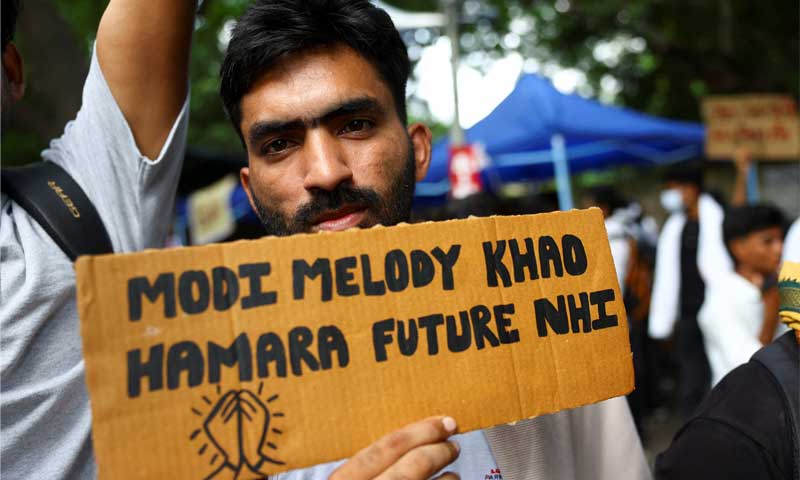
NEW DELHI: Indian Prime Minister Narendra Modi on Thursday announced that the government would establish fast-track courts to prosecute those responsible for examination paper leaks, marking his first public response after days of student-led protests demanding the resignation of Education Minister Dharmendra Pradhan.
The announcement, however, failed to satisfy protesters and opposition parties, who reiterated their demand for Pradhan’s resignation. Opposition lawmakers also continued to disrupt parliamentary proceedings for the fourth consecutive day.
Late on Wednesday, demonstrators briefly clashed with police in New Delhi, where officers used tear gas and batons to disperse the crowds.
The protests have grown into the largest youth-led challenge to Modi’s government since he took office in 2014, with opposition parties backing the demonstrators’ demands. The unrest has emerged as the most significant political crisis of Modi’s third term, which began in 2024.
“Nothing is more important than the welfare and future of our youth!” Modi posted on X.
“We have decided to set up fast-track courts to ensure swift and stringent punishment for those involved in paper leaks,” he said, adding that those who try to harm the future of young people will not be spared.
Fast-track courts are designed to quickly process cases, circumventing India’s notoriously overburdened and slow justice system that can take years to conclude cases.
Such special courts have been set up to handle sex crimes against women and children, terrorism, money laundering, and crimes by lawmakers.
CJP, Gandhi not impressed by announcement
The self-named Cockroach Janta Party (CJP) launched protests last month against the exam paper leaks that affected some 2 million students and have been linked to several suicides.
CJP spokesperson Ashutosh Ranka said what courts do after paper leaks is just one aspect.
“But Modi-ji, tell us why are paper leaks happening in this country in the first place?” he said, using the Hindi honorific.
“Fast-track courts are set up in this country for every other issue, but whether those fast-track courts have actually solved those issues, you know the answer to that question, and so do we.”
CJP founder Abhijeet Dipke said their protest would continue until Pradhan resigned.
The leader of India’s main opposition Congress party, Rahul Gandhi, said it was Modi who had most harmed the future of young people.
Opposition lawmakers held placards and shouted slogans seeking Pradhan’s resignation outside the parliament building and then disrupted proceedings inside, forcing the chambers to be repeatedly suspended.
Lawmakers from Modi’s Bharatiya Janata Party (BJP) and its allies staged a counter-protest, calling for a discussion on examination paper leaks.
Modi’s ministers said the opposition was not being sincere as it was not agreeing to a parliamentary debate on the subject.
Late on Wednesday, more than 10,000 people gathered at the Jantar Mantar protest site in central New Delhi, local media said. Some protesters attacked police with stones and plastic bottles, injuring a few officers who were taken to hospital, news agency ANI quoted Delhi Police as saying.
Delhi Metro shuts stations
Thousands of protesters had returned to the site by Thursday afternoon, carrying anti-government posters and chanting slogans amid heavy security deployment.
Delhi Metro Rail Corp. said it was shutting 16 stations in and around central New Delhi on Thursday until further notice, the second such large-scale closure this week due to security concerns, inconveniencing thousands of commuters.
Responding to the sustained pressure from protesters, Modi’s government has held one round of talks with CJP leaders and assured them that their demands will be considered and exam system reforms launched.
The CJP protests began as an online satire and involved only a few hundred young people when they were first launched. The movement’s surge in popularity reflects frustrations among young Indians over issues such as job shortages, as well as frequent exam leaks.
It has also given opposition parties a rare opening to pressure Modi and his BJP, which counts young voters as a core base and has won a series of state elections since a shock result in the 2024 election, when Modi did not win an outright parliamentary majority.