
- Aasiya Niaz
- 1 Hour ago
Munich security conference: Allies urged to ‘step up’ amid global strains
-

- Web Desk
- Feb 16, 2026
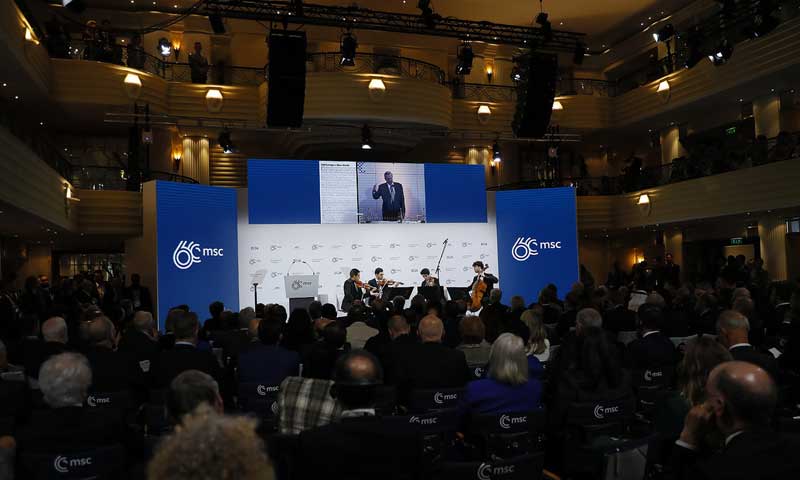
WEB DESK: At the 62nd Munich Security Conference, leaders balanced cautious optimism with stark warnings as Europe was pressed to assume greater responsibility for its own defence.
According to Al Jazeera, the second day of the 62nd Munich Security Conference unfolded on 14 February 2026 at Munich’s Hotel Bayerischer Hof, drawing senior global figures against a backdrop of mounting geopolitical tension. Held under the sombre theme “Under Destruction”, deliberations ranged from transatlantic cohesion and European strategic autonomy to the war in Ukraine, Middle Eastern instability, Sino-American rivalry and the evolving architecture of global security.
Rubio signals recalibration in transatlantic ties
US Secretary of State Marco Rubio delivered one of the day’s most closely watched addresses. Striking a notably conciliatory tone towards Europe, Rubio insisted that the United States and Europe “belong together”, even as he signalled a recalibration under President Trump. He urged European allies to align with Washington’s shifting outlook on international security, including a reappraisal of NATO with enhanced European contributions, as well as renewed thinking on Ukraine, tariffs, defence trade, climate policy and migration.
European leaders responded with measured optimism. Ursula von der Leyen, President of the European Commission, described Rubio’s remarks as a constructive overture, yet echoed calls for Europe to shoulder greater responsibility. She urged member states to strengthen defence capabilities and operationalise the European Union’s mutual defence clause, reinforcing arguments for greater strategic autonomy amid uncertain American signals.
Ukraine war and Russia tensions dominate
Ukrainian President Volodymyr Zelenskyy was among the conference’s most prominent voices. Accepting the Ewald von Kleist Award on behalf of the Ukrainian people, he paid tribute to their resilience and warned that Russian aggression would persist without robust European security guarantees. Describing Russian President Vladimir Putin as a “slave to war”, Zelenskyy pressed for clarity on Ukraine’s accession to the European Union, stating that Kyiv aims to be technically prepared by 2027 and now “needs a date” for membership.
Five European nations also levelled fresh accusations against Moscow, alleging that Russian authorities poisoned opposition leader Alexey Navalny with a rare toxin, further straining already fragile relations.
Indo-Pacific and Middle East concerns raised
From Beijing, Wang Yi issued stark caution over Taiwan, asserting that attempts to separate the island from China risk propelling Beijing and Washington towards direct confrontation, a reminder of intensifying Indo-Pacific tensions.
Elsewhere, Sigrid Kaag called for immediate progress on the second phase of the Gaza ceasefire, criticising what she described as a failure by the international community to uphold international law. Syria’s Foreign Minister, Asaad Hassan al-Shaibani, confirmed ongoing discussions with Israel concerning security arrangements and withdrawals from territories occupied since 2024.
Beyond the formal sessions, Munich saw demonstrations highlighting Iran’s human rights situation, with exiled opposition figure Reza Pahlavi advocating a secular democratic transition and appealing for support from Washington.
Diplomacy and demonstrations on the sidelines
Bilateral diplomacy featured prominently. Zelenskyy and Rubio exchanged a symbolic handshake, while German Chancellor Friedrich Merz met Baltic counterparts. Panels addressed issues ranging from girls’ rights to the future of European security architecture.
As proceedings moved towards their final day, the prevailing mood combined guarded optimism, particularly following Rubio’s outreach, with a palpable sense of urgency. With alliances under strain and conflicts unresolved, the conference underscored a central question: whether Europe is prepared to match its rhetoric with the resolve and resources required to defend its core values in an increasingly fractured world.
You May Also Like