- Web Desk
- 55 Minutes ago
Murad Ali Shah defends Sindh budget, claims wheat self-sufficiency
-

- Web Desk
- Now
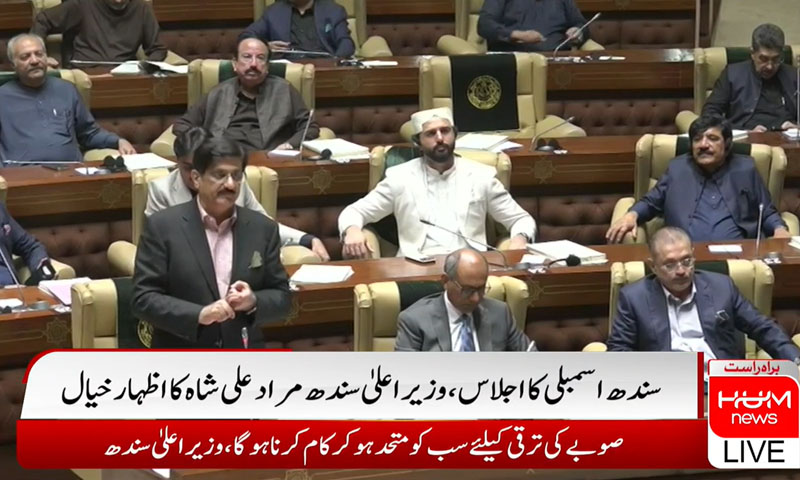
KARACHI: Sindh Chief Minister Murad Ali Shah on Sunday defended his government’s fiscal management, saying that the province has achieved self-sufficiency in wheat production for the first time despite facing a Rs344 billion budget deficit and a massive revenue shortfall from the federal government.
Delivering a comprehensive address to the provincial assembly on his 13th consecutive budget, Shah presented a detailed overview of the province’s financial health, structural reforms, and strategic expenditures ahead of the June 30 fiscal year-end closing.
Shah said that the Sindh government had experienced a severe reduction in projected transfers from the federal capital.
A year ago, he said, Islamabad had promised a National Finance Commission (NFC) share of Rs2,095 billion, however, the Federal Board of Revenue (FBR) later revised this down to Rs1,926 billion, resulting in a baseline shortfall of Rs150 billion.
“To date, we have received only Rs1,750 billion, with Rs176 billion still expected to arrive,” Shah said, noting that the final accounting would clear up on June 30.
“Despite these constraints and under strict International Monetary Fund (IMF) conditionalities, the provincial government has retained Rs370 billion in its accounts,” he claimed.
The chief minister said that Sindh had utilised a never-before-used constitutional provision to assist the cash-strapped federal government in national defence funding.
Under Article 164 of the Constitution of Pakistan, the province transferred Rs260 billion out of its saved reserves to the federation for defence spending, he said.
“Look at the vision of martyr Zulfikar Ali Bhutto, who recognised 54 years ago that the federation might require economic support from the provinces,” Shah told lawmakers, adding that while other provinces were open to cutting the overall NFC formula, Pakistan People’s Party (PPP) Chairman Bilawal Bhutto Zardari had firmly rejected any structural rollbacks.
Clarifying his party’s political stance, Shah noted that the PPP is not part of the federal government, defining the government strictly as the prime minister and his cabinet ministers, rather than constitutional positions like the president or the Senate chairman.
Sectoral Subsidies and Infrastructure Models
Addressing critics of his government’s developmental spending, Shah stated that despite the Rs344 billion deficit, the government has completed more than 1,000 localised schemes alongside roughly 100 major development projects.
He said that previously, over Rs43 billion were allocated in targeted subsidies for wheat cultivation, successfully rendering the province self-sufficient in the staple crop.
He said that an additional Rs6 billion were diverted to the police force, Rs5.51 billion for Expanded Programme on Immunisation (EPI) vaccine procurement, and over Rs1 billion for supplementary flood relief.
He said that Rs4.48 billion were provided to victims of the Gul Plaza tragedy, with an aggregate subsidy of Rs8 billion linked to the incident, the inquiry report of which will soon be made public.
Shah strongly rejected opposition criticism labeling fuel subsidies given to motorcyclists as a mere political gimmick. “I challenge anyone to prove if a single rupee of this subsidy went to an undeserving individual,” he said.
The chief minister highlighted the province’s public-private partnership (PPP) framework — under which the Shahrah-e-Bhutto highway was built and bridge financing was provided for the Hyderabad-Sukkur Motorway.
He said that Prime Minister Shehbaz Sharif had asked the Sindh PPP chapter to brief federal authorities to replicate the model nationally.
Shah paid tribute to deceased assembly colleagues, including former speaker Agha Siraj Durrani, Naeem Ahmed Kharal, Nawab Yousuf Talpur and Aftab Shaban Mirani, praising their lifelong contributions to the development of the province.
Defending the legislative environment against bitter criticisms leveled by opposition benches the previous day, Shah argued that the Sindh Assembly maintains the highest standards of democratic freedom in the country.
He noted that due to severe fiscal limitations, the government omitted the traditional pre-budget session this year, but maintained its practice of consulting opposition members.
Shah said the provincial assembly witnessed record participation in this year’s budget debate, with 143 lawmakers, or 88 per cent of the house, taking part.
He said that the participation rate was higher than in other legislatures across the country, noting that fewer than 65 per cent of National Assembly members participated in the federal budget debate, compared with 56 per cent in the Punjab Assembly, 44 per cent in the Khyber Pakhtunkhwa Assembly and 39 per cent in the Balochistan Assembly.
Shah said the figures reflected the Sindh Assembly’s commitment to providing lawmakers with an open forum to debate the budget.
“Every member speaking any language has total freedom here,” Shah said.
“In Sindh, the opposition is not just given equal opportunities, but better opportunities to express themselves than the treasury benches.”
You May Also Like