
- Reuters
- August 20, 2026
NA passes Defence Forces, National Command Authority amendment bills
-

- WEB DESK
- August 20, 2026
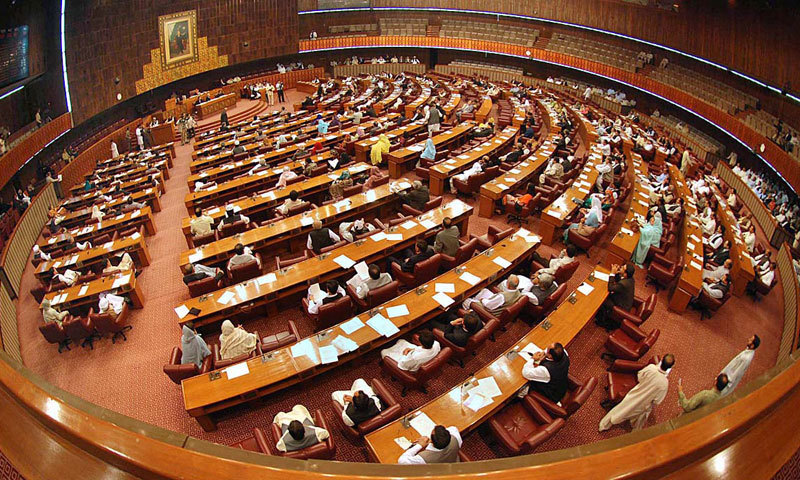
ISLAMABAD: The National Assembly on Thursday passed the Defence Forces Act 2026 and the National Command Authority Act 2010 amendment bills by a majority vote.
Both pieces of legislation aimed at aligning the existing legal framework with changes introduced through the 27th Constitutional Amendment.
Defence Minister Khawaja Asif moved both bills in the National Assembly, which approved them despite objections from opposition lawmakers that they had not been given sufficient time to examine the proposed legislation.
Earlier in the day, the federal cabinet, chaired by Prime Minister Shehbaz Sharif, had approved the draft Defence Forces Act 2026 and amendments to the National Command Authority Act 2010.
The bills were subsequently brought before the National Assembly during its ongoing session.
The Defence Forces Act seeks to provide a legal framework for administrative matters relating to the office of the Chief of Defence Forces (CDF) and the Chief of Defence Forces Headquarters.
The legislation follows changes made under the 27th Constitutional Amendment, which restructured the country’s higher defence command system.
The 27th Amendment abolished the office of the Chairman Joint Chiefs of Staff Committee and created the post of Chief of Defence Forces, a position held concurrently by the Chief of Army Staff. Field Marshal Asim Munir became the country’s first Chief of Defence Forces under the new arrangement.
The constitutional changes also created the position of Commander of the National Strategic Command, a four-star post responsible for the operational integration of Pakistan’s strategic forces.
Last month, Prime Minister Shehbaz Sharif promoted Lt Gen Syed Aamer Raza to four-star rank and appointed him as the country’s first Commander of the National Strategic Command.
The appointment necessitated changes to the National Command Authority Act, 2010, which continued to reflect the military command structure that existed before the 27th Amendment.
Law minister defends legislation
Speaking during the debate, Law Minister Azam Nazeer Tarar described the proposed legislation as technical in nature and said the government was carrying out the legislation after taking parliamentary leaders into confidence.
He said the office of the Chief of Defence Forces had already been created and the legislation was intended to clearly define its powers.
Tarar said the amendments would remove ambiguities regarding the appointments of the Chief of Defence Forces and the chiefs of the Pakistan Air Force and Pakistan Navy.
The law minister also referred to the controversy surrounding the possible transfer of PTI founder Imran Khan to a hospital, saying there was no ambiguity in the relevant legal provisions.
He questioned how Article 125 of the Constitution should be interpreted when a person in prison was required to be moved out of jail on medical grounds.
“Whenever someone has to be sent out of prison, a medical board will be constituted,” Tarar said, explaining that the law provided a mechanism for dealing with such cases.
He said the first option would be a government hospital and questioned whether the law should allow a prisoner to be shifted to another hospital or sent outside the government system.
“There is no ambiguity in this matter,” Tarar said, adding that there was nothing negative in the provision.
PPP Chairman Bilawal Bhutto Zardari said that the opposition had not been taken into confidence over the legislation.
However, he said he supported the legislation passed by the National Assembly.
Bilawal also criticised the government’s handling of Imran Khan’s possible transfer to a hospital, saying the government could have played a better role in the matter.
He said the government initially accepted the decision regarding the former prime minister’s medical treatment but later decided to challenge it in court.
Opposition Leader in the National Assembly Mahmood Khan Achakzai also objected to the manner in which the bills were brought before the House.
“We are members of this Parliament,” Achakzai said, adding that the opposition wanted legislation to be carried out but needed sufficient time to examine the bills.
He asked the government to provide copies of the proposed legislation so that lawmakers could read them and give their opinion.
“Keep them for at least two or three days so that they can be debated,” he said.
Achakzai also called for a briefing on Pakistan’s regional and foreign policy situation, particularly developments involving Iran, the United States and Afghanistan.
Referring to US President Donald Trump’s reported warning against countries conducting economic dealings with Iran, he said Pakistan should be briefed on what was happening in the region.
Achakzai also criticised the government’s handling of Pakistan’s diplomatic engagement with Afghanistan.
He said that opposition lawmakers had recently visited the Afghan embassy, where ambassadors from several countries were present.
“We went to the Afghan embassy the other day. Ambassadors of all countries were sitting there,” he said.
He claimed that while other countries were represented by senior diplomatic officials, Pakistan had sent a desk officer to the Afghan embassy.
“This was embarrassing for us,” Achakzai said, calling for greater seriousness in Pakistan’s engagement with Afghanistan.
He also criticised what he described as excessive focus on Imran Khan, saying the former prime minister had been turned into an unnecessarily major issue.
“Even the worst criminal has the right to have his health taken care of,” he said, arguing that the government should focus on broader national interests.
Achakzai urged the government and opposition to sit together and find solutions to the country’s problems.
“Whatever legislation you want to bring, bring it, but at least take us into confidence,” he said.
“Let us sit together so that we can put the country right.”
The legislation comes as the government moves to bring existing laws into conformity with the new constitutional structure following the sweeping changes made through the 27th Amendment.
You May Also Like


- WEB DESK
- August 20, 2026
Gold price surges, PSX sheds 254 points

- WEB DESK
- August 20, 2026
Misbah Arshad crowned Miss Universe Pakistan
- WEB DESK
- August 20, 2026
