
- AFP
- October 15, 2026
Naqvi renews dialogue offer, asks PTI to make decisions at the table
-

- WEB DESK
- October 15, 2026
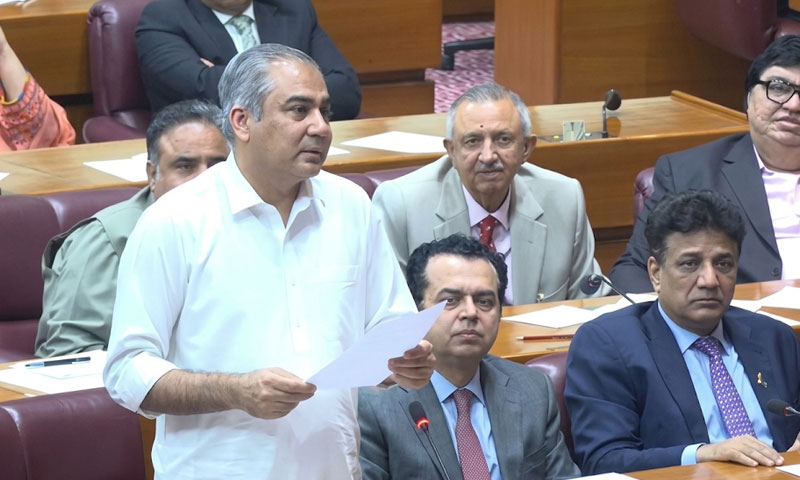
ISLAMABAD: Interior Minister Mohsin Naqvi on Thursday renewed the government’s offer of dialogue to Pakistan Tehreek-e-Insaf (PTI), urging its delegation to make decisions during negotiations rather than return to jail to seek approval from party founder and former prime minister Imran Khan.
Speaking at the joint sitting of the Parliament, Naqvi said the government had made repeated efforts to secure PTI’s cooperation on counterterrorism but faced differences with the party and the Khyber Pakhtunkhwa government over a coordinated response to the security situation.
Defending the federal government’s decision to impose governor’s rule in the province, he said it had been reluctant to take the step but had been left with no alternative after months of disagreements and unsuccessful efforts to reach an understanding with the PTI and the KP government.
Naqvi said the federal government could not pursue one policy against terrorism at the national level while the provincial government adopted a different approach.
“If we think that we cannot stand with a soldier because we cannot politically afford it, how are we supposed to lead an operation?” he asked, urging lawmakers to separate political differences from security concerns.
He said the government had not accused the PTI as a party of carrying out terrorist activities, but had raised concerns about alleged coordination between some individuals at the local level and militants.
“No political party should be accused of terrorism,” he said, adding that any wrongdoing, if established, should be addressed.
The minister urged PTI lawmakers to engage with their provincial leadership to identify and resolve the differences that had undermined cooperation on counterterrorism.
Naqvi says govt did not walk out of talks
Rejecting the opposition’s claim that the government had walked away from negotiations, Naqvi said its representatives had remained available while the PTI-led opposition delegation consulted among its members.
“We did not walk away from the negotiations,” he said, asking lawmakers who had participated in the discussions, including National Assembly Speaker Sardar Ayaz Sadiq, to verify his account.
Naqvi said the government had continued trying to reach an understanding until the final hours, even when the prospects of success appeared limited. He maintained that the talks had not been treated as a matter of political prestige and that the government had attempted to accommodate the opposition’s demands.
He said the document outlining the points discussed during the negotiations placed the start of political dialogue at the top of the agenda. It envisaged a meeting between Prime Minister Shehbaz Sharif and opposition leaders, followed by the formation of a political committee to discuss outstanding issues.
The document also addressed prisoners’ legal rights, including medical treatment and meetings with family members, as well as applications concerning the sentences of elderly and sick prisoners, Naqvi said.
He added that the final point concerning the end of a long march had been included at the suggestion of Pakistan People’s Party (PPP) Senator Sherry Rehman.
PTI urged to decide without Imran’s approval
Renewing the offer of dialogue, Naqvi said the government remained ready to negotiate but expected PTI representatives to have the authority to make decisions at the negotiating table.
He questioned why the party’s senior leadership appeared reluctant to allow its representatives to negotiate independently, saying the delegation should arrive with a clear mandate and take decisions during the talks instead of returning to jail to consult Imran.
“We are ready. We were ready before, and we are ready now,” he said, adding that the prime minister had repeatedly expressed support for political dialogue.
Naqvi said meetings between the two sides had continued in recent weeks and that the government had no objection to further engagement. The central issue, he argued, was whether PTI’s representatives had sufficient authority to reach an agreement.
Says it accommodated demands over Imran’s health
The interior minister also defended the government’s handling of requests concerning Imran’s health, saying officials had repeatedly tried to address the concerns raised by the opposition.
He said doctors had provided detailed briefings to opposition representatives and that arrangements had been made for Imran to undergo hospital check-ups on the same night whenever concerns arose about changes in his health.
Referring to the former prime minister’s eye condition, Naqvi said the government had agreed to requests made by his family and accepted the names proposed by the opposition for involvement in the hospital arrangements. However, he claimed that after the matter appeared to have been settled, further conditions were raised and the opposition subsequently said it would visit the hospital itself.
Naqvi said the government had made concessions on these matters as part of its broader effort to keep negotiations on track.
Naqvi cites differences over counterterrorism
Recalling an Apex Committee meeting held in Peshawar in February, attended by him, the corps commander and the Khyber Pakhtunkhwa chief minister, Naqvi said the meeting had been intended to establish a common position on counterterrorism.
He said the government had faced difficulties in convening the meeting and had wanted a joint statement conveying that all sides would work together against terrorism. However, he argued, the process had failed to produce the public commitment the government had sought.
Naqvi also referred to the killing of security personnel on the day of the meeting, saying participants had learnt of the deaths during the proceedings. He said the chief minister had subsequently been persuaded to attend the funeral prayers of the slain personnel.
The minister said there was a difference between positions expressed by some PTI representatives during political discussions and the approach adopted by the provincial government.
He singled out PTI leader Asad Qaiser, saying Qaiser had expressed willingness to sign an agreement and support counterterrorism measures. Naqvi said he had urged Qaiser to convey that position to the provincial leadership because, in his assessment, the two positions were not aligned.
He also alleged that PTI representatives had been reluctant to publicly condemn the banned Tehreek-e-Taliban Pakistan (TTP), despite requests during discussions.
Naqvi said counterterrorism had been among the first subjects taken up in negotiations and rejected suggestions that the government had raised the issue for political purposes.
National Action Plan was agreed under PTI govt, Naqvi says
Naqvi argued that the National Action Plan was not a new demand being imposed by the present government, saying the framework had been approved with the participation of political parties, including during PTI’s tenure in power.
He said the plan had been endorsed by political stakeholders and should not be abandoned simply because a party was no longer in government.
The minister said the provincial government should take the lead in counterterrorism, with the army, Frontier Corps and other security institutions providing support.
He referred to a proposal developed with the provincial government to strengthen police in five districts and gradually withdraw civilian armed forces over six months, allowing the police to assume greater responsibility. However, he questioned whether the plan had been implemented effectively, saying political disagreements had complicated efforts to establish a coordinated security strategy.
Says govt explored alternatives to governor’s rule
Naqvi said the federal government had continued exploring alternatives to the breakdown in negotiations until the final 24 hours and had not wanted the process to fail.
One proposal, he said, was for the provincial government to introduce emergency measures itself in 12 districts, an option he claimed had been discussed and agreed upon during the negotiations.
He also rejected allegations that the federal government had used Khyber Pakhtunkhwa’s financial difficulties for political purposes. Naqvi said he had held several meetings with the chief minister and federal finance minister to address the province’s concerns, and had facilitated discussions with the prime minister and Planning Minister Ahsan Iqbal.
He maintained that the government’s efforts had been aimed at reaching an understanding on security and governance, rather than gaining a political advantage.
Naqvi said the federal government had a responsibility to prevent terrorism and would fulfil it, urging PTI lawmakers to work with their provincial leadership to resolve the differences.
At the end of his address, he responded to opposition leader Mahmood Khan Achakzai’s remarks concerning Form 47, which has featured in allegations of electoral manipulation. Naqvi said he could not speak on behalf of the opposition benches but challenged lawmakers to swear to the legitimacy of their own electoral victories.
Dar blames PTI for engaging TTP, defends KP governor’s rule
Deputy Prime Minister and Foreign Minister Ishaq Dar on Thursday blamed decisions taken during the Pakistan Tehreek-e-Insaf (PTI) government under former prime minister Imran Khan for the resurgence of terrorism, questioning who had allowed thousands of Tehreek-e-Taliban Pakistan (TTP) militants to return to Pakistan from Afghanistan.
Addressing a joint sitting of Parliament, Dar claimed that 35,000 to 40,000 militants who had fled across the border were brought back during the PTI government, while more than 100 “hardened criminals” were released from prisons.
“Who opened the borders and allowed these TTP men who had fled to return to Pakistan?” he asked, questioning who had authorised the release of imprisoned militants and why such decisions had been taken.
Dar said Pakistan had paid a heavy price to suppress militancy through military operations and a nationwide counterterrorism campaign, only to see violence return following what he described as wrong decisions by a few individuals during a change of government.
His remarks came as the federal government defended the imposition of emergency and governor’s rule in Khyber Pakhtunkhwa, where the PTI-led provincial government was suspended on October 11. The government has cited the province’s deteriorating security situation and alleged lack of cooperation from its leadership in counterterrorism efforts as reasons for the move.
Dar maintained that the decision was taken after extensive deliberations by the federal cabinet and was not an arbitrary move by the president or the prime minister.
PTI has rejected the federal government’s allegations and described the suspension of its provincial government as politically motivated.
Dar recalls military operations against militancy
Recounting the history of Pakistan’s counterterrorism campaign, Dar said the fight against militancy intensified after the December 2014 attack on the Army Public School in Peshawar, which prompted political parties to unite behind a national strategy.
He said an all-parties conference and subsequent consultations led to the formulation of the National Action Plan, with PTI also participating in the process.
Dar recalled the military operation Zarb-e-Azb, followed by the nationwide Operation Radd-ul-Fasaad, saying the country had spent hundreds of billions of rupees and made enormous sacrifices to dismantle militant networks.
He said militants who escaped military operations either crossed into Afghanistan or dispersed within Pakistan, prompting further efforts to locate and arrest them.
The deputy prime minister argued that these operations had brought terrorist violence to very low levels, but questioned why the country had subsequently allowed militants to return.
“How many times will we repeat these mistakes?” he asked, referring to the deaths of security personnel, civilians and children in subsequent attacks.
Dar said the decisions of a few individuals should not be allowed to undermine the sacrifices made by the armed forces and the public. He also urged political leaders to demonstrate their commitment to fighting terrorism through practical cooperation rather than statements alone.
PTI-era talks with TTP under scrutiny
Dar’s criticism referred to the negotiations with the TTP pursued during Imran Khan’s tenure, particularly in 2021 and 2022, when the Afghan Taliban facilitated contacts between the Pakistani government and the outlawed group.
The process included ceasefire arrangements and discussions about the return of militants from Afghanistan. In June 2022, the federal government said any final agreement with the TTP would be subject to parliamentary approval.
Dar argued that the return of militants and the release of prisoners had undermined the gains made through years of military operations.
He said the country could not continue paying the price for decisions taken for political reasons, adding that the security situation required political parties to set aside their differences and agree on a common course of action.
The TTP has carried out attacks against Pakistani security personnel and civilians. Pakistan has repeatedly called on Afghanistan’s Taliban authorities to prevent militants from using Afghan territory to launch attacks inside Pakistan. Kabul has rejected accusations that it allows its territory to be used against Pakistan.
Dar says PTI refused to condemn TTP during talks
The deputy prime minister also criticised PTI’s position during recent negotiations with the federal government, saying the party had refused to include explicit language condemning terrorism and the TTP in the proposed text.
Dar said the federal government had sought a public condemnation of terrorism and a commitment from the PTI-led provincial government to work jointly with Islamabad against militant groups.
He described the condemnation of terrorism as one of the conditions discussed by the federal cabinet before the decision on governor’s rule.
According to Dar, the government also wanted the provincial leadership to announce that it would work with the federal government to combat militancy and that emergency measures would be introduced in districts where the situation had become unmanageable.
He said the federal government had been willing to pursue political reconciliation but believed that the security situation had reached a point where action could no longer be delayed.
Dar rejected the argument that the government should prioritise political reconciliation over counterterrorism, saying the security issue had to be addressed first.
“Political reconciliation can follow, but this menace has to be dealt with first,” he said in substance.
Dar details talks involving Fazlur Rehman
Dar also recounted efforts by Jamiat Ulema-e-Islam-Fazl (JUI-F) chief Maulana Fazlur Rehman to revive negotiations between the government and PTI.
He said Fazlur Rehman approached Prime Minister Shehbaz Sharif after returning from Umrah and offered to make another attempt to bridge the differences between the two sides.
According to Dar, the prime minister told the JUI-F chief that the matter had gone too far and that the federal cabinet would first consider the situation.
Dar said Fazlur Rehman contacted the prime minister again early the following morning and sought another meeting with government representatives. Dar said he and Interior Minister Mohsin Naqvi were subsequently tasked with communicating the cabinet’s decision to the JUI-F chief.
He said the cabinet had deliberated for approximately two and a half hours and identified four conditions it considered necessary to address the situation in Khyber Pakhtunkhwa.
The first, Dar said, concerned a change in the provincial leadership. The second was a public condemnation of terrorism and the TTP. The third was a commitment by the provincial government to work jointly with the federal government against militancy. The fourth concerned emergency measures in districts where the security situation had become unmanageable.
Dar said he and Naqvi conveyed the cabinet’s position to Fazlur Rehman, who, according to the deputy prime minister, indicated that he could not deliver the requested commitments.
He argued that the federal government had exhausted its options after repeated attempts to reach an understanding and had ultimately concluded that further delay was not possible.
Dar said Prime Minister Shehbaz Sharif had described the decision as a “now or never” moment during the cabinet meeting, reflecting the government’s assessment that the security situation demanded immediate action.
Dar cites Rs800bn allocated to KP for war on terror
The deputy prime minister also challenged the provincial government’s handling of resources allocated for counterterrorism, pointing to Khyber Pakhtunkhwa’s additional share under the National Finance Commission (NFC) Award.
He recalled that the seventh NFC Award, agreed in December 2009, provided the province with an additional one per cent share of the federal divisible tax pool to help it meet the costs associated with terrorism.
Dar said the arrangement had been designed to give the province the resources needed to fight militancy and rebuild its security capacity.
According to official figures reported earlier this month, KP received approximately Rs799.36 billion under the additional one per cent allocation from 2010-11 to September 2026.
Dar questioned whether the provincial government had used the available resources to build the necessary counterterrorism capacity, including an effective Counter-Terrorism Department (CTD), forensic laboratories and other investigative facilities.
He argued that the continuing reliance on the armed forces to lead security operations raised questions about the capacity of civilian law-enforcement institutions in the province.
The provincial government has previously disputed the federal government’s criticism of its handling of security and finances, while the allocation under the NFC Award is transferred as part of the province’s broader financial resources.
Dar said the federal government had a responsibility to ensure that provincial authorities fulfilled their obligations and that resources intended to address terrorism were used effectively.
Dar invokes constitutional provisions
Defending the imposition of governor’s rule, Dar referred to Article 234 of the Constitution, which governs the president’s response when a provincial government cannot be carried on in accordance with the Constitution.
He read out Article 234(3), which requires a proclamation issued under the article to be placed before a joint sitting of Parliament. The provision states that the proclamation ceases to remain in force after two months unless approved by a resolution of the joint sitting. It also provides for extensions of up to two months at a time, subject to a maximum period of six months.
Dar said the government had followed the constitutional process by placing the proclamation before Parliament for consideration.
He argued that the president had not acted unilaterally and that the decision followed deliberations by the federal cabinet.
The emergency proclamation and governor’s rule were presented as separate constitutional measures, with the government maintaining that both were necessary in response to the situation in the province.
PTI has challenged the measures, arguing that the suspension of its elected provincial government is politically motivated and undermines its democratic mandate.
Dar urges political parties to unite against terrorism
Dar concluded by urging political leaders to put aside their differences and work together to address the security crisis in Khyber Pakhtunkhwa.
He recalled earlier periods of political confrontation in Parliament, saying parties had eventually reached consensus on major national issues when they recognised the need for collective action.
He said the current situation required a similar approach, but maintained that counterterrorism measures could not be postponed indefinitely in the name of political reconciliation.
Dar urged PTI leaders to demonstrate their opposition to militancy through explicit condemnation and practical cooperation with the federal government.
He said the people of Khyber Pakhtunkhwa had endured years of violence and deserved a provincial administration capable of protecting them and using public resources to strengthen law enforcement.
The deputy prime minister maintained that the decision on governor’s rule had been taken after repeated efforts to resolve the dispute politically and that the federal government would continue to pursue measures aimed at restoring security in the province.
Dar claimed that former first lady Bushra Bibi was regularly meeting her husband and former prime minister Imran Khan. He said he had received confirmation of the meetings in writing.
You May Also Like
- WEB DESK
- October 15, 2026
The economic cost of Pakistan-Afghanistan border closure

- WEB DESK
- October 15, 2026