- WEB DESK
- October 7, 2026
Oil rises over 3% as Middle East tensions fuel supply concerns
-

- Reuters
- July 8, 2026
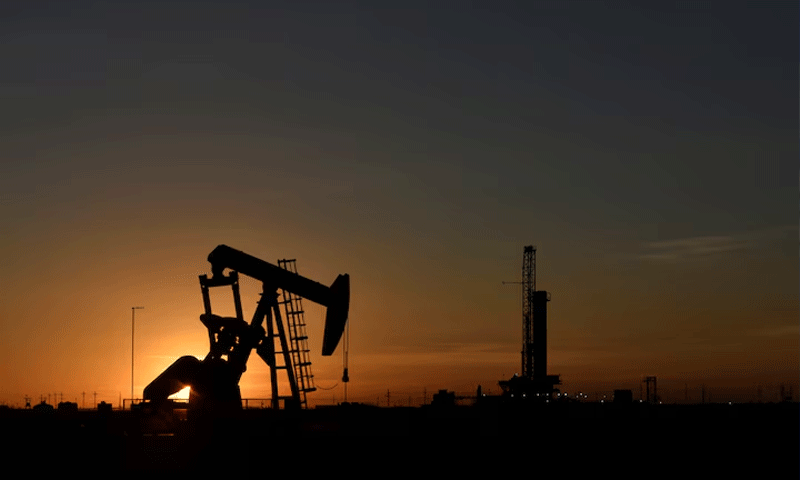
SINGAPORE: Global oil prices surged by more than three per cent on Wednesday after a dramatic escalation in military tensions between the United States and Iran, coupled with the reimposition of US sanctions on Iranian crude, sparking widespread fears that a fragile truce between the two nations is rapidly unravelling.
Brent crude futures jumped by $2.40, or 3.2pc, to reach $76.56 a barrel by 0645 GMT. Concurrently, US West Texas Intermediate (WTI) crude climbed $2.26, also a 3.2pc gain, to trade at $72.70 a barrel.
The sharp uptick builds on momentum from Tuesday, when both benchmarks rose roughly three per cent following Washington’s decision to revoke the general licence that had previously authorised the sale of Iranian crude.
Commodity strategists at ING noted that while the revocation may not immediately shift fundamental market dynamics, it heavily impacts market sentiment.
The decision significantly heightens the risk of a total breakdown in the temporary deal struck between the US and Iran just last month.
Escalating military strikes
The latest price rally follows a direct exchange of firepower. According to US Central Command, the US military launched airstrikes in response to Iranian attacks on three commercial vessels transiting the vital Strait of Hormuz on Tuesday.
In a swift retaliation early on Wednesday, Iran’s Revolutionary Guards announced they had targeted US military installations in Bahrain and Kuwait.
While Tehran has not officially claimed responsibility for the initial ship assaults, regional dynamics have strained further, with Qatar blaming Iran for a drone attack on a Qatari liquefied natural gas (LNG) tanker that caused a fire in its engine room.
Separately, maritime security sources reported damage to a Saudi-flagged supertanker, the Wedyan, off the coast of Oman under circumstances that remain unclear.
The hostilities have renewed intense focus on the Strait of Hormuz, a critical maritime chokepoint that accounted for nearly one-fifth of the global energy supply before wider regional conflict erupted in February.
Iran is currently asserting stricter control over the passage, ordering commercial ships to navigate closer to its coastline rather than the traditional routes near Oman. Conversely, the US maintains that the waterway must remain an open, free international passage.
Market positioning and supply pressures
The sudden friction has caught energy traders off guard. Following the signing of the US-Iran truce last month, oil prices had plummeted back to pre-war levels. Anticipating a massive wave of pent-up Middle Eastern supply hitting the global market, traders had amassed record “short” positions—financial bets that oil prices would continue to fall.
Analysts suggest the current conflagration serves as a stark reminder of how vulnerable the waterway remains. Experts warn that if traffic through the Strait stays below 50pc of pre-war levels, prolonged supply constraints will inevitably provide sustained upward pressure on prices, forcing short-sellers to hurriedly cover their positions.
Compounding the geopolitical anxiety are shrinking global buffers. Since the onset of the conflict, nations have steadily drawn down their emergency oil inventories to compensate for ongoing supply shortfalls.
Fresh data from the American Petroleum Institute indicated that US crude inventories fell yet again last week, ahead of official analysts’ forecasts which had predicted a decline of 2.4m barrels for the week ending July 3.
You May Also Like