
- Reuters
- November 4, 2026
One Constitution Avenue to become five-star hotel as govt takes possession
-

- WEB DESK
- November 4, 2026
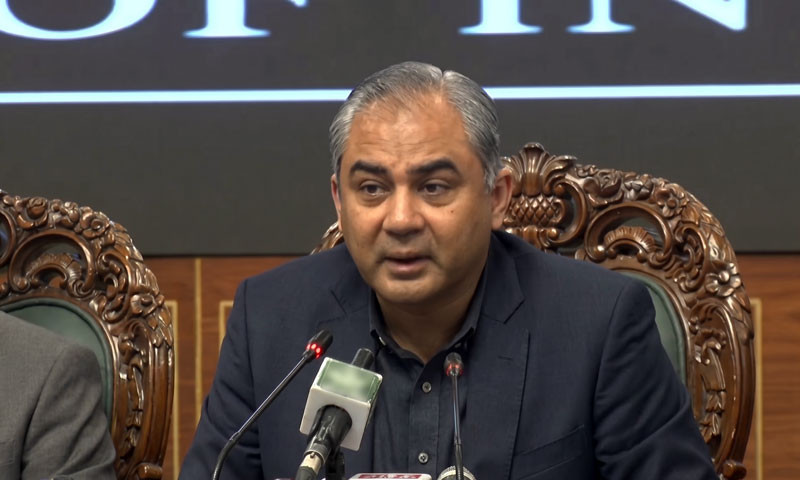
ISLAMABAD: Interior Minister Mohsin Naqvi said on Wednesday that the government had legally taken possession of the disputed One Constitution Avenue project in Islamabad and planned to convert the building into a five-star hotel within the next few months.
Speaking at a press conference in Islamabad following the federal cabinet meeting, Naqvi said the government would approach a major hotel chain to reach an agreement for converting the high-rise into a hotel, citing a shortage of hotels in the capital.
“Possession of One Constitution Avenue has legally come into our hands following today’s cabinet meeting,” he said.
Naqvi said the government would not allow encroachments on public land in Islamabad, whether involving government buildings, police stations on green belts or other forms of illegal occupation.
Describing the scale of encroachment in the capital as extensive, he urged residents who had extended their lawns beyond their property boundaries in sectors including F-6, F-7, F-8 and F-10 to return to their designated limits.
He said the government wanted to ensure equal application of the law, regardless of whether those involved were wealthy or poor.
Naqvi said the government would make every effort to convert the building into a five-star hotel within months, adding that this was its original intended purpose.
He also credited the CDA team involved in pursuing the case while acknowledging that mistakes by authority officials had contributed to the controversy.
Naqvi also said the government would compensate affected investors according to the amounts determined in the Joint Investigation Team (JIT) report, describing its recommendations as binding on the government.
He thanked Prime Minister Shehbaz Sharif for supporting the process, saying the premier had backed a decision based on merit despite the controversy surrounding the government’s earlier attempts to take possession of the building.
Naqvi said the committee previously overseeing the building’s affairs had been dissolved following the JIT report, and the CDA member for administration would take charge of its matters immediately.
Earlier, the federal minister announced plans to re-auction the One Constitution Avenue project and compensate affected investors with their principal investment and an additional amount calculated on the basis of the Karachi Interbank Offered Rate (KIBOR).
Information Minister Attaullah Tarar said the federal cabinet had approved an inquiry report recommending action against Capital Development Authority (CDA) officials and others who allegedly facilitated illegal construction at the Islamabad high-rise.
Addressing the press conference alongside Minister of State for Interior Talal Chaudhry and Planning Minister Ahsan Iqbal, Tarar said the Joint Investigation Team (JIT) had identified the alleged offences and those responsible.
He said the National Accountability Bureau (NAB) had been asked to fast-track its investigation and complete it within three months.
Tarar added that the cabinet had endorsed the report and appreciated the JIT’s work, stressing that no one would escape accountability irrespective of their position or influence.
Talal says project received facilitation over two decades
Talal Chaudhry said the project had remained under way for around 20 years, during which action had been taken on only two occasions, both under Pakistan Muslim League-Nawaz (PML-N) governments.
He said investigations by the Federal Investigation Agency (FIA), efforts to take control of the project and cancellation of its contract had taken place during PML-N tenures, while facilitation had continued during other governments.
Chaudhry alleged that people beyond the CDA, including politicians, media figures and judges, had also facilitated the project, contributing to the losses suffered by investors.
He said authorities had given apartment claimants opportunities to establish the legality of their ownership and transactions. Some people, he added, had acquired flats through transactions involving alleged facilitation.
Responding to a question about people who had not appeared before the authorities, Chaudhry said most had responded to repeated notices, but some had not. He named PTI founder and former prime minister Imran Khan among those who, according to him, had failed to appear.
Chaudhry said the detailed report would be uploaded to the government’s website and stressed that the law would be applied equally in Islamabad.
Investors to receive principal amount plus KIBOR-based compensation
Talal said the government did not want people who had fallen victim to the alleged fraud to suffer financial losses.
He said affected investors would receive their principal investment as well as compensation calculated on the basis of KIBOR. Some buyers had invested money brought from abroad and possessed legal documentation, while many had no fault in the matter, he added.
He said the JIT had recommended protecting such investors by returning their investment along with the additional amount calculated on the KIBOR basis.
The government also plans to put the project through a fresh, transparent bidding process as part of its proposed restructuring.
Asked why investors should be compensated despite repeated reports and court proceedings raising questions about the legality of the project, the minister said the government wanted to protect those who had been defrauded and would follow the JIT’s recommendations.
Main contractor, other accused already on ECL
The ministers said the main contractor, identified as Hafeez Sheikh, and other accused were already on the Exit Control List (ECL) and a blocklist.
They said NAB’s ongoing investigation would examine the role of all those allegedly involved, including individuals outside the CDA who may have provided protection or facilitated the illegal activity.
The bureau has been given three months to complete its investigation and file a reference against those found responsible.
Asked whether former chief justice of Pakistan Saqib Nisar would also be investigated over a court ruling concerning the project, the ministers said the investigation would examine the role of all those who had facilitated the scheme.
Ahsan Iqbal outlines inquiry findings
Ahsan Iqbal said Prime Minister Shehbaz Sharif had constituted a committee to investigate the One Constitution Avenue project, whose JIT report was presented to the federal cabinet and approved on Wednesday.
He said the inquiry found that rules and regulations had been relaxed to benefit the developer company, enabling construction in violation of prescribed requirements and causing losses to the national exchequer.
The report identified former CDA chairman Kamran Lashari and other officials in connection with the alleged irregularities and recommended action against those involved.
Iqbal said the inquiry had also found that the project’s name, One Constitution, had been obtained through forgery and recommended that it be changed.
The report recommended a transparent re-auction of the project, a comprehensive overhaul of the CDA and a policy requiring its officers to be rotated every two years to improve accountability and prevent the development of entrenched interests.
Iqbal said the government would ensure that people who had invested their life savings in the project received their money back. He did not provide a detailed timetable for the re-auction, compensation payments or the project’s future use.
One Constitution Avenue is a high-rise residential and commercial development near Islamabad’s Constitution Avenue that has remained embroiled in legal and regulatory disputes over alleged violations of building regulations and outstanding obligations.
How One Constitution Avenue project became a 20-year legal and financial dispute?
The controversy surrounding One Constitution Avenue dates back to the allocation of a prime 13.5-acre plot next to Islamabad’s Jinnah Convention Centre in 2005.
The land was originally offered for a five-star hotel and convention-centre development, but the developer, BNP (Pvt) Ltd, went on to construct a luxury residential and commercial complex and sell apartments. The project became the subject of allegations of unlawful changes to the original development terms, preferential treatment by CDA officials, substantial unpaid dues and the sale of apartments without the required legal approvals.
The dispute has since involved the CDA, the developer, successive governments, the FIA, NAB, the Islamabad High Court (IHC) and the Supreme Court. It has also left hundreds of apartment buyers, including prominent public figures and overseas Pakistanis, uncertain about their investments and ownership claims.
How the project began
The origins of the development go back to the 1990s, when the government considered building a hotel alongside the Convention Centre. In 2004, the CDA moved towards auctioning the land for a five-star hotel-cum-conference centre, partly to provide facilities for international events.
The authority advertised the 13.5-acre plot in 2004 and subsequently held the auction in 2005. A consortium comprising Bismillah Textile, Niagara Mills, Paragon City and Belhasa International emerged as the successful bidder. The bid, accepted in June 2005, was worth approximately Rs4.88 billion, with payment initially spread over 15 years. A lease deed was executed on July 28, 2005.
The IHC’s 2017 judgment recorded that the CDA handed over possession after receiving an initial payment of around Rs800 million. The court also noted that the original bidding conditions made clear that serviced apartments would be part of the hotel property, operated by the hotel management, but could not be sold separately. Shops were also not to be sold
The first major controversy: changes to the original terms
Questions over the project arose as the developer sought changes to the payment schedule and building plans.
In May 2006, BNP requested rescheduling of its instalments. In February 2007, the former CDA chairman sent a summary to the Economic Coordination Committee (ECC) concerning the request. The ECC said the CDA Board was competent to decide on the matter, but its response did not itself amount to approval of the rescheduling. The CDA Board subsequently approved revised payment arrangements in August 2007, and an amended lease deed was executed in October that year.
A further controversy concerned the nature of the apartments. In May 2007, the CDA informed the developer’s architects that luxury apartments were not permitted and that only serviced apartments were allowed under the approved parameters.
The building plans approved in March 2008 included hotel tower apartments and serviced apartments, with a total of 200 units. When BNP sought a no-objection certificate to assign or sub-lease parts of the project to banks and other third parties, the CDA declined, saying no portion could be sub-leased to third parties.
In August 2008, the company itself wrote to the authority denying that it was constructing or selling residential apartments and said it was building serviced apartments in accordance with the approved plans
The project also faced objections over its proposed height. The building plans initially allowed construction of up to 725 feet, but the Civil Aviation Authority, the Ministry of Defence and the Pakistan Air Force raised objections. The developer later agreed to reduce the height, and a further amended lease in January 2013 extended the payment period until 2026 and reduced the proposed building from 45 to 23 storeys.
The changes to the lease and payment terms attracted scrutiny from auditors and parliamentary oversight bodies. An audit objection in 2014 alleged that the CDA had unlawfully altered the original lease terms. The matter was taken up by the National Assembly’s Public Accounts Committee. NAB and the FIA initiated separate inquiries in 2015.
Kamran Lashari’s role and the allegations against CDA officials
Former CDA chairman Kamran Lashari became one of the central figures in the controversy because he headed the authority during the period when the original lease was executed and the first major changes to the payment arrangements were processed.
The IHC’s 2017 judgment records that the proposed lease deed was placed before the CDA chairman for consideration and approved on June 15, 2005. The lease was signed with BNP on July 28. The judgment also records that the CDA chairman forwarded a summary concerning the developer’s request to reschedule payments to the ECC in February 2007. The CDA Board approved the revised payment arrangement in August 2007.
Separately, The Express Tribune, reporting on the case in June 2017, said allegations had been raised that relaxed bylaws were approved during Lashari’s tenure, including changes to the development conditions.
It reported that the relaxed terms were approved by the CDA chairman on the recommendations of the authority’s planning and finance officials. These allegations formed part of the wider investigation into how the original hotel project was allowed to evolve into a high-rise residential development.
In May 2017, the FIA registered a formal case against Lashari, several former CDA board members and officials, as well as BNP chief executive Abdul Hafeez Sheikh. The FIR alleged that the developer had constructed luxury apartments instead of the hotel and sold them illegally, while CDA officials had facilitated the arrangement. Those named included former members responsible for planning, finance, administration and engineering, as well as officials from the authority’s legal, estate and project-management wings.
However, the investigation did not lead to a prosecution. In March 2018, the FIA had closed its inquiry after its investigation officer concluded that allegations including fraud, abuse of authority, forgery, criminal breach of trust and cheating could not be substantiated against Lashari and some other named individuals. NAB then formally opened a separate investigation into the alleged misuse of authority in the allotment of the plot and construction of the project.
CDA cancels the lease and IHC declares apartment construction illegal
The CDA cancelled BNP’s lease in July 2016, citing violations of the original terms and building regulations. It also sealed the site, arguing that the land had been allotted for a hotel and not for the construction and sale of private residential apartments.
BNP challenged the decision in the IHC, as did apartment purchasers who feared losing their investments.
In a judgment delivered on March 3, 2017, former Judge Justice Athar Minallah upheld the CDA’s cancellation of the lease and declared the construction and purported sale of residential apartments illegal.
The court held that the project had been approved for a five-star hotel and that the conversion into a residential apartment complex violated the Capital Development Authority Ordinance, 1960, and the city’s zoning and building regulations.
The judgment was also critical of the CDA and the federal government, holding that their regulatory failure and negligence had exposed apartment buyers to financial losses. While the court said buyers could not claim legal ownership on the basis of an unlawful project, it directed the authorities to protect their interests to the extent of compensation.
The judgment described the case as an example of regulatory failure and said the developer and the authority could face claims for damages from buyers.
The IHC’s decision was upheld by a division bench in September 2018, which dismissed appeals against the cancellation of the lease. The court maintained that the residential apartments had been constructed on land meant for the hotel project.
Supreme Court restores the lease in 2019
The case took a major turn in January 2019 when a three-member Supreme Court bench headed by then chief justice Saqib Nisar, with Justices Ijazul Ahsan and Faisal Arab, set aside the IHC judgments and restored the lease, subject to revised financial conditions.
The court directed BNP to pay Rs17.5 billion to the CDA in instalments over eight years. The arrangement also required bank guarantees and provided that the CDA could terminate the lease if the developer defaulted on an instalment or guarantee, after giving a 30-day notice.
The ruling gave the project another opportunity to proceed and provided a legal basis for its revival. The building was subsequently de-sealed in 2021. However, the developer’s payment obligations remained a central issue.
Another default and fresh cancellation in 2023
The developer subsequently failed to meet the revised payment schedule. The CDA said BNP had not deposited an instalment of approximately Rs2.916 billion due at the end of 2022, despite reminders.
In February 2023, the Public Accounts Committee directed NAB to investigate the non-payment. The CDA issued a lease termination notice and cancelled the lease on March 8, 2023, saying the developer had defaulted on its financial obligations under the Supreme Court’s 2019 order.
The authority maintained that the project had reverted to it following the cancellation. BNP disputed the action and challenged the CDA’s move. The CDA also filed a review petition in the Supreme Court against the 2019 decision restoring the lease, but the apex court rejected the review in June 2023.
2026: IHC upholds cancellation, but apartment owners challenge the decision
The dispute returned to the IHC in 2026 after the CDA moved to take control of the building and initiate proceedings against its occupants.
On May 4, the IHC issued a detailed judgment upholding the cancellation of the lease. Chief Justice Sardar Mohammad Sarfraz Dogar dismissed petitions filed by BNP, investors and other stakeholders, ruling that the developer had failed to fulfil the financial conditions imposed by the Supreme Court in 2019.
The court found that BNP had failed to make timely payments and furnish acceptable bank guarantees. It rejected the developer’s argument that administrative delays by the CDA had prevented it from meeting its obligations.
The judgment also held that apartment buyers did not have ownership rights because their claims were dependent on the validity of the developer’s lease. It said they could pursue legal remedies against the builder to recover their investments.
However, the matter remained contested. On May 25, a two-member IHC division bench restrained the CDA from dispossessing apartment owners until further orders while hearing intra-court appeals against the single-bench judgment. The buyers argued that they had purchased apartments after the CDA approved the building plans and issued relevant clearances, and that they should not be penalised for the dispute between the authority and the developer. The Bank of Punjab, which also has a financial interest in the property, challenged the judgment separately.
In August, the division bench had temporarily suspended the effect of the single-bench decision after the bank and apartment owners filed appeals. The court was also dealing with a separate dispute involving the Bank of Punjab and a loan recovery order against the builder.
Latest development: JIT report and government takes control
Amid the continuing litigation and concerns over the fate of apartment owners, Prime Minister Shehbaz Sharif ordered the formation of a high-level JIT to investigate the project. The team was headed by a NAB officer and included representatives of the FIA, Securities and Exchange Commission of Pakistan, Federal Board of Revenue, Intelligence Bureau and Inter-Services Intelligence. It was tasked with submitting its findings to the prime minister within 60 days.
On November 4, 2026, the federal cabinet approved the JIT report.
The report also recommended action against those involved, a transparent re-auction of the project, compensation for affected investors and a change of the project’s name, which it alleged had been obtained through forgery.
Interior Minister Mohsin Naqvi subsequently said the government had legally taken possession of the building following the cabinet decision and planned to convert it into a five-star hotel, its original intended purpose.
You May Also Like

- AFP
- November 4, 2026
Bangladesh wage board agrees to increase garment workers’ pay

- AFP
- November 4, 2026
