- Web Desk
- 11 Minutes ago
Orban ousted after 16 years as Hungary votes for change
-

- Web Desk
- 6 Minutes ago
BUDAPEST/WARSAW: Hungary’s long-serving Prime Minister Viktor Orban has been voted out of power after 16 years, in a major political upset that is being seen as a turning point for both Hungary and the wider European political landscape.
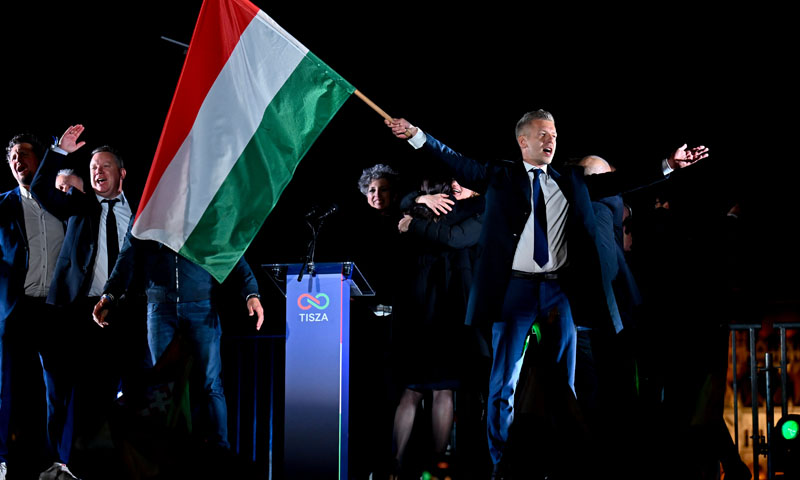
Preliminary results from Sunday’s general election show the centre-right Tisza party, led by Peter Magyar, securing a decisive victory and a strong majority in the 199-seat parliament.
End of an era
Orban, 62, who had dominated Hungarian politics since 2010 and championed what he described as an “illiberal democracy,” conceded defeat, calling the result “painful but clear.”
His government had come under increasing criticism domestically and internationally over concerns of democratic backsliding, economic stagnation, and close ties with Moscow.
Magyar, 45, addressing jubilant supporters in Budapest, declared victory, saying Hungary had “reclaimed its future” and broken from Orban’s political system.
Landslide victory and reform agenda
According to near-final results, the Tisza party is projected to win around 138 seats — enough for a two-thirds majority, which would allow it to amend the constitution and roll back reforms introduced under Orban’s rule.
Magyar had framed the election as a choice between aligning Hungary more closely with Europe or continuing Orban’s confrontational stance towards the European Union.
Political analysts say the outcome could pave the way for anti-corruption reforms, institutional changes, and a shift in Hungary’s foreign policy direction.
Global and regional implications
The result is expected to have far-reaching consequences beyond Hungary.
European leaders, including Ursula von der Leyen, welcomed the outcome, expressing hope that Hungary would now play a more cooperative role within the European Union.
The change in leadership could also unlock billions in European Union funds that had been frozen over rule-of-law concerns.
Meanwhile, Ukrainian President Volodymyr Zelenskiy congratulated Magyar and signalled willingness to strengthen ties, particularly on issues of regional security and support for Ukraine.
Orban had been one of Russian President Vladimir Putin’s closest allies within the EU, often opposing sanctions and blocking key financial packages for Ukraine.
Shockwaves in Washington
The election outcome has also triggered reactions in the United States, where Orban had enjoyed support from President Donald Trump and conservative circles.
Democratic leaders, including Chuck Schumer and Hakeem Jeffries, welcomed Orban’s defeat, portraying it as a rejection of authoritarian-style governance.
However, some of Trump’s allies expressed disappointment. Tech billionaire Elon Musk criticised the outcome on social media, reflecting divisions within US political circles over the result.
Regional reactions
Neighbouring countries also moved quickly to respond.
Slovak Prime Minister Robert Fico congratulated Magyar and expressed readiness for “intensive cooperation,” while acknowledging Orban’s longstanding partnership.
Polish Prime Minister Donald Tusk described the election as evidence that Europe is not inevitably drifting towards authoritarianism, calling it a positive signal for democratic forces in the region.
What lies ahead
Despite the clear mandate, analysts caution that challenges remain for Hungary’s incoming leadership, including managing economic pressures, repairing relations within the EU, and navigating sensitive issues such as migration and energy dependence.
Still, Sunday’s high voter turnout suggests strong public engagement and a desire for change after more than a decade and a half of Orban’s rule.
The transition marks one of the most significant political shifts in Central Europe in recent years, with implications likely to shape the region’s direction for years to come.
You May Also Like