
- Javed Soomro
- August 21, 2026
Pakistan, Arab-Islamic countries condemn Israeli actions in Palestine, Syria
-

- WEB DESK
- August 21, 2026
ISLAMABAD: Pakistan and other Arab and Islamic countries have condemned Israel’s settlement expansion in the occupied Palestinian territory and its military actions in Syria, warning that such measures threaten regional peace and stability and undermine the prospects of a political settlement.
In two separate joint statements issued on Friday, Pakistan and other Muslim countries rejected Israel’s “E1” settlement plan in the occupied West Bank and condemned Israeli airstrikes targeting the Abu al-Duhur military airbase in northwestern Syria.
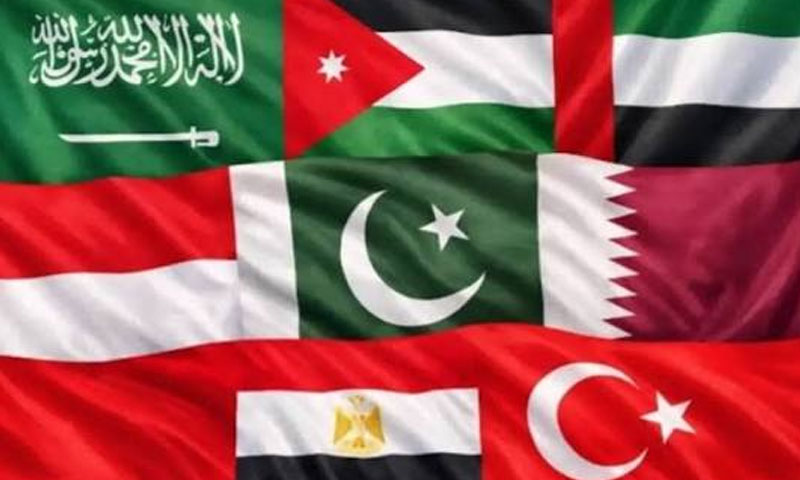
The statements was issued by Pakistan with Egypt, Türkiye, Indonesia, Jordan, Qatar, Saudi Arabia and the United Arab Emirates on the Palestine issue, while a separate statement on Syria was signed by the foreign ministers of Pakistan, Türkiye, Algeria, Indonesia, Jordan, Lebanon, Malaysia, Mauritania, Palestine, Qatar, Saudi Arabia and Somalia.
E1 settlement plan rejected
In the first statement, the foreign ministers of eight Arab and Islamic states unequivocally condemned Israel’s continued settlement policies in the occupied Palestinian territory and categorically rejected the E1 settlement plan and related settlement activities east of occupied East Jerusalem.
They also condemned violations and acts of violence allegedly perpetrated by Israeli settlers, with the support of Israeli occupying authorities, against Palestinians and their property.
The ministers said such actions violated international law and relevant United Nations resolutions and posed a serious threat to regional and international peace and security.
They described the E1 plan as a “dangerous escalation” that would further advance settlement expansion and annexation while undermining the geographical contiguity of the occupied Palestinian territory.
The ministers particularly warned that the plan threatened the territorial connection between the West Bank and East Jerusalem, thereby undermining the viability of an independent and contiguous Palestinian state based on the 1967 lines, with East Jerusalem as its capital.
They said the settlement measures also represented a direct challenge to international efforts aimed at achieving peace.
The statement referred to US President Donald Trump’s Comprehensive Plan, including its rejection of annexation and forced displacement and mechanisms envisaged for its implementation, including through the Board of Peace.
The ministers also referred to Trump’s stated commitment not to allow the annexation of the West Bank, saying this was aimed at achieving stability and bringing the conflict to an end.
Two-state solution reaffirmed
The eight foreign ministers reaffirmed that the two-state solution, based on international law and relevant UN resolutions, remained the only viable path towards a just, comprehensive and lasting peace.
They warned that actions undermining this solution risked escalating tensions, threatening regional and international peace and security and jeopardising prospects for lasting peace and stability.
The countries also backed efforts to ensure accountability for those responsible for illegal settlement activities in Palestine.
They called for appropriate international measures and sanctions against entities and individuals responsible for illegal settlements, including the E1 plan, as well as those supporting, facilitating or implementing settlement expansion and annexation policies.
The ministers further called for an end to any support or financing contributing to the establishment, expansion or entrenchment of illegal settlements.
They warned that a lack of accountability would contribute to the continuation of violations and further undermine prospects for a just and comprehensive peace.
The ministers called for the immediate halt of the E1 settlement plan and the rescinding of all measures taken in connection with it.
They also demanded an end to settlement activities and other measures aimed at altering the geographic and demographic character of the occupied Palestinian territory.
The UN Security Council, states and relevant international actors were urged to fulfil their responsibilities under international law and take urgent and effective measures to halt settlement expansion.
They also called for the protection of the Palestinian people and their inalienable rights, including the right to self-determination, and for the realisation of an independent Palestinian state in accordance with international law and relevant UN resolutions.
Pakistan, 11 countries condemn Israeli strikes on Syria
In a separate joint statement, Pakistan and 11 other Muslim countries strongly condemned Israeli airstrikes targeting the Abu al-Duhur military airbase in northwestern Syria.
The countries described the attacks as an “extreme escalation” and a “flagrant violation” of Syria’s sovereignty, territorial integrity and political unity.
The foreign ministers expressed deep concern over what they described as Israel’s continued targeting and degradation of Syrian territory and infrastructure.
They warned that such actions risked undermining Syria’s efforts to restore security, rebuild national institutions and address the humanitarian consequences of years of conflict.
The ministers stressed that Israel’s continued violations of Syria’s sovereignty and territorial integrity could further escalate tensions, undermine regional peace and stability and erode respect for international law and the principles of the UN Charter.
Call for Israeli withdrawal from occupied areas
The 12 countries called on the international community to adopt a firm and principled position against what they described as continued aggression against Syria.
They urged states to take concrete steps in accordance with international law and the UN Charter to bring an end to the violations and ensure full respect for the 1974 Disengagement Agreement.
The ministers also called for the withdrawal of Israeli forces from areas they have occupied, warning that continued military activity could lead to further escalation and threaten regional peace and stability.
They underscored the need to respect Syria’s sovereignty, independence, territorial integrity and political unity and rejected any attempt to undermine these principles.
The ministers urged the international community to act to prevent further escalation and protect regional peace and stability.
Both statements were issued in Islamabad on August 21, 2026, reflecting growing coordination among Pakistan and Arab and other Muslim countries over Israel’s actions in the occupied Palestinian territory and Syria.