- Web Desk
- Mar 13, 2026
Pakistan denies joining Abraham Accords via Board of Peace, joining stabilisation force
-

- Web Desk
- Jan 29, 2026
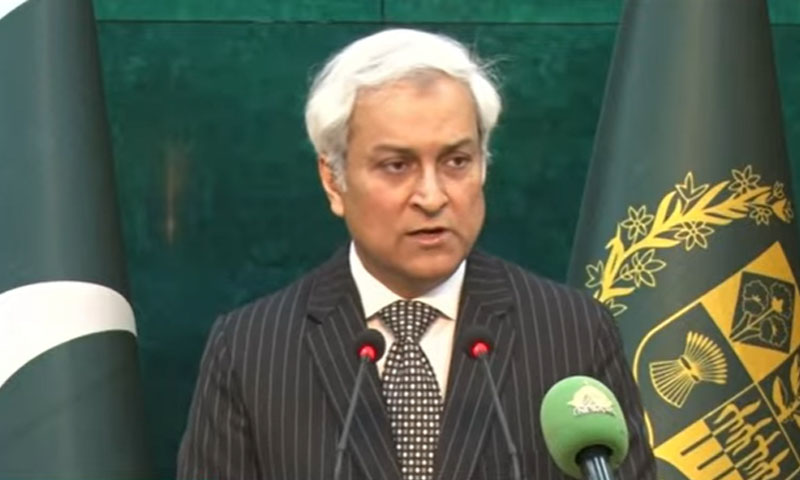
ISLAMABAD: Pakistan’s Foreign Office on Thursday rejected suggestions that its decision to join the newly formed “Board of Peace” is connected to the Abraham Accords and reiterated that the country will not become a party to those normalization agreements.
Foreign Office spokesperson Tahir Andrabi told a weekly briefing that equating Pakistan’s participation in the Board of Peace with joining the Abraham Accords was a “misconception”.
He said Islamabad’s position on the Palestinian issue remained unchanged and that Pakistan would not join the Abraham Accords, which are US-brokered agreements normalising ties between Israel and several Arab states.
Andrabi said Pakistan had no plans to join any international stabilisation force for Gaza, and that membership of the Board of Peace — an initiative aimed at supporting ceasefire implementation, humanitarian assistance and reconstruction in Gaza — did not involve military commitments.
He stressed that Pakistan’s objectives were to help consolidate a ceasefire in Gaza, support reconstruction efforts and promote a lasting peace based on the Palestinians’ right to self-determination.
Pakistan joined the Board of Peace alongside seven other Muslim-majority countries — including Saudi Arabia, Turkiye, Egypt, Jordan, the United Arab Emirates, Indonesia and Qatar — as part of what government officials described as a collective effort to advance peace in the war-torn Palestinian territory.
The Board of Peace, which was announced at the World Economic Forum in Davos and has drawn both support and criticism, is intended to complement United Nations efforts, though some analysts and opposition figures in Pakistan have questioned the government’s decision, arguing it could entangle Islamabad in geopolitical frameworks tied to the United States.
At the briefing, Andrabi also said that reports of negative changes to US travel advisories on Pakistan were inaccurate and that the updates could allow more Americans to visit the country.
He reiterated Pakistan’s support for peaceful diplomacy and dialogue in regional affairs, emphasising continued opposition to interference in the internal affairs of other countries.
He said that Prime Minister Shehbaz Sharif attended the annual World Economic Forum in Davos, where he met several global leaders to discuss economic developments, regional affairs, and promoting cooperation. Sharif also met the IMF Managing Director to discuss Pakistan’s economic situation and ongoing reforms.
He said that during the Davos Forum, Sharif consulted with leaders from Gulf countries regarding the Gaza Board. Pakistan, along with seven other Muslim-majority countries, issued a joint statement on the initiative.
The Foreign Office spokesperson also said that President Asif Zardari met with UAE President Sheikh Zayed bin Nahyan to discuss bilateral relations, investment opportunities, and ways to further strengthen cooperation.
He said that Deputy Prime Minister and Foreign Minister Ishaq Dar also participated in Davos, holding side meetings with global leaders and visiting the UAE to meet with business leaders, including the heads of PTCL and Etisalat, to discuss expanding trade and investment relations.
Andrabi said that Pakistan has received multiple phone calls from international leaders in the past week and recently signed key agreements with Myanmar’s foreign minister during his visit to Pakistan.
Regarding recent changes in the US travel advisory, the FO spokesperson said it was not a negative change but an “update” that would allow more Americans to travel to Pakistan. Pakistan continues to maintain that it is fully safe and open for international travelers.
You May Also Like