- Web Desk
- 1 Minute ago
Pakistan deploys thousands of security personnel, drones for 9th Muharram
-

- Web Desk
- 6 Hours ago
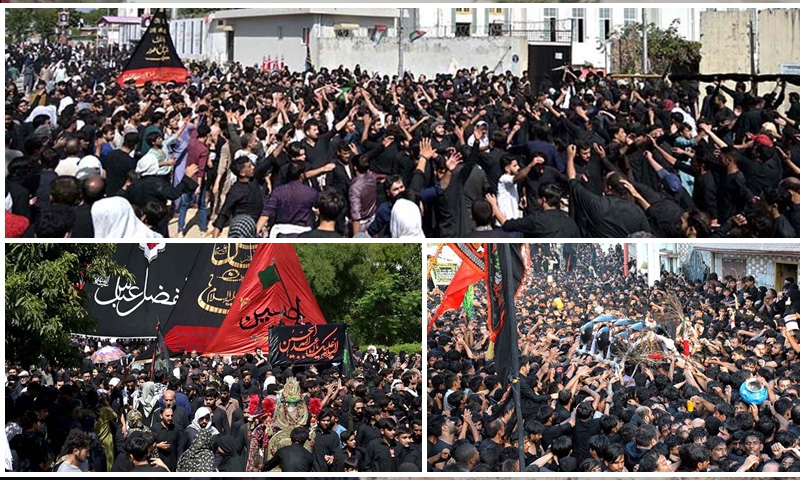
ISLAMABAD/KARACHI/LAHORE: Federal and provincial governments have deployed hundreds of thousands of security personnel and drones, and enforced strict traffic diversions on Thursday as millions of mourners turned out across the country to mark Muharram 9 amid heightened security and the suspension of mobile phone services in several cities, including Karachi.
The annual commemorations, which mark the 7th-century martyrdom of Hazrat Imam Hussain (RA), the grandson of the Holy Prophet Muhammad (Peace Be Upon Him), at the Battle of Karbala, are being monitored under a massive, multi-tiered security apparatus involving police, Rangers, and the army.
Over 152,000 personnel have been mobilised across Punjab, while tens of thousands more are securing major urban hubs in Sindh, Khyber Pakhtunkhwa and Balochistan.
Mobile phone service has been suspended in high-risk zones, including parts of Karachi, while major mass transit networks like Peshawar’s Bus Rapid Transit (BRT) have been halted for Muharram 9 and 10.
Law enforcement agencies are utilising a “four-tier security cordon” backed by live digital monitoring via Safe City CCTV networks, aerial drone surveillance, and specialised anti-drone teams.
Karachi
In Karachi, the main procession departed from Nishtar Park following a central sermon by prominent cleric Allama Shahanshah Hussain Naqvi. The city’s main artery, MA Jinnah Road, was entirely sealed off to regular commuters.
A Karachi police spokesperson confirmed that over 20,000 personnel including more than 5,000 dedicated force has been deployed to secure the main route. Mobile phone services were suspended around Nishtar Park and adjoining areas as a preventative measure against remote-controlled explosive devices.
Islamabad
In Islamabad, police, Rangers, and Frontier Constabulary (FC) personnel have been deployed to secure the central procession as it moved from the Asna-e-Ashri Imambargah toward Melody Chowk. Authorities launched a dedicated “Mehfooz Muharram” mobile application, allowing citizens to report suspicious activity in real-time using live location and image-sharing features.
Punjab
In Punjab, Chief Minister Maryam Nawaz implemented a strict three-tier security architecture.
In Lahore, around 11,000 police personnel secured 32 Muharram processions under a four-layer security cordon.
In Punjab, more than 152,000 security personnel were deployed under a three-tier security plan, while authorities also activated 4,700 QR code-enabled panic buttons at imambargahs.
Organizers at 4,700 Imambargahs have been instructed to utilise advanced QR-coded panic buttons for immediate emergency response.
Lahore Capital City Police Officer (CCPO) Bilal Siddique Kamyana stated that 11,000 officers were securing 32 processions across the provincial capital.
In a departure from other major cities, Kamyana noted that mobile phone signals in Lahore would remain functional, relying instead on a centralized four-layer physical cordon and extensive CCTV coverage.
Meanwhile, Punjab Governor Sardar Saleem Haider Khan visited Chakwal to personally review civic and security arrangements, urging public cooperation to maintain sectarian harmony.
In Khyber Pakhtunkhwa, Inspector General of Police Zulfiqar Hameed confirmed that between 43,000 and 50,000 personnel had been deployed province-wide, with 12,000 concentrated in Peshawar alone.
The deployment is supported by drone and anti-drone teams, while Peshawar’s Bus Rapid Transit (BRT) service remained suspended.
“There is a threat of terrorism, but the police are fully prepared,” Hameed told reporters.
He said that alongside traditional bomb disposal sweeps and sniffer dogs, the department has deployed dedicated drone and anti-drone teams to neutralise any aerial threats over the dense urban processions.
Out of 614 Imambargahs in the province, 127 have been designated as “highly sensitive.”
In Balochistan, a joint force of more than 32,000 personnel comprising district police, the Balochistan Constabulary, Frontier Constabulary and anti-riot units has been deployed to secure processions across Quetta and other sensitive districts.
Traffic Diversions and Public Lockdowns
To accommodate the massive crowds and prevent vehicle-borne attacks, major cities issued comprehensive traffic rerouting orders.
In Rawalpindi, Chief Traffic Officer Farhan Aslam announced that over 1,100 traffic officers were managing a strict lockdown of the city’s central commercial zones, completely shutting off access to Raja Bazar, Committee Chowk, and Iqbal Road.
Public transit commuters across the country have been advised to avoid non-essential travel until the conclusion of the Youm-e-Ashura (Muharram 10) processions on Friday.
You May Also Like