- Reuters
- October 7, 2026
Pakistan, seven other Muslim countries condemn Israeli actions in Gaza
-

- WEB DESK
- August 6, 2026
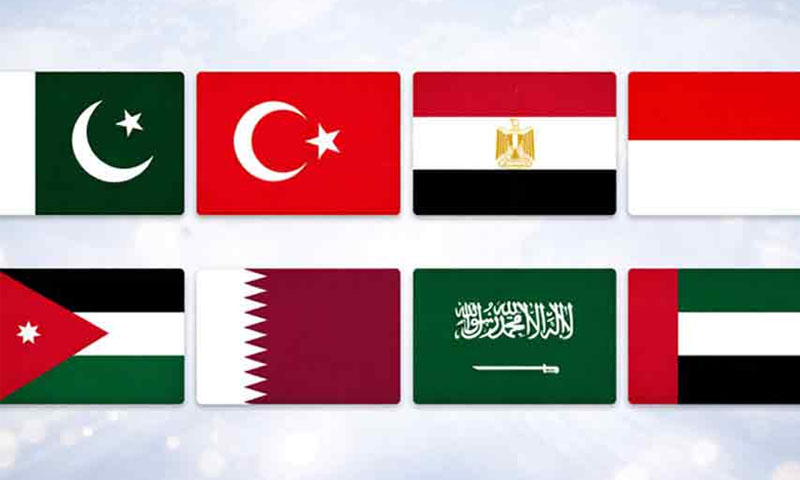
ISLAMABAD: The foreign ministers of Pakistan, Egypt, Turkiye, Indonesia, Jordan, Qatar, Saudi Arabia and the United Arab Emirates have issued a joint statement strongly condemning Israel’s military actions in Gaza, calling for an immediate and permanent ceasefire, unrestricted humanitarian access and renewed efforts to achieve a two-state solution to the Israeli-Palestinian conflict.
The joint statement, shared by Pakistan’s Foreign Office on Thursday, expressed grave concern over continued Israeli operations despite ongoing diplomatic efforts aimed at ending the conflict.
The eight countries condemned what they described as Israel’s attacks on hospitals, medical centres and critical healthcare infrastructure in Gaza, saying such actions constituted serious violations of international law and international humanitarian law.
The ministers said attacks on civilian infrastructure and the killing of civilians, including women and children, were unacceptable and violated international legal obligations.
They warned that Israel’s continued military operations were undermining efforts to implement a comprehensive roadmap for ending the Gaza conflict.
The statement noted that Israeli actions continued despite US President Donald Trump’s announcement that Palestinian factions had agreed to a proposed roadmap aimed at advancing the peace process.
According to the ministers, the continued military campaign threatened ongoing diplomatic efforts, fuelled regional tensions and further deepened the humanitarian crisis in Gaza.
Call for humanitarian access
The joint statement stressed that protecting civilians, hospitals, healthcare workers and humanitarian personnel was a legal obligation under international humanitarian law.
The ministers called for the immediate, safe and unhindered delivery of humanitarian assistance, medical supplies and relief aid throughout the Gaza Strip.
They also said the deteriorating humanitarian situation in Gaza could not be viewed separately from developments in the occupied West Bank.
The statement condemned attacks by Israeli settlers in the occupied West Bank as well as continued settlement expansion and attempts to alter the legal and historical status of occupied East Jerusalem.
The ministers said such measures sought to change facts on the ground through force and were undermining prospects for a negotiated two-state solution.
Rejection of annexation
The eight countries reaffirmed their rejection of any attempt to annex any part of the Occupied Palestinian Territory or impose Israeli sovereignty over occupied land.
They also categorically rejected any effort to forcibly displace the Palestinian population, describing such actions as violations of international law and relevant United Nations resolutions.
The ministers said attempts to deprive Palestinians of their legitimate rights were inconsistent with international law and longstanding UN resolutions on the conflict.
Appeal to UN Security Council
The joint statement urged the international community, particularly the United Nations Security Council, to fulfil its legal and moral responsibilities by ensuring Israel complies with international law, international humanitarian law and UN Security Council Resolution 2803.
It also called for accountability for those responsible for what it described as serious violations of international law.
The ministers stressed the need for effective international action to secure a permanent ceasefire and ensure the full implementation of agreements aimed at ending the conflict.
Reaffirming their support for a negotiated settlement, the eight countries said the establishment of an independent and sovereign Palestinian state based on the pre-1967 borders, with East Jerusalem as its capital, remained the only just and lasting solution to the decades-old conflict.
They added that the launch of a credible political process leading to the implementation of the two-state solution was the only path towards achieving comprehensive, just and lasting peace in the Middle East.