- WEB DESK
- October 30, 2026
Pakistan, Singapore agree to deepen cooperation as they mark 60 years of diplomatic ties
-

- WEB DESK
- October 30, 2026
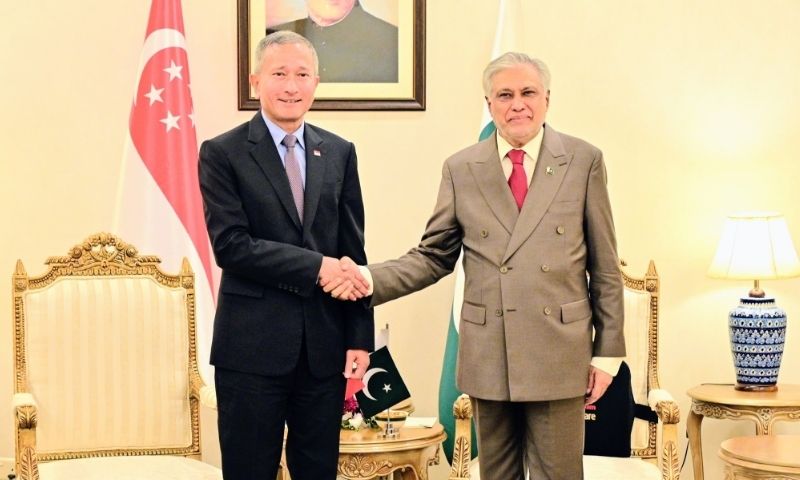
ISLAMABAD: Pakistan and Singapore have agreed to step up efforts to strengthen trade and investment ties, encourage greater business-to-business engagement and explore new areas of cooperation as the two countries mark 60 years of diplomatic relations, Deputy Prime Minister and Foreign Minister Ishaq Dar said on Friday.
Speaking at a joint press conference with Singaporean Foreign Minister Dr Vivian Balakrishnan in Islamabad, Dar said the two sides had discussed ways to expand economic cooperation, including through business delegations, stronger links between chambers of commerce and the possible resumption of direct flights.
The visit is the first by a Singaporean foreign minister to Pakistan in more than two decades. Dar said it reflected the two countries’ shared commitment to strengthening their longstanding friendship and broadening cooperation.
The ministers held a restricted meeting followed by delegation-level talks, covering political and economic relations, technology, education, culture and people-to-people contacts, as well as regional and international developments.
“Economic cooperation was central to our discussions,” Dar said, adding that the two sides had welcomed growth in bilateral trade but recognised considerable untapped potential in their relationship.
He said they had agreed to encourage closer engagement between business communities through exchanges of delegations and stronger links between their chambers of commerce to facilitate business-to-business ties.
Dar also highlighted the reopening of Pakistan’s trade and investment office at its high commission in Singapore, describing it as a demonstration of Islamabad’s resolve to promote commercial links with the Southeast Asian country.
Balakrishnan said the two countries enjoyed excellent diplomatic relations, but their trade ties should be much stronger.
“To be very candid, at a diplomatic level we’ve got excellent ties. In fact they are so good that it makes it even more obvious that actually our trade relations and looking at the numbers and the data ought to be much higher,” he said.
He said facilitating greater trade and investment flows was the first priority, stressing the need for closer links between small and medium-sized enterprises and business communities in South Asia and Southeast Asia.
Governments, he added, should help businesses identify opportunities and understand the risks involved in operating in each other’s markets.
Balakrishnan also identified carbon markets as a potential area of cooperation, saying they could attract investment into projects in Pakistan that reduce emissions while supporting sustainable development. Officials from the two countries were exploring opportunities in this field, he said.
The ministers also discussed cooperation in education, research and innovation, particularly in digital technologies and artificial intelligence, as well as stronger links between universities and research institutions.
Balakrishnan said Singapore wanted to deepen cooperation between its higher education institutions, including Nanyang Technological University and the National University of Singapore, and Pakistan’s National University of Sciences and Technology.
He said the two sides hoped to expand these links and provide greater opportunities for young people, particularly in developing skills relevant to emerging industries and future jobs.
Dar said they had also discussed cooperation in human resource development, agriculture and climate-related matters. He noted that Pakistani professionals working in Singapore contributed to its economy and society and served as a bridge between the two countries.
The possible resumption of direct flights was also discussed to facilitate business, travel and closer contact between their peoples.
Disaster-management cooperation
The two foreign ministers announced the exchange of a memorandum of understanding on disaster-management cooperation between Pakistan’s National Disaster Management Authority and the Singapore Civil Defence Force.
Dar said the agreement had been exchanged following their meeting.
Balakrishnan said the MoU would provide a framework for cooperation in early warning systems, sharing best practices, strengthening search-and-rescue capabilities and potentially conducting joint training and exercises.
He said climate change had made disaster preparedness increasingly important, describing extreme weather events as a clear and present threat.
Pakistan had extensive experience in responding to large-scale natural disasters, including floods and other extreme weather events, he said, adding that Singapore could learn from Pakistan’s experience in improving resilience and disaster response.
“Disasters do not respect boundaries, do not have passports,” Balakrishnan said, stressing the importance of countries preparing and working together.
Regional and international issues
The talks also covered regional and international developments, including tensions in the Gulf, maritime trade and the importance of keeping sea routes and supply chains secure.
Dar said the two sides had reaffirmed the importance of dialogue and diplomacy, respect for international law and adherence to the principles of the United Nations Charter in addressing global challenges.
He said Pakistan remained engaged with regional and international partners to encourage dialogue, describing diplomacy as the only viable way to resolve outstanding challenges.
Balakrishnan commended Pakistan’s role in efforts to address the current crisis in the Gulf, noting that much of the energy passing through the region was destined for South Asia, Southeast Asia and Northeast Asia.
He also stressed the importance of international law and freedom of navigation, particularly under the United Nations Convention on the Law of the Sea (UNCLOS).
As an island city-state whose trade volume is three times its gross domestic product, Singapore considered maritime routes essential, he said. He welcomed what he described as Pakistan’s similar position on the issue.
Dar said he had briefed his counterpart on Pakistan’s position on Palestine, expressing concern over the expansion of Israeli settlements and attempts to alter the status of the West Bank and Al Quds Al Sharif.
He reiterated Pakistan’s support for an independent, sovereign, viable and contiguous Palestinian state based on the pre-June 1967 borders, with Al Quds Al Sharif as its capital, and called for unhindered humanitarian assistance to Gaza.
On South Asia, Dar briefed Balakrishnan on the need for a just, durable and peaceful settlement of the longstanding Jammu and Kashmir dispute in accordance with relevant UN Security Council resolutions.
The ministers also discussed Pakistan’s engagement with the Association of Southeast Asian Nations (ASEAN), of which Pakistan is a sectoral dialogue partner.
Dar conveyed Pakistan’s best wishes to Singapore as it prepares to assume the ASEAN chairmanship in 2027, saying Islamabad looked forward to working with Singapore to strengthen cooperation with the regional bloc.
Balakrishnan said Singapore would work closely with Pakistan to identify opportunities for deeper engagement with ASEAN and cooperation between the two regional groupings.
He also recalled that Pakistan was among the earliest countries to recognise Singapore’s independence, describing the 60th anniversary of diplomatic relations as an important milestone.
“60 years is an important milestone, but what matters more is what we do in the next 60 years,” he said.
Balakrishnan thanked Dar for his hospitality and said he looked forward to translating the discussions into practical steps to strengthen relations between the two countries.
Earlier, Pakistan and Singapore agreed to step up efforts to strengthen economic cooperation, expand trade and investment, and promote skills development as the two countries mark 60 years of diplomatic relations.
The understanding was reached during a meeting between Dar and Balakrishnan at the Ministry of Foreign Affairs in Islamabad on Friday.
The two foreign ministers reviewed longstanding bilateral relations and discussed ways to translate their longstanding diplomatic ties into stronger economic and commercial cooperation, with an emphasis on trade, investment, connectivity, skills development and greater business-to-business and people-to-people exchanges.
Speaking at a joint press conference after their meeting earlier, Dar said the potential for cooperation between Pakistan and Singapore was substantial, but the depth of their diplomatic relationship was not adequately reflected in their economic ties.
“The depth of diplomatic relations is not reflected in our economic relations,” he said, stressing the need for both countries to work together to unlock the untapped potential.
Dar said economic diplomacy had been a priority since he joined the Foreign Office two years ago, drawing on his 35 years of experience serving in economic ministries.
He said he had made it clear to Foreign Office officials from his first day that promoting economic diplomacy would be a central focus of Pakistan’s foreign policy engagement.
“If we work together and promote and push and facilitate, I’m sure we can reach a new level of our economic relations,” he said.
The deputy prime minister also appreciated Singapore’s support in providing training opportunities to Pakistani officials, saying nearly 1,500 officials had benefited from training facilities offered by the Southeast Asian country.
Dar highlighted the role of Pakistan’s Special Investment Facilitation Council (SIFC), saying the initiative had been established as a one-window platform to facilitate foreign investors.
He said the SIFC and the Board of Investment (BOI), which had previously operated separately, had now been merged under the Board of Investment to provide investors with a single platform.
The arrangement would make it easier for potential investors to access information about investment opportunities in Pakistan, including sector-specific profiles and promotional material, he said.
Dar urged Singaporean businesses to explore the available opportunities and encouraged closer engagement between the two countries’ investment bodies and business communities.
He also called for the early conclusion of an agreement involving Singapore’s Institute of Technical Education and a memorandum of understanding with Pakistan’s National Vocational and Technical Training Commission (NAVTTC) to promote skills development.
The proposed cooperation is aimed at strengthening technical and vocational training and creating opportunities for the exchange of expertise and experience between the two countries.
On disaster management, Dar said the two sides were expected to exchange a memorandum of understanding later on Friday.
He said Pakistan had completed the necessary approvals for the agreement and that it would be placed before the federal cabinet for ratification within a week.
The foreign minister also highlighted cooperation between Pakistan and Singapore at multilateral forums, saying the two countries regularly coordinated their positions and maintained close contact on issues of mutual interest.
He appreciated Balakrishnan’s cooperation on multilateral matters and his engagement with regional developments.
Dar said the two ministers had also discussed a range of regional and international issues during their restricted meeting, including Palestine, Jammu and Kashmir and matters relating to the International Court of Justice (ICJ).
He said Pakistan valued Singapore’s engagement on regional issues and that both countries would continue exchanging views and keeping each other informed about developments.
Balakrishnan, meanwhile, thanked Pakistan for the opportunity to visit Islamabad and said the timing of his visit was particularly pleasant given the good weather.
He recalled Pakistan’s early recognition of Singapore’s independence, describing it as an important part of the historical relationship between the two countries.
Singapore, which recently marked 61 years of independence, was commemorating six decades of diplomatic relations with Pakistan, he said.
Balakrishnan said he had a long list of issues to discuss with his Pakistani counterpart and that the two sides had substantial work to pursue.
He also welcomed the decision of Prime Minister Shehbaz Sharif to accept Singapore’s invitation to visit the country, saying the two sides now faced the challenge of delivering on the commitment.
“I’m also glad that your prime minister has agreed to accept our invitation. And now the challenge will be we’ve got a deadline to deliver,” he said.
The visit comes as Pakistan seeks to attract foreign investment, strengthen economic partnerships and expand engagement with Southeast Asian economies.
Both countries have maintained friendly relations since establishing diplomatic ties in 1966, with Friday’s discussions underscoring a shared interest in building on that foundation through stronger economic cooperation, institutional exchanges and closer people-to-people contacts.
Singaporean foreign minister calls on PM Shehbaz in Islamabad
Meanwhile, Singaporean Foreign Minister Dr Balakrishnan called on Prime Minister Shehbaz Sharif in Islamabad on Friday, with the two sides discussing ways to strengthen bilateral trade and investment and expand cooperation in key sectors.
The meeting took place as Pakistan and Singapore mark the 60th anniversary of the establishment of diplomatic relations this year.
According to a statement issued by the Prime Minister’s Office, Shehbaz reaffirmed Pakistan’s commitment to further strengthening its longstanding and friendly relations with Singapore.
The prime minister expressed admiration for Singapore’s economic transformation and achievements in innovation and development, and underscored the importance Pakistan attached to its partnership with Singapore, both bilaterally and multilaterally, including within the Association of Southeast Asian Nations (ASEAN).
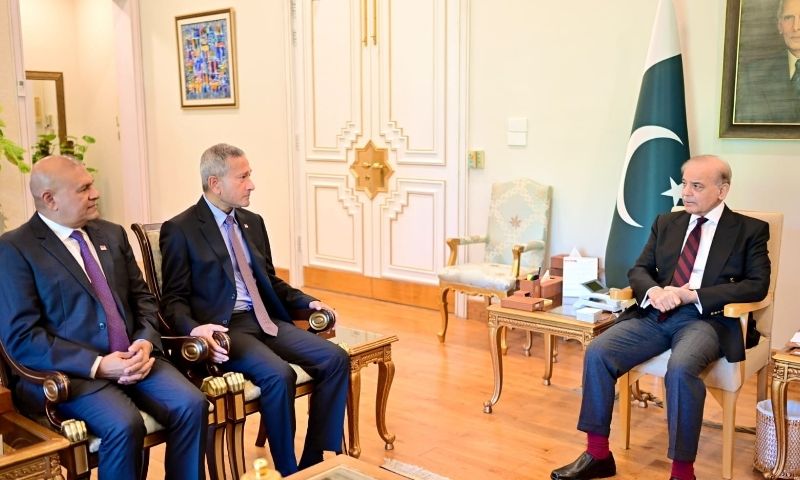
The two sides discussed expanding cooperation in priority areas, including the digital economy, fintech, infrastructure development, logistics, small and medium-sized enterprises (SMEs) and the services sector.
They also explored new avenues for mutually beneficial economic cooperation and discussed enhancing people-to-people contacts.
The two sides exchanged views on regional and international developments and reaffirmed their commitment to continued engagement and cooperation at bilateral and multilateral forums.
You May Also Like