- Web Desk
- 9 Minutes ago
Pakistan tops global air pollution ranking in 2025
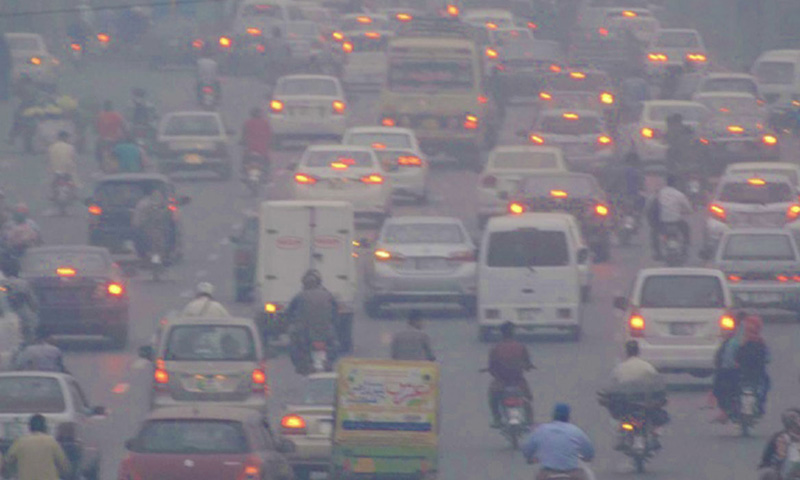
Pakistan recorded the highest average level of fine particle pollution in the world in 2025, according to a new annual assessment of global air quality. The findings placed the country at the top of the list for PM2.5 pollution, a dangerous form of airborne particulate matter small enough to enter the lungs and bloodstream, and linked its average exposure to levels far above the safety threshold recommended by the World Health Organization.
The report, released by Swiss air quality monitoring company IQAir, found that Pakistan’s annual PM2.5 concentration stood at roughly 13 times the WHO guideline, underscoring the scale of the air quality crisis facing the country. PM2.5 refers to microscopic particles measuring 2.5 microns or less, widely regarded as one of the most harmful pollutants because of their ability to penetrate deep into the respiratory system.
The study also showed that Pakistan was not alone in facing severe smog conditions. Bangladesh and Tajikistan ranked second and third among the most polluted countries and territories in 2025, reflecting a broader regional pattern of hazardous air quality in parts of South and Central Asia.
Most countries still fail to meet WHO limits
Globally, the report painted a bleak picture. Out of 143 countries and territories assessed, 130 did not meet the WHO’s recommended annual PM2.5 limit of less than 5 micrograms per cubic metre. Only 13 countries and territories managed to stay within that benchmark during the year, an improvement from seven in 2024, but still a very small minority overall.
Among the countries that did meet the recommended level were Australia, Iceland, Estonia and Panama. Even so, the report noted that only 14 per cent of cities worldwide stayed within the WHO standard in 2025, down from 17pc the previous year. That decline was attributed in part to pollution spikes caused by Canadian wildfires, which affected air quality across large parts of North America and even reached Europe.
The report also highlighted how weather patterns shaped outcomes in several countries. Laos, Cambodia and Indonesia recorded noticeable declines in PM2.5 levels compared to 2024, largely because wetter and windier La Nina conditions helped disperse pollutants. Mongolia also saw a marked improvement, with average concentrations falling by 31pc to 17.8 micrograms per cubic metre.
Overall, 75 countries reported lower PM2.5 averages than a year earlier, while 54 saw pollution rise.
South Asia remains at the centre of the crisis
The city-level data showed that some of the worst urban pollution was concentrated in South Asia and China. Loni in India was named the most polluted city in the world in 2025, with an annual average PM2.5 concentration of 112.5 micrograms per cubic metre. It was followed by Hotan, in China’s Xinjiang region, at 109.6 micrograms.
According to the report, the world’s 25 most polluted cities were all located in India, Pakistan and China, reinforcing the extent to which the region remains at the centre of the global air pollution emergency.
Data gaps cloud parts of the global picture
The report also warned that data limitations may have affected pollution rankings in some cases. Chad, which had been identified as the most polluted country in 2024, fell to fourth place in 2025. However, the apparent reduction in PM2.5 levels may not reflect a real improvement.
Researchers said the shift was likely linked to missing data after the United States ended a global monitoring programme in March 2025 that had relied on pollution readings from embassies and consulates. That move removed an important source of information for several countries with chronic smog problems.
Because of those gaps, Burundi, Turkmenistan and Togo were left out of the 2025 report altogether. Researchers cautioned that in some places, the absence of complete readings may make air quality appear to have improved when the actual conditions remain unclear.
Taken together, the findings point to a world where unsafe air remains the norm rather than the exception, with Pakistan now standing at the sharpest edge of that crisis.
You May Also Like