- Web
- 1 Hour ago
Pakistan’s air power: Achieving asymmetric advantage against numerically superior adversaries
-

- sadia.basharat
- Feb 14, 2026
In the modern and highly competitive environment of South Asian air power, the year 2026 represents a critical point of inflection that reveals two distinct strategic approaches. India’s strategy is one of scale, with a major defence purchase package approved on February 12, totaling about INR3.6 trillion, with 114 Rafale MRCA aircraft at the heart of its plans.
The clear intention is to fill the gap in the number of squadrons in the Indian Air Force to better its air dominance and range-strike capabilities. This major acquisition package contains within it a more recognizable set of challenges, such as foreign dependence, interoperability, and delays in indigenous development programmes such as the Advanced Medium Combat Aircraft (AMCA), which is likely to mature only in the mid-2030s.
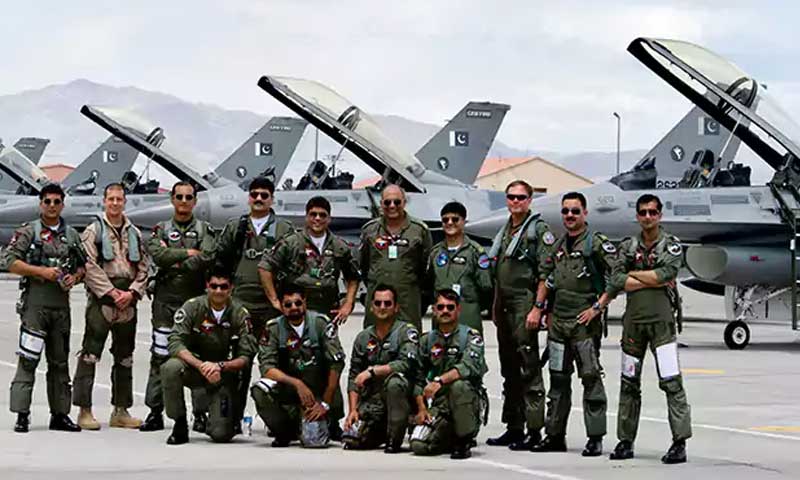
On the other side of the border, the Pakistan Air Force exhibits strategic agility through its asymmetric effectiveness, with a disproportionate effect on the conventional military balance. While India focuses on large-scale acquisitions, the Pakistan Air Force focuses on operational excellence through highly integrated operations, innovation, and professionalism. In a world where air superiority is no longer a function of strategic insight and system-level coordination, the Pakistan Air Force’s system-of-systems approach may have the effect of mitigating India’s cost advantage and placing Pakistan as the de facto air guardian of the region.
PAF’s Fifth-Generation Air Power
The Pakistan Air Force’s (PAF) fifth-generation project is centered around the upcoming Shenyang J-35E stealth fighter. It is expected that the first units will begin arriving in the mid-2026 to 2027 timeframe, with a possible rate of delivery approximating 40 aircraft in a series of incremental orders. As the Chinese export model of a cutting-edge design, the J-35E features low-observable technology intended to extend the ranges of detection beyond those of advanced platforms such as the Indian S-400 battery formations. The J-35E’s sensor fusion and multi-role capabilities allow for the operation of contested airspace, suppression of high-end threats such as the Rafale, and ground support. This evaluation takes into account a well-considered stealth strategy that takes advantage of India’s roughly decade-long lack of homegrown fifth-generation development.
The stealth technology is further enhanced by the PAF’s high-low strategy, pairing the J-35E with proven platforms such as the rapidly expanding J-10CE force and the JF-17 Thunder Block III. The Block III variant, equipped with an active electronically scanned array (AESA) radar and electronic warfare suite, has already proven its operational efficacy in regional exercises and possesses the ability to launch long-range ordnance such as the PL-15E missile, boasting a range of over 200 kilometers for first-shot, first-kill engagements.
Supporting this package is the PAF’s indigenous Taimoor air-launched cruise missile, which successfully completed its maiden flight in January 2026. With a rough range of 600 kilometers and a terrain-hugging, low-radar-profile design, Taimoor can be launched from JF-17s or older Mirage IIIs, providing a cost-effective deep strike capability that may potentially outmatch India’s pricier foreign-supplied options such as the BrahMos or SCALP.
Long- and Medium-Range Missile Shield Securing National Airspace
The strength of the Pakistan Air Force (PAF) does not lie solely in its air power but in a comprehensive security paradigm that encompasses the airspace, effectively turning it into a secure zone. The HQ-9BE long-range surface-to-air missile defense system secures the perimeter, in service since 2025, with a maximum range of 260 km and the ability to target aircraft and cruise missiles.
This is further supplemented by the HQ-16FE medium-range system, with a maximum range of 160 km, thus forming a composite defense system that can effectively counter potential invasions by being part of the Pakistani defense system. This system overcomes the interoperability issues that could arise in coalition formations with other nations, unlike the systems in place in coalitions of other nations like France, Russia, and India.
PAF embraces distributed lethality and manned-unmanned teaming with YALGHAR-200
The advent of new technologies is ushering in the era of distributed lethality. The YALGHAR-200 loitering drone, showcased at the World Defense Show in early 2026, heralds the beginning of a new era where the engagement range could be around 200 km and the loiter time could be between 90 and 120 minutes. This marks a new era in Manned-Unmanned Teaming (MUM-T) in the PAF airspace.
The plan is to have a J-35E aircraft using YALGHAR unmanned aerial vehicles (UAVs) controlled by PAF pilots to engage and destroy adversary targets. The proposed system is designed to saturate enemy interception resources by launching cheap threats that fight for resource allocation. This is unlike the current unmanned initiatives by India, such as the CATS program or the purchase of MQ-9B drones, which are still in their infancy.
However, the hardware component is not the sole determinant of the outcome of military engagements; rather, the individuals operating the hardware are of prime importance. In this regard, the doctrinal evolution of the Pakistan Air Force (PAF) is worth highlighting. The February 2019 incident, following the Balakot strikes by India, is a relevant case study that exemplifies sound operational performance. In the face of mounting incursions, the PAF conducted a counteroperation that employed reverse precision and network-centric strategies, leading to the downing of a MiG-21. The treatment of captive Wing Commander Abhinandan Varthaman is also worth mentioning.
He was protected from harm and treated with respect before being released. Wing Commander Varthaman praised the professionalism of the Pakistan Army and Air Force, terming them “very professional,” and further elaborated on the manner in which they performed.
This philosophy seems to have been reflected in the high-intensity engagements that took place in May 2025, where the Pakistan Air Force’s awareness of the situation and the PL-15E’s superiority factor created the impression of “first-shoot, first-kill.” By virtue of extensive training, joint operations, and a model that combines lethal effectiveness with ethical restraint, the PAF builds a force that is not only lethal but also disciplined, able to register tactical successes without necessarily triggering strategic escalation.
Regional contrasts in the aerial balance are expected to sharpen further by 2030. India’s capital-driven progress towards a 4.5-generation capability, as represented by Rafale fighters, offers strategic time advantages but faces challenges in terms of integration and long-term viability. On the other hand, Pakistan’s efficiency-driven modernization strategy is focused on securing a first mover’s advantage through continued investment in fifth-generation stealth, indigenous weapons, and manned-unmanned teaming (MUM-T) capabilities. By the time the Indian Advanced Medium Combat Aircraft (AMCA) becomes operational, the Pakistan Air Force (PAF) is likely to be a seasoned fifth-generation force with an optimized environment that supports effortless, real-time information sharing among various platforms.
In this Indo-Pak balance of aerial power, the PAF is no underdog but a model for modern warfare. It proves that effective deterrence derives from organisational flexibility, innovation, and professionalism, not from endless spending. For Pakistan, the strategic imperative goes beyond simple border protection to rally the nation’s resolve through capability and quiet confidence. In the context of the current regional tensions, it is sound international judgment to understand that, in the South Asian skies, respect is due to a smart and professional military.
You May Also Like