- Web Desk
- 18 Minutes ago
Pakistan’s Civil-Military Leadership Convenes to Tackle Economic and Security Headwinds
-

- Web Desk
- 1 Minute ago
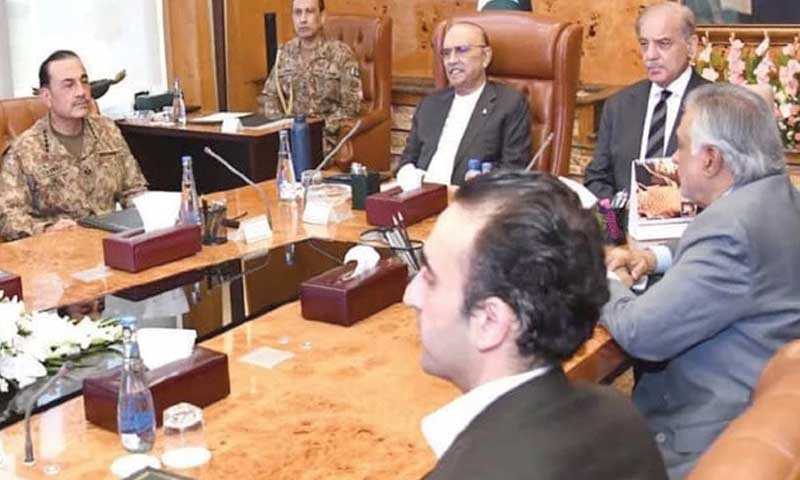
WEB DESK: In a significant display of institutional harmony, Pakistan’s top civilian and military leaders gathered at the Aiwan-e-Sadr on Thursday to forge a national consensus against a backdrop of mounting regional volatility and surging energy costs.
Chaired by President Asif Ali Zardari, the high-level consultative meeting served as a strategic review of the nation’s economic resilience, according to the Express Tribune.
The session was attended by Prime Minister Shehbaz Sharif and the Chief of Defence Forces and Chief of Army Staff, Field Marshal Syed Asim Munir, alongside key cabinet members.
The discussions focused heavily on the “war fallout” specifically the disruption of global oil and gas supplies and the subsequent pressure on the domestic exchequer.
Mitigating the energy crisis and inflationary pressure
A primary concern for the forum was the precarious state of the energy sector. With global petroleum prices fluctuating due to geopolitical uncertainty, Finance Minister Muhammad Aurangzeb and Petroleum Minister Ali Pervaiz Malik briefed the leadership on immediate measures to stabilise costs.
The participants explored strategies to shield the public from the “spillover effects” of rising fuel prices, which threaten to drive up the cost of living across all sectors.
To counter these fiscal strains, the leadership underscored the necessity of strict austerity measures. The government plans to enforce rigorous fiscal discipline to reduce expenditure, while simultaneously launching public awareness campaigns.
These initiatives will encourage citizens to adopt fuel-saving habits, such as increasing the use of public transport and engaging in shared ride systems, to lower the national oil import bill.
Strategic alignment on regional security and food stocks
Beyond the immediate ledger, the meeting delved into the broader implications of regional security developments. The leadership reached a firm agreement that economic management and national security can no longer be viewed in isolation.
There was a shared recognition that food security and energy planning are now intrinsic to Pakistan’s wider defensive posture.
By bringing together figures such as Deputy Prime Minister Ishaq Dar, PPP Chairman Bilawal Bhutto Zardari, and Interior Minister Mohsin Raza Naqvi, the session aimed to solidify a “national consensus.”
The Presidency’s statement emphasised that institutional coordination is paramount, the objective is to ensure that future policy decisions prioritise national stability while safeguarding the interests of the public during these turbulent times.
You May Also Like