
- Waqas Buneri
- October 22, 2026
Pakistan’s defence pacts: Common front or competing interests?
-

- Farhan Muhammad Khan
- October 22, 2026
ISLAMABAD: Pakistan has signed three significant defence-related agreements with Muslim-majority countries over the past 13 months, reflecting an effort to broaden its security partnerships as geopolitical tensions and regional security challenges reshape the strategic landscape.
The agreements include a Strategic Mutual Defence Agreement with Saudi Arabia, a joint defence agreement involving Saudi Arabia and Turkiye, and the Badr memorandum of understanding signed with Turkiye, Qatar and Indonesia.
The agreements come amid shifting global power dynamics, rising regional tensions and evolving security challenges. Across the Muslim world, countries are seeking to strengthen defence ties, enhance military capabilities and explore new avenues of cooperation. For Pakistan, the agreements represent an effort to broaden its defence partnerships beyond traditional diplomatic relations.
But the three agreements are not alike. While all relate to defence and security, they differ in their signatories, scope and underlying objectives.
A closer look at the agreements offers insight into how Pakistan is shaping its defence relationships, what it hopes to achieve through these partnerships and how they could influence regional security and military cooperation.
Pakistan-Saudi Strategic Mutual Defence Agreement
Pakistan and Saudi Arabia signed a Strategic Mutual Defence Agreement in Riyadh on September 17, 2025. Prime Minister Shehbaz Sharif and Saudi Crown Prince and Prime Minister Mohammed bin Salman signed the agreement.
According to the two countries’ official statements, the agreement aims to strengthen defence cooperation, reinforce their shared commitment to security and enhance their collective defence capabilities against aggression.
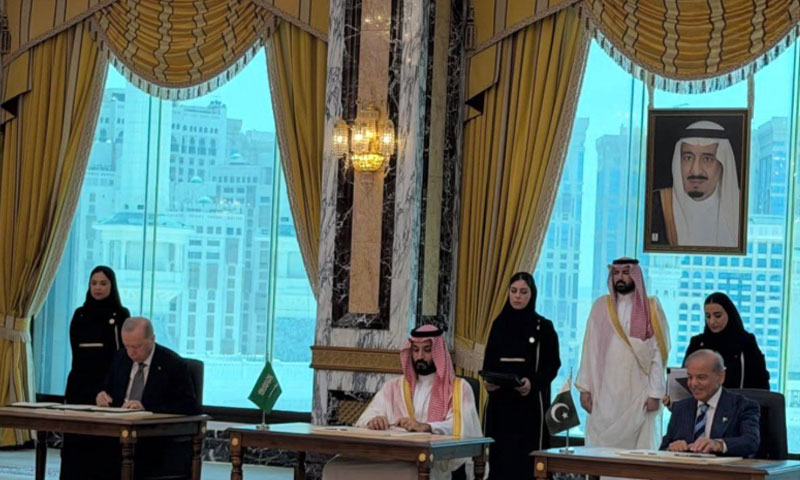
A key provision states that aggression against either country will be considered aggression against both.
The agreement formalised a longstanding defence relationship between Pakistan and Saudi Arabia, whose political, economic and security ties date back nearly eight decades.
However, the public announcement did not spell out every operational aspect of a joint response, including the precise circumstances under which military deployments might take place or the procedures that would govern any such action.
Why does the agreement matter?
The agreement gives a formal strategic framework to the two countries’ commitment to each other’s security. It also provides a basis for expanding defence cooperation and strengthening their capacity to respond to potential threats.
For Pakistan, Saudi Arabia is an important partner not only in defence but also in economic, diplomatic and political affairs. Saudi Arabia, meanwhile, has long maintained defence ties with Pakistan and values its military experience and capabilities.
The agreement’s practical significance will depend on how the two countries implement their commitments, expand military cooperation and translate their mutual-defence pledge into operational arrangements.
The Makkah Joint Defence Agreement: Pakistan, Saudi Arabia and Turkiye
Pakistan, Saudi Arabia and Turkiye signed the Makkah Joint Defence Agreement in Makkah on August 7, 2026.
According to official statements, the agreement aims to strengthen the collective security of the three countries, enhance their joint defence capabilities against external aggression and promote regional peace and stability.
Under a key provision, an armed attack against any one of the three countries will be treated as an attack against all three. The agreement also envisages closer cooperation in various defence-related fields.
Pakistan’s Foreign Office has described the arrangement as defensive in nature and said it is not directed against any country.
What makes this agreement different?
Unlike the bilateral Pakistan-Saudi agreement, the Makkah arrangement formally brings Turkiye into a three-country collective-defence framework.
It therefore extends the existing defence relationship between Pakistan and Saudi Arabia into a broader arrangement involving a third strategic partner.
Cooperation has also moved beyond the declaration of a mutual-defence commitment. At a meeting in Istanbul on August 31, 2026, the three countries agreed to strengthen institutional coordination and expand cooperation in defence industries, joint technology development and production.
According to the joint announcement, a secretariat is to be established in Saudi Arabia, initially headed by a secretary-general from Pakistan for a three-year term.
Turkiye submitted the agreement to its parliament for ratification on October 20, beginning the domestic approval process. Parliamentary ratification and practical implementation are separate stages, and the progress of the agreement will depend partly on the completion of the relevant legal procedures.
What could it mean for regional security?
The agreement creates a formal framework for collective-defence cooperation among three countries with established military capabilities and strategic relationships.
Its eventual impact will depend on how the parties coordinate their defence policies, develop institutional mechanisms and implement their commitments.
The agreement should not automatically be interpreted as the establishment of a single military command or a broader alliance involving all Muslim countries. Its stated commitments and participating countries define its scope.
The Badr Memorandum: Pakistan, Turkiye, Qatar and Indonesia
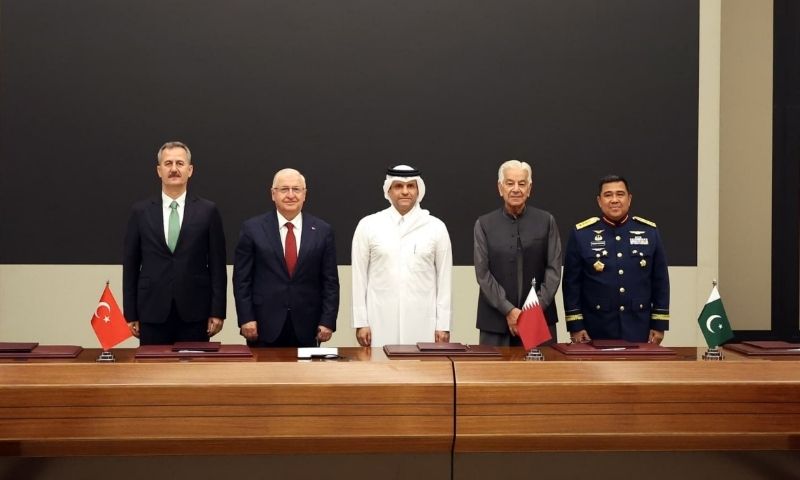
Pakistan, Turkiye, Qatar and Indonesia signed the Badr memorandum of understanding in Doha on October 21, 2026.
According to Turkiye’s defence ministry, the memorandum aims to strengthen defence cooperation among the four countries, enhance their military capabilities and promote collaboration between their defence industries.
Pakistan was represented at the signing by Defence Minister Khawaja Asif, alongside the relevant defence ministers from Turkiye, Qatar and Indonesia.
According to Reuters, the memorandum focuses on defence production, technical training, research and development, and cooperation between the participating countries’ defence industries.
The arrangement seeks to draw on the individual strengths of the four countries to improve cooperation, integrate industrial capabilities and expand their ability to meet the needs of partner countries.
How is Badr different from the other two agreements?
The Badr memorandum has a different focus from the Pakistan-Saudi agreement and the Makkah Joint Defence Agreement.
No provision treating an armed attack against one signatory as an attack against all four was announced in the details made public about Badr. Instead, the memorandum centres on defence-industry cooperation, joint projects, training, research and technological collaboration.
It could open opportunities for joint defence manufacturing, technology transfers and collaborative research. However, these are potential areas of cooperation rather than confirmed projects, and their implementation will depend on the details, financing arrangements and terms agreed by the participating countries.
For Pakistan, the arrangement could provide opportunities to strengthen its defence industry, benefit from technical expertise and explore ways to expand domestic production capabilities.
Qatar’s existing economic relationship with Pakistan, including its employment of Pakistani workers, also provides a wider context for the development of bilateral ties. The memorandum could add a new dimension to that relationship by expanding cooperation in defence-related fields.
Pakistan’s Foreign Office had not issued a separate statement on the signing at the time of the reports cited here. Radio Pakistan, however, carried details of the agreement and remarks by Defence Minister Khawaja Asif.
Three agreements, three different objectives
Pakistan and Turkiye are common participants in all three arrangements only in part: both are involved in the Makkah and Badr agreements, while Pakistan and Saudi Arabia are parties to the first two agreements.
Despite these overlapping relationships, the agreements serve different purposes.
The Pakistan-Saudi Strategic Mutual Defence Agreement formalises a bilateral defence commitment. The Makkah Joint Defence Agreement establishes a collective-defence framework involving Pakistan, Saudi Arabia and Turkiye. The Badr memorandum, meanwhile, focuses on cooperation in defence production, training, research and technology among Pakistan, Türkiye, Qatar and Indonesia.
It would therefore be inaccurate to describe all three as identical defence pacts or to treat Badr as equivalent to a mutual-defence treaty.
Their practical significance will depend on the terms of each arrangement, their legal status, the mechanisms established to implement them and the projects that emerge from them.
‘A possible security vacuum as US dominance wanes’
Former Pakistani ambassador and analyst Maleeha Lodhi views the agreements against the backdrop of changing security dynamics in the Middle East and regional countries’ efforts to explore new forms of defence cooperation.
Speaking to HUM News Digital, Lodhi said the Badr memorandum signed by Pakistan, Turkiye, Qatar and Indonesia was different in nature from the Strategic Mutual Defence Agreement between Pakistan and Saudi Arabia.
She described Badr as a memorandum of understanding focused on defence production and cooperation across different areas of defence rather than a mutual-defence pact.
Lodhi said the agreements indicated that Gulf and other countries had become less confident in the US-led security system.
In her assessment, US dominance in the Middle East appeared to be waning, creating a potential vacuum that regional countries were attempting to address through different defence arrangements.
She argued that the regional situation following the war between Iran and the United States had encouraged countries in the Middle East, as well as other powers with interests in the region, to consider new security and defence partnerships.
The role of the United States in such arrangements, she suggested, might not remain as prominent as it had been in the past.
Lodhi viewed the Badr memorandum as part of this wider shift, saying it could enhance Pakistan’s strategic importance and create additional opportunities for defence cooperation with other countries.
She noted that Pakistan’s relationship with Qatar had historically focused largely on economic cooperation, making the new memorandum a potential opening for closer defence ties.
In her view, the arrangement could mark the beginning of a new phase in Pakistan-Qatar defence cooperation.
Her assessment of declining US dominance and the emergence of a potential regional security vacuum is an analytical interpretation, rather than a stated provision of any of the three agreements. The publicly announced terms also do not establish a single, unified Muslim defence alliance or a common military command.
What happens next?
The three agreements signed over the past 13 months show Pakistan pursuing several avenues to expand its defence partnerships.
It is strengthening its bilateral defence commitment with Saudi Arabia, developing a collective-defence arrangement with Saudi Arabia and Turkiye, and seeking opportunities for industrial and technological cooperation through the Badr memorandum.
The agreements’ eventual impact, however, will depend on more than the signing ceremonies.
Key questions include how the Makkah agreement’s institutional mechanisms and defence-industry cooperation develop, how Turkiye’s ratification process progresses, and whether the Badr memorandum leads to concrete joint-production, research or training projects.
It will also be important to see whether the participating countries can sustain cooperation, develop technical expertise and improve domestic defence-production capabilities while advancing their respective security objectives.
The defence agreements signed over the past 13 months show that Pakistan is expanding its defence ties with various countries, but their practical implications will depend on the terms of the agreements, the legal processes involved and the steps taken to implement them in the future.
You May Also Like

- Reuters
- October 22, 2026
IMF, OECD warn AI could widen rich-poor country divide

- WEB DESK
- October 22, 2026
