- WEB DESK
- August 31, 2026
Hina Javed and the hashtag culture: When will women in Pakistan get justice?
-

- Rida Lodhi
- August 31, 2026
“To be born a girl in Pakistan is to be born a woman. To be a woman is to have already committed a crime.”
Several years ago, activist and content creator Sabah Bano Malik broke the ice during one of her TEDx Talks with these direct opening remarks. Perhaps what she did not contemplate at that point was how many times she would have to reiterate the same thought. Today, the woman who defiantly spoke up against the rise of gender-based violence faced by Pakistani women is seeking justice for her cousin, who was allegedly murdered by her husband within the walls of her home earlier this month.
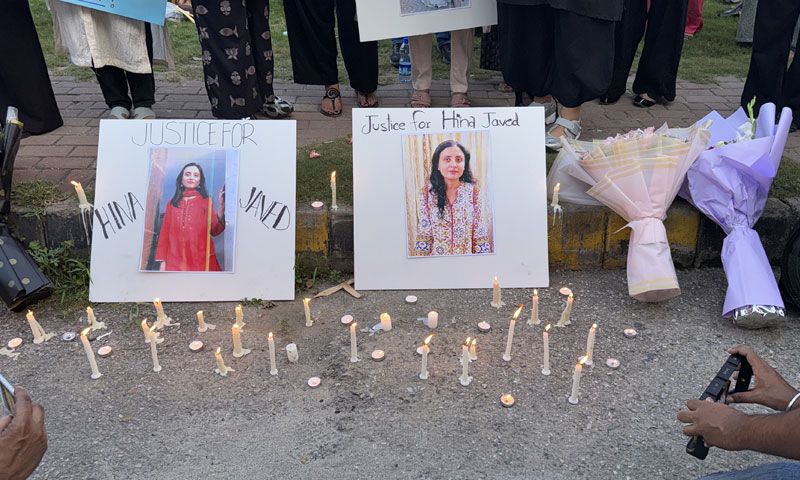
Family, friends and colleagues of Hina Javed — a 45-year-old Rawalpindi woman whose life was cut short after her husband of 10 months, Faisal Asghar Imam, allegedly murdered her — are speaking out after her brother was asked by her in-laws to collect her body, bound and battered, on an early August morning. Since then, Hina’s family and friends have been on the streets and social media, demanding justice for her killing.
“When we don’t call a spade a spade, that’s where the problem lies,” Sabah told HUM News Digital outside the National Press Club, where she and many others stood in solidarity with her cousin and remembered her. “We call these domestic issues, we call these honour killings, we call these misunderstandings. It is femicide. Our culture, education system, society — everything reinforces the idea that women are the lesser gender, they are shameful; they are property. So, how can we combat violence when violence is bred into the culture?” Sabah questioned.
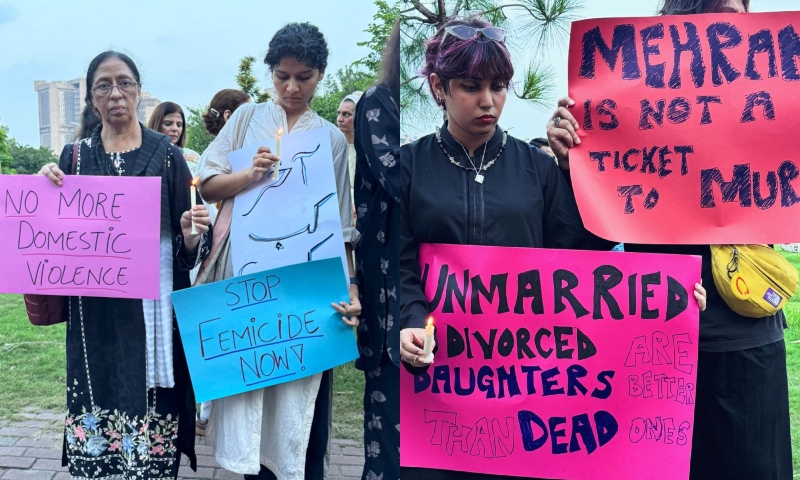
The activist further commented on how the system has continually failed women in Pakistan.
“We need to understand the problem holistically,” Sabah added. “The issue doesn’t just lie at the hands of individual perpetrators, but within a broader system that fails to act. We need to ponder what we have done as a country that is reinforcing these stereotypes against girls and women.”
Statistically? Not much
According to Sahil’s Six Months Cruel Numbers Report for 2026, 3,172 gender-based violence cases were reported during the first six months of the current year. The unreported figures are another story altogether.
Artist Osman Khalid Butt, a relentless voice for justice since the tragic 2021 murder of 27-year-old Noor Mukadam by Zahir Jaffer, emphasised the urgent need for fast-track trials.
“Justice cannot continue to depend on how hard and how long the victim’s family is willing to fight for it,” he told HUM News Digital. “We saw it with Noor Mukadam’s case. It has been five long, arduous years for that particular family; we have had vigils, protests, press conferences every year to keep her story alive in public consciousness. Not everyone has that luxury.”
The artist listed how witness tampering, victim-blaming and putting the onus on everyone but the perpetrator can turn the pursuit of justice into a never-ending battle.
“It cannot take this long for justice to be served,” he said. “Until there’s no certainty of punishment for the culprit, there’s a huge pockmark on us as a society.”
Activist and director of Bolo Bhi, Usama Khilji, concurred.
“The justice system is slow, biased and riddled with loopholes,” he said, adding that it has worsened over the last few years. “With the 26th and 27th amendments now in play, we have seen a massive influence of the executive over the judiciary. With the new amendments enforced, justice has become more distant in this country.”
Usama shed light on how patriarchal the entire justice system remains.
“It’s a reflection of the society,” the activist said. “You have one woman judge in the Supreme Court; you have minimal women’s presence in the high courts.”
Even those gains, according to Usama, are marred by the deep-rooted bias against women in the criminal justice system.
The overall priority of the state, Usama lamented, is not human rights or justice.
“If you see the budgetary allocations towards education, social services, or healthcare, they’re diminishing,” he remarked, adding that the government has different priorities and that they are not directed towards the common man.
“The cases of gender-based violence are increasing with impunity,” Usama said.
“Maybe we need to start teaching from the very beginning; from the day the child is born and how he is socialised. The entire mindset shift has to begin at home.”
Osman, however, believed the time for talks about awareness and social reforms is over.
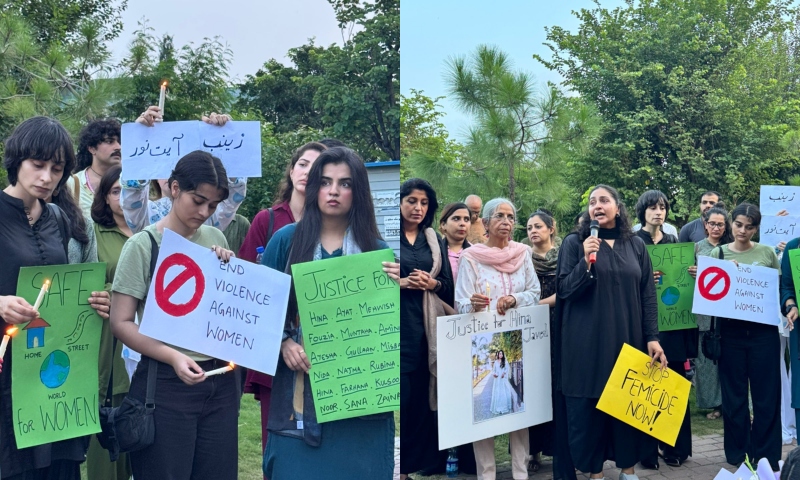
“We’ve been talking about this for ages,” he asserted. “Of course, you have to educate your children; of course, you have to hold your friends and family members accountable. However, the rule of law has to go side by side.”
The onus of it all
The Sahil report revealed that 54 per cent of the incidents occurred in the victims’ own homes, while 12 per cent took place at the perpetrators’ residences, making these the two most common locations for gender-based violence.
In just 14 days of this month, we saw the murders of Hina Javed, Hina Zareef and TikToker Ayesha Gilamana take over social media. Every other day, a new hashtag was created, demanding justice for lives cut short by men who allegedly felt entitled to end them.
The husbands, fathers and brothers that women were told were their protectors are allegedly the murderous culprits behind these cases.
Not just women; even toddlers are unsafe in the country. The cases of Ayat Noor and Aizal Ali, who were allegedly assaulted and killed, also surfaced this month.
Perhaps there is a societal rot we urgently need to address.
Women in Pakistan are not just fighting an uphill battle for survival; they are fighting against the patriarchal notions taught to them from the moment they are born. They are fighting the continuous failure of governance that vows protection for them but delivers impunity in practice.
They are exhausted by the weight of honour, shame and guilt associated with their gender. They are tired of shrinking themselves to preserve the family’s dignity that is enforced upon them. They are drained by the perpetual weaponisation of shame that conditions them to stay silent and mask abuse to ‘make a relationship work’.
Perhaps, for once, the blame for a man killing a woman should rest squarely on the perpetrator, not the victim.
We must do better
We must have men as allies who lend their voices to the movement against violence towards women. Men who will not shy away from holding their friends, colleagues and family members accountable. Men who call out other men who are complicit in harbouring wrongdoers. Men who break the bro-codes to offer safety to women.
The change will begin when men stand side by side with feminists, women and activists demanding impartial outcomes for victims.
We must build a system that genuinely protects women; one that doesn’t demand weekly hashtags, candlelight vigils and angry street protests just to demand basic justice.
A system that doesn’t witness more Noor Mukadams, Hina Javeds, Zainabs, Sara Inams, Ayat Noors and hundreds of unnamed women who are silenced.
There has to be a seismic shift.