
- Reuters
- September 4, 2026
PM Shehbaz, ADB vice president discuss early groundbreaking of ML-1 project
-

- WEB DESK
- September 4, 2026
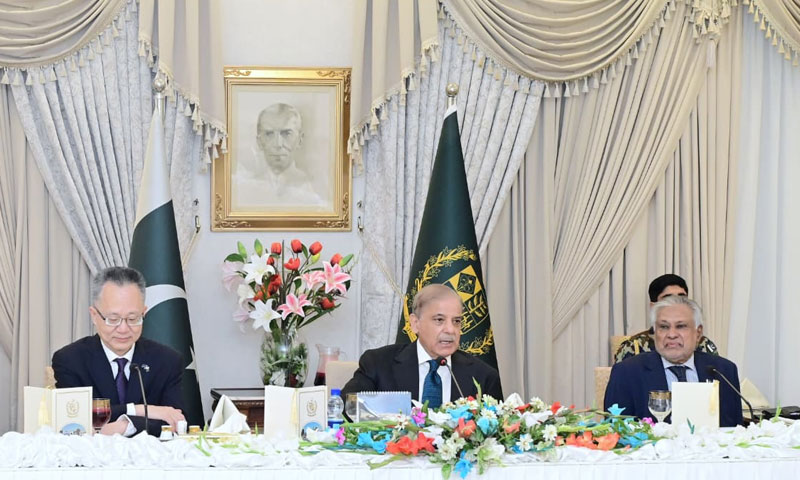
ISLAMABAD: Prime Minister Shehbaz Sharif and Asian Development Bank (ADB) Vice President Yingming Yang on Friday discussed the early groundbreaking of the long-delayed Main Line-1 (ML-1) railway project, with the government describing the Karachi-Peshawar corridor as a key priority for modernising freight logistics and strengthening regional trade.
Yang, the ADB vice president for South, Central and West Asia, met Shehbaz during his first official visit to Pakistan in the role, with the two sides also reviewing priorities under the bank’s new Country Partnership Strategy (CPS) for 2026-2030.
The ML-1 upgrade, which envisages modernising the country’s main railway corridor from Karachi to Peshawar, was a central focus of the discussions.
Shehbaz stressed the need for early groundbreaking of the project, saying its implementation was vital for infrastructure development, improved connectivity and the modernisation of Pakistan’s transport and freight network.
The prime minister said that an upgraded ML-1 would help strengthen freight logistics, facilitate regional trade and support major industrial initiatives.
The meeting also discussed expanding cooperation with the ADB in support of the private sector, energy security and food security, as well as measures to improve export competitiveness and cooperation in artificial intelligence and information technology.
Shehbaz said that Pakistan had successfully navigated a difficult economic turnaround through fiscal, structural and governance reforms.
He said the corrective measures had restored macroeconomic stability and reinforced investor confidence, while major international credit rating agencies, including Fitch, Moody’s and S&P, had upgraded or improved their outlook for Pakistan.
The prime minister said that his government remained committed to long-term economic transformation and was working to remove administrative bottlenecks through dedicated execution task forces.
Shehbaz praised the ADB’s role in Pakistan’s development, particularly its support for urban infrastructure, transport and public service projects.
The meeting reviewed the two sides’ multi-decade development partnership and sought to identify priority interventions under the CPS 2026-2030.
Shehbaz and Yang concluded by reaffirming their commitment to turning the strategy’s priorities into concrete development projects aimed at supporting sustainable economic growth and improving living standards in Pakistan.
ADB launches PPP Monitor
Meanwhile, Pakistan on Friday renewed its push to mobilise private capital for infrastructure and economic development through public-private partnerships (PPPs) and privatisation, saying government spending alone could not meet the country’s growing investment needs.
The ADB, the Ministry of Privatisation and the Public Private Partnership Authority (P3A) organised a National Strategic Dialogue on mobilising private investment, bringing together Finance Minister Muhammad Aurangzeb, Prime Minister’s Adviser on Privatisation Muhammad Ali, ADB Vice President Yingming Yang, representatives of federal and provincial financial institutions and members of the investment community.
The ADB also launched the Pakistan PPP Monitor, a platform designed to consolidate information on PPP projects and investment activity and provide investors and other stakeholders with clearer information about opportunities in the country.
According to the PPP Monitor, Pakistan has completed 154 PPP projects since 1990, involving investment of around $36 billion.
Privatisation Adviser Muhammad Ali said the government had begun shifting the responsibility for economic growth towards the private sector.
“We have started handing over the reins of economic growth to the private sector,” Ali said.
He said Pakistan’s future infrastructure and development needs could not be met through government expenditure alone, and the private sector would have to play a larger role in financing, building and managing infrastructure and economic assets.
Finance Minister Aurangzeb said that the private sector should lead the next phase of Pakistan’s economic development.
“PPPs and privatisation can help bring investment, improve efficiency and create space for greater private-sector participation,” he said.
Yingming Yang welcomed Pakistan’s efforts to strengthen partnerships with the private sector and reaffirmed the bank’s commitment to working with the country to promote large-scale private investment.
Yang also highlighted the importance of the Pakistan PPP Monitor, saying the platform would bring together information on projects and investment activity and help investors and other stakeholders identify opportunities in Pakistan.
The dialogue underscored the government’s broader commitment to mobilising private capital through PPPs and privatisation as it seeks to reduce reliance on public spending and expand investment in infrastructure and economic assets.