- Web
- 19 Minutes ago
PM Shehbaz to reach DC today for Board of Peace summit
-

- Web Desk
- Feb 18, 2026
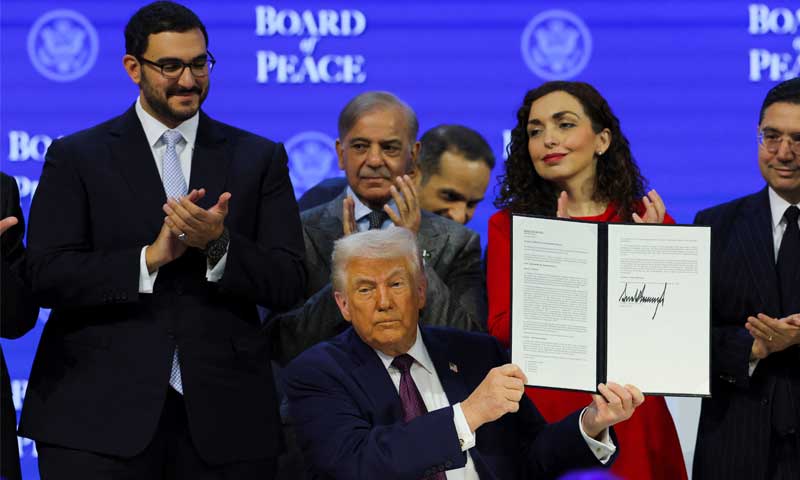
WEB DESK: Prime Minister Shehbaz Sharif is set to arrive in Washington on Wednesday to attend the inaugural global summit of the Board of Peace (BoP), an initiative led by US President Donald Trump that seeks to redefine international conflict management beyond the war in Gaza.
The gathering is expected to focus on three immediate objectives: strengthening the Gaza ceasefire, mobilising financial support for the new platform, including an initial $5bn commitment from Washington, and finalising the institutional contours of the Board, which the US administration envisions as a more agile alternative to existing multilateral frameworks.
Participants are also expected to deliberate on the creation of an International Stabilisation Force (ISF), proposed to secure reconstruction areas and assist in establishing a post-conflict governance structure in Gaza.
Troop commitments and political red lines
For Islamabad, the potential contribution of troops to the ISF has emerged as a key issue. The matter reportedly came up in discussions between Chief of Army Staff Field Marshal Asim Munir and US Secretary of State Marco Rubio on the sidelines of the Munich Security Conference.
As per Dawn, diplomatic sources suggest that while several Muslim-majority countries are willing to support a stabilisation framework, they are reluctant to take on combat roles that could place their forces in direct confrontation with Hamas. Many are also pressing for a clearly defined political pathway towards Palestinian statehood and opposing any unilateral Israeli annexation moves in the West Bank.
The BoP’s proposed structure, a compact, leader-driven forum with an operational arm in the form of the ISF and a dedicated funding pool, reflects Washington’s preference for coalition-based arrangements operating outside the slower processes of the United Nations. This approach has sparked debate among diplomats and scholars over questions of legality, effectiveness and legitimacy.
Pakistan’s former ambassador to the US, UK and UN, Maleeha Lodhi, expressed reservations about the initiative, arguing that the absence of Palestinian representation raises concerns about its credibility. She cautioned that externally imposed governance models risk reinforcing old power hierarchies and suggested Islamabad may have moved too quickly in aligning itself with a body whose long-term direction remains unclear.
Balancing Washington and Beijing
Beyond the Gaza agenda, the visit underscores broader foreign policy considerations. Akbar Ahmed, Ibn Khaldun Chair of Islamic Studies at American University, described the prime minister’s trip as unfolding against both domestic and external pressures.
At home, Shehbaz Sharif must manage a delicate civil-military balance amid mounting security challenges, while also navigating political sensitivities surrounding the continued incarceration and health of former premier Imran Khan.
Internationally, the challenge lies in maintaining equilibrium between Washington and Beijing. Engagement with the Trump administration provides access to American military and economic channels, while China remains a central strategic and economic partner. With tensions persisting along Pakistan’s borders with Afghanistan and India, sustaining this balance is seen as imperative.
For the Trump administration, the summit aims to secure troop pledges for the ISF, attract reconstruction funding and build political backing for a US-led stabilisation model. For many Muslim and Arab states, participation hinges on assurances of a lasting ceasefire, a credible route to Palestinian statehood and a strictly non-combat mandate for any multinational force.
How Prime Minister Shehbaz Sharif navigates these intersecting expectations will shape not only Pakistan’s role at the summit but also its broader positioning in any emerging post-conflict framework for Gaza.
You May Also Like