- Web Desk
- 2 Minutes ago
President Zardari expresses condolences to Iran over Ali Larijani’s death
-

- Web Desk
- 3 Minutes ago
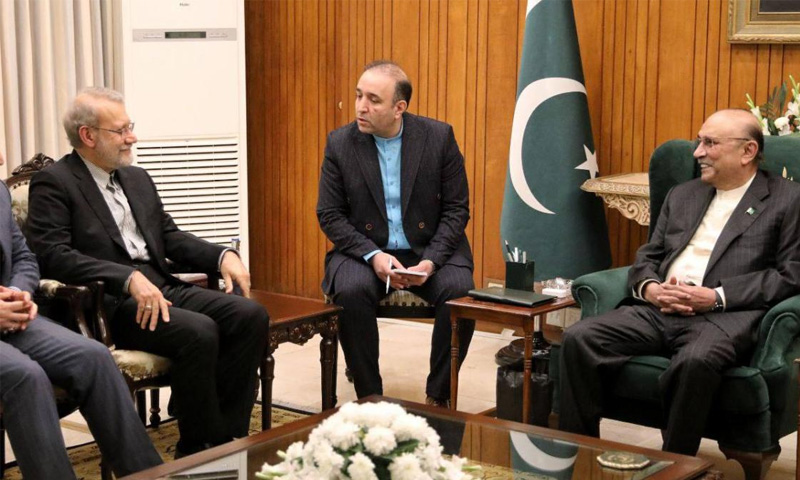
President Asif Ali Zardari has expressed heartfelt condolences to the government and people of Iran over the death of senior Iranian leader Ali Larijani.
According to details shared on Wednesday, the president conveyed his sympathies following Larijani’s death and said Pakistan stood with Iran in this moment of grief. He recalled Larijani’s official visit to Pakistan in November 2025, describing it as an important occasion in bilateral ties.
The president’s message comes as tributes continue to pour in for Larijani, who was regarded as one of Iran’s most influential political figures. His visit to Pakistan last year had drawn significant attention and was seen as a reflection of the close relationship between Islamabad and Tehran.
By remembering that visit in his condolence message, President Zardari reflected upon Larijani’s importance in regional diplomacy and his role in strengthening ties between the two neighbouring countries.
Ali Larijani: Iran’s veteran insider and power broker
Ali Larijani, one of the most prominent figures in Iran’s political and security establishment, died at 67, ending a decades-long career at the heart of the Islamic Republic. He was widely seen as a seasoned insider whose influence stretched across state media, nuclear diplomacy, parliament and the country’s top leadership circles.
Born in Najaf, Iraq, in 1958, Larijani came from a powerful religious-political family with deep roots in Iran’s governing system. His background helped shape a career that placed him in some of the country’s most sensitive and influential roles. Early on, he served in Iran’s Revolutionary Guards, linking him closely to the state’s security apparatus.
Larijani later became head of Iran’s state broadcasting organisation, a post he held for 10 years and one that strengthened his standing within the establishment. In 2004, he moved into a more strategic role as an adviser to Supreme Leader Ayatollah Ali Khamenei. Although he entered the 2005 presidential race and failed to win, his influence only grew.
That same year, he was appointed secretary of Iran’s Supreme National Security Council and became the country’s chief nuclear negotiator. He took a firm stance against Western pressure, especially on the nuclear issue, and opposed any move that required Iran to abandon its nuclear fuel programme in return for incentives.
After stepping down as nuclear negotiator in 2007, Larijani remained central to Iranian politics. In 2008, he became speaker of parliament, serving until 2020. During this period, he built a reputation as a moderate conservative, part of the system, but often seen as more pragmatic than its hardliners.
Though later barred from presidential races in 2021 and 2024, he remained influential. Khamenei appointed him political adviser and a member of the Expediency Council in 2020, ensuring that even outside elected office, Larijani stayed close to the centre of power. His death marks the loss of a figure who long shaped Iran’s political direction from within.
You May Also Like