
- WEB DESK
- October 24, 2026
Punjab finance minister presents Rs5.85tr budget amid loud opposition protest
-

- Shafiq Sharif
- June 16, 2026
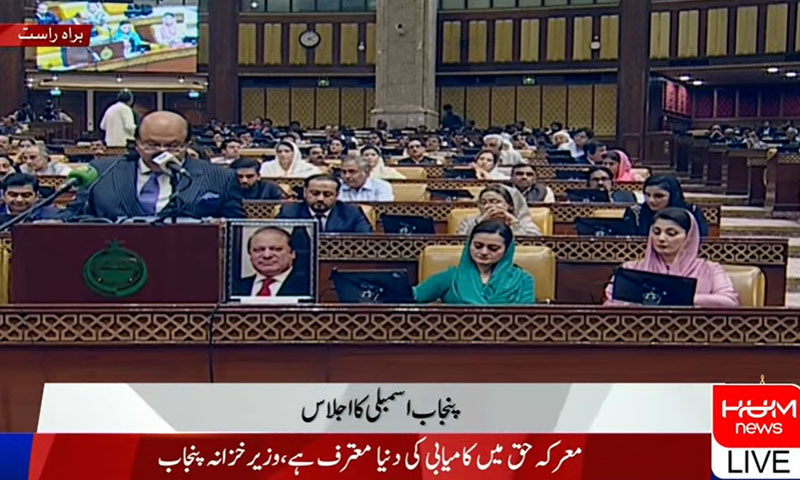
LAHORE: LAHORE: Punjab Finance Minister Mujtaba Shuja-ur-Rehman presented a Rs5.85-trillion budget for the fiscal year 2026–27 in the Punjab Assembly amid chaotic scenes and aggressive protest by opposition lawmakers on the assembly floor.
As soon as Rehman commenced his budget speech, opposition members rushed to the well of the house, gathering directly in front of the speaker’s dais. The agitated lawmakers chanted anti-government slogans and disrupted proceedings, attempting to drown out the finance minister’s address.
Earlier in the day, the provincial cabinet, chaired by Chief Minister Maryam Nawaz Sharif, formally reviewed and approved the draft budget proposal, clearing it for parliamentary tabling.
According to official budget estimates, the total expenditure for the province has been set at over Rs5,850 billion.
From the total fiscal package, the provincial government has allocated a development outlay of Rs752 billion to fund infrastructure, social sectors, and regional growth initiatives over the coming fiscal year.
Despite the persistent desk-thumping and sloganeering from the opposition benches, the finance minister continued to read the fiscal proposals, which align with the broader macroeconomic targets set by the federal government.
Rehman declared that the government had successfully protected development spending despite national economic headwinds. To signal austerity, he announced that the provincial cabinet had accepted a voluntary reduction in their own ministerial salaries.
“Under the leadership of Chief Minister Maryam Nawaz Sharif, the government has taken revolutionary steps to rescue the economy and deliver public services directly to the doorsteps of citizens across every district and tehsil,” Rehman said.
He highlighted that Punjab had acted as the “elder brother” in stabilizing national defense and macroeconomics by handing over Rs546 billion to the federal government as a provincial cash surplus.
“Punjab is the backbone of Pakistan,” Rehman said, adding that the provincial government had successfully generated over 400,000 merit-based public sector jobs within a record period.
Big-Ticket Infrastructure and Transit Spending
Out of the total budget size of Rs5,903 billion, the government has set aside Rs752 billion strictly for its Annual Development Programme (ADP).
Among the premier urban and rural connectivity projects, the budget documents outline a massive Rs168-billion rupee plan to purchase 2,000 e-buses for tehsil headquarters, alongside an allocation of Rs26.60 billion to establish mass transit systems in the industrial hubs of Faisalabad and Gujranwala.
The finance minister said that another Rs10 billion have been allocated to rehabilitate aging railway tracks across the province, while the extensive canal irrigation network will receive Rs61.14 billion for upgrades.
Social Safety Nets, Housing, and Populist Initiatives
He said that the fiscal plan introduces a series of targeted relief cards and social programmes strongly backed by the Pakistan Muslim League-Nawaz (PML-N).
He said that the “Apni Chhat Apna Ghar” housing scheme has been allocated Rs300 billion as part of a major interest-free loan initiative aimed at expanding affordable housing.
The “Suthra Punjab” cleanliness initiative has been allocated Rs170 billion to improve waste management systems across towns and cities, Rehman said.
For social protection, he said, Rs40 billion have been set aside for ration cards to subsidise essential food items.
Under social security measures, Rs5 billion have been allocated for the Himat Card for persons with disabilities, while Rs40 billion have been earmarked for a newly structured social security food card. In addition, he said, Rs4 billion have been proposed for a Minority Card initiative.
For religious and community welfare, the budget proposes Rs18.50 billion for honorariums to mosque prayer leaders (Aima) and Rs5 billion for the restoration of historic and religious heritage sites.
Separately, the finance minister said, Rs1.70 billion have been allocated for the Chief Minister’s Dhee Rani programme, a mass marriage subsidy initiative, Rs2.06 billion for Aafiat old age homes and Rs19.34 billion for the Sahulat Bazaar Authority to help control commodity inflation.
Education, Healthcare, and Youth
Rehman said that the education department has been allocated a combined total of Rs750 billion, breaking down into a Rs686.80-billion non-development (salary and operational) fund and a Rs63.30-billion development wallet.
Included in the educational funding is a Rs4-billion school meal programme, a Rs6.90-billion project to install 244 IT labs in colleges, and Rs40 billion to establish the Nawaz Sharif and Maryam Nawaz Centers of Excellence and Laboratories.
For higher education, he said, Rs550 million have been proposed to set up the Dera Ghazi Khan Women University.
The healthcare sector has been allocated Rs500.62 billion to upgrade hospitals and treatment access.
Meanwhile, the finance minister said, the Youth Development Initiative will receive Rs39 billion rupees, backed by sports infrastructure expansion including the Rs50-billion Maryam Nawaz Sports City in Lahore and Rs6.60 billion for upgrading diverse sports venues.
Climate and New Industries
Addressing Punjab’s recurring air pollution crisis, the minister noted that Rs123 billion was spent on smog mitigation during the current fiscal year.
For the upcoming cycle, he said, the government announced to launch a vehicle scrappage scheme to buy back old, high-polluting vehicles from the roads.
In a bid to boost the creative economy, the government has proposed an ambitious Rs55-billion plan to introduce a “Film City” programme in the province.
Another Rs990 million have been allocated to set up an Automated Technologies Center in the Shahdara locality of Lahore.
The provincial police and security infrastructure will receive Rs252 billion under the Safe Punjab Vision, Rehman said.
Agriculture and Green Energy
Agriculture, the traditional mainstay of Punjab’s economy, the minister said, will receive Rs132.54 billion covering farming, livestock, and aquaculture. This includes Rs10 billion for the Kisan Card programme providing subsidies to farmers, and Rs16.90 billion for a Green Tractor program to modernize farm machinery.
Government Employees and Revenue Targets
The budget has proposed a 7 per cent salary increase for government employees, setting aside Rs638.93 billion for public sector wages, while retired employees are tipped to receive a Rs3.5 per cent increase in pensions.
To fund this massive spending blueprint, Punjab relies heavily on federal transfers through the National Finance Commission (NFC) award, which is estimated to provide Rs4,390.94 billion next year.
Concurrently, the province has increased its total revenue collection target to Rs1,209.86 billion for the new fiscal year, reflecting an upward revision in fiscal expectations.
Revenue collection agencies have been assigned steep targets to meet the overall goal.
The Punjab Revenue Authority (PRA) has been set a target of Rs528.50 billion, while the Excise and Taxation Department is expected to collect Rs124.00 billion during the period.
Similarly, the Board of Revenue, responsible for land and stamp duty-related taxes, has been tasked with collecting Rs86.19 billion. Non-tax revenue has been estimated at Rs461.17 billion for the fiscal year.
The finance minister expressed high confidence in its fiscal machinery, stating that the province is on track to achieve 99% of its revenue targets for the current fiscal year, with total tax and non-tax receipts hitting 820.16 billion rupees by June 30.