- Web Desk
- Jan 31, 2026
Punjab seeks constitutional amendment to protect local governments
-

- Web Desk
- Oct 31, 2025

ISLAMABAD: The Punjab Assembly has forwarded a resolution passed earlier by the provincial assembly to the federal government recommending an amendment to Article 140-A of the Constitution of Pakistan to empower and protect local governments.
The resolution, passed unanimously during the Punjab Assembly’s session on October 29, has also been sent to National Assembly and Senate secretaries.
The resolution, jointly moved by PML-N’s Ahmad Iqbal and PPP’s Ali Haider Gilani, seeks to add a new chapter to the Constitution defining the tenure, powers, and responsibilities of local governments.
It calls for constitutional amendment making it mandatory to hold local government elections within 90 days of the dissolution of a district or tehsil council, and requiring the first session of the elected body to be convened within 21 days.
It also stresses ensuring financial, administrative, and political authority for local governments to effectively resolve public issues at the grassroots level.
The resolution says that since the 18th Constitutional Amendment, local governments in Punjab remained functional for only two years, disrupting democratic continuity.
It also cites the Supreme Court’s observation that local governments are a fundamental pillar of democracy, pointing out that globally such systems enjoy constitutional protection. The Election Commission of Pakistan had also proposed amending Article 140-A in 2022.
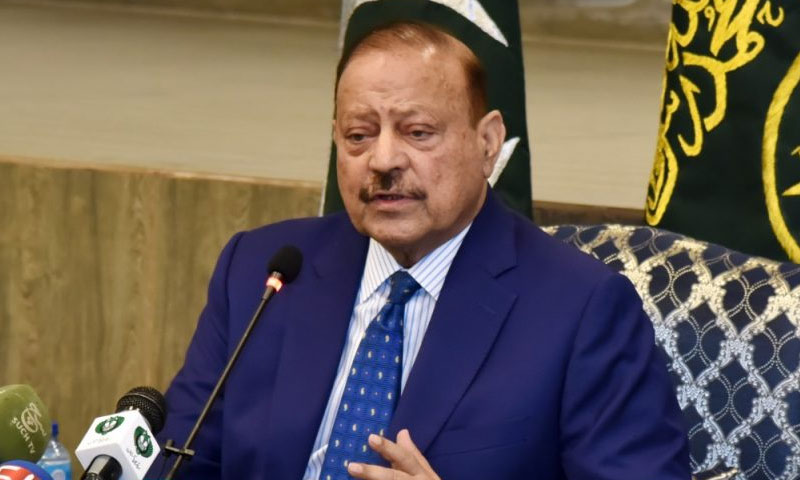
Speaking at a press conference on Friday, Punjab Assembly Speaker Malik Muhammad Ahmad Khan called for giving constitutional protection to the local government act.
He said, “The resolution passed by the Punjab Assembly seeks to protect the tenure of district governments and recommends a new constitutional amendment for which the National Assembly and Senate must play their role.”
He said that over the past 50 years, local governments had never achieved stability, and that all political parties — including the PML-N, PPP, and PTI — should support this amendment.
“The absence of district governments weakens the state’s social contract, and in the past, provincial governments have dissolved local bodies due to weak legislation,” he said
Background of Article 140-A
Article 140-A of the Constitution, introduced in 2001 during General Pervez Musharraf’s tenure, directs provincial governments to establish local government systems through law and to transfer political, administrative, and financial authority to elected representatives. However, the details of this framework depend on provincial laws, allowing repeated changes to the tenure and powers of local governments.
Critics argue that the current form of Article 140-A is inadequate because it enables provincial governments to dissolve local systems at will, thereby weakening the roots of democracy. The Punjab Assembly’s resolution aims to fill this gap and ensure continuity of democracy at the grassroots level.
Punjab Local Government Act 2025
The resolution is part of the Punjab government’s ongoing reform efforts. In March 2025, the Punjab Assembly passed the “Punjab Local Government Act 2025”, which was approved on March 12 and notified on October 23.
Under the act, a new structure was introduced, replacing district councils with municipal corporations, town municipal administrations, and union councils.
The law empowers local bodies to rename roads and public places, collect and transfer taxes on urban properties, and manage municipal affairs. However, critics note that since it is a provincial law, future governments can amend or repeal it without constitutional protection — as has happened in the past.
Against this backdrop, the resolution urges the federal government to grant constitutional status to the local government system to prevent provincial interference and ensure efficient delivery of public services.
Speaker Malik Ahmad Khan termed this a “fundamental responsibility of the state,” calling on all political forces to take part in the process. Experts believe that if the federal government acts on this recommendation, it will strengthen devolution of power to the grassroots level — a vital step toward Pakistan’s sustainable development.
You May Also Like