
- Reuters
- October 27, 2026
Rana Sanaullah says no demands could be accepted by holding state hostage
-

- WEB DESK
- October 7, 2026
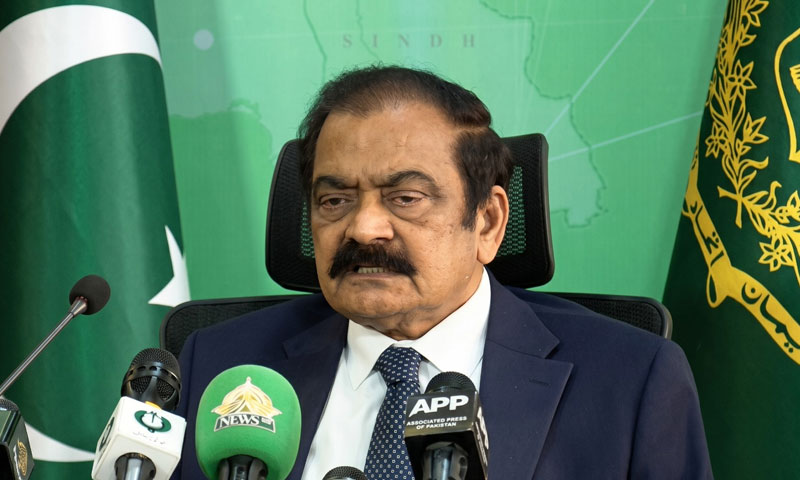
ISLAMABAD: Adviser to Prime Minister on Political Affairs Rana Sanaullah on Tuesday said that the government’s doors remained open for negotiations but warned that no demands could be accepted by holding the state hostage or creating political instability, urging political parties not to place personal agendas above the national interest.
His comments come as the Pakistan Tehreek-e-Insaf’s long march on Islamabad entered its fourth day on Wednesday, with the convoy set to move into Khyber district from Mattani on the outskirts of Peshawar.
Speaking at a press conference in Islamabad, Sanaullah said that Prime Minister Shehbaz Sharif had already invited the opposition to sit for talks and that all outstanding issues should now be resolved through dialogue.
He said the government had repeatedly tried to engage the Khyber Pakhtunkhwa government and the PTI, including through negotiations over the party’s planned march on Islamabad.
However, he accused the PTI of promoting a culture of abuse, intolerance and political confrontation, saying the party had pursued the objective of besieging Islamabad since 2014 and was now using the resources of the Khyber Pakhtunkhwa government for that purpose.
Sanaullah said that the political tolerance that should underpin democratic politics had been eroded, adding that the PTI had pursued its political agenda at the expense of broader national interests.
‘KP government using provincial resources for Islamabad march’
Referring to the PTI’s long march, Sanaullah said that the Khyber Pakhtunkhwa government had been mobilising people through rallies, slogans and drums, urging them to gather and move towards Islamabad.
He said that the provincial government’s conduct was particularly troubling when security personnel and civilians from the province were being killed in terrorist attacks.
“On one side, the bodies of martyrs are lying, while on the other, the entire provincial government was beating drums and raising slogans, urging people to gather and march towards Islamabad,” he said.
Sanaullah said the victims included customs officials, police personnel, civilians and members of the armed forces, stressing that they were residents of Khyber Pakhtunkhwa rather than supporters of any particular political party or province.
He said that a large number of personnel of the armed forces who had been martyred in the fight against terrorism also belonged to Khyber Pakhtunkhwa.
The adviser claimed the KP government’s mobilisation drive had failed to attract significant public support, saying the marchers had not been able to gather more than a few thousand people at any location since the march began on October 4.
He also questioned the arrangements at camps set up for the protesters, saying millions, even tens of millions, of rupees had allegedly been collected for the camps but basic facilities such as mats for people to lie on were not available.
Sanaullah said the provincial government had repeatedly been asked to reconsider its approach and focus on governing and serving the people.
“But they say their agenda is not governance or the welfare of the people,” he said, referring to the KP government, adding that its stated objective was driven by its commitment to PTI founder Imran Khan.
He said a province with a population of around 40 million people should not be subjected to instability because of an individual or political agenda.
Government rejects PTI claim over terrorism policy
Sanaullah also sought to clarify what he described as a misleading interpretation of the issue that led to a deadlock in talks between the government and PTI.
He rejected PTI leader Salman Akram Raja’s claim that the government had refused to incorporate the opposition’s viewpoint into its policy on counterterrorism.
According to Sanaullah, it was incorrect to suggest that the government had told the PTI that it had no role in the formulation of the counterterrorism policy.
“The counterterrorism policy already exists and is being implemented,” he said.
He said the policy was based primarily on intelligence-based operations being conducted by the armed forces and law-enforcement agencies in Khyber Pakhtunkhwa.
Sanaullah said security forces were conducting these operations with “great courage” and making sacrifices to eliminate militants responsible for attacks on law-enforcement personnel and civilians.
He said the PTI had repeatedly expressed opposition to such operations, questioning how intelligence-based operations against terrorists could be opposed when the targets were militants attacking Pakistani citizens and security personnel.
He referred to attacks on customs officials and police personnel, as well as an attack on a passport office and a suicide bombing at a jirga in Swat where civilians were present.
“These intelligence-based operations are against these terrorists. How can they be stopped and how can anyone oppose them?” he asked.
Sanaullah categorically rejected the impression that a new military operation was being launched in Khyber Pakhtunkhwa or that fresh internally displaced persons (IDPs) would be created.
He said Field Marshal Asim Munir and the federal government had already made it clear that there would be no new displacement of people.
He said intelligence-based operations would continue and expressed confidence that terrorists would eventually be eliminated from Pakistani territory.
Pakistan’s demand from Afghanistan
Sanaullah said the second major issue discussed in the negotiations concerned Afghanistan.
He said Pakistan’s demand was straightforward: Afghan territory should not be allowed to be used for terrorism against Pakistan.
He said Pakistan had sought the help of friendly countries, including Saudi Arabia, Qatar, China and Türkiye, to persuade the Afghan regime to provide assurances that its territory would not be used for terrorist activities against Pakistan.
According to Sanaullah, these countries had made efforts to convince the Afghan authorities, but the Afghan regime had not agreed to provide the required guarantee.
He said Defence Minister Khawaja Asif had publicly spoken about the issue and had travelled to Istanbul twice for negotiations, while representatives of Pakistan’s military leadership had also participated in the process.
Sanaullah said the Afghan authorities had acknowledged the evidence presented by Pakistan regarding the use of Afghan territory for terrorist activities, but had nevertheless refused to provide a guarantee that such activities would not take place.
He said Pakistan’s policy was that if training camps or other activities existed on Afghan soil that could subsequently result in terrorism inside Pakistan, Islamabad reserved the right to neutralise such threats.
Pakistan, he added, had already conducted limited operations based on evidence.
He said the policy was based on Pakistan’s experience of dealing with Afghanistan, the Taliban, the Tehreek-e-Taliban Pakistan (TTP) and other groups over the past four decades.
Sanaullah rejected the suggestion that the PTI or the KP government had been excluded from discussions on the policy.
He said the policy was based on decades of experience and enjoyed a national consensus, arguing that only the PTI was seeking to place its political interests above the national interest.
‘KP CM held only one Apex Committee meeting in 11 months’
Sanaullah said the role of the KP government was critical to the success of the counterterrorism policy, particularly once security forces had cleared areas of militants.
He pointed out that the provincial Apex Committee was headed by the chief minister and questioned the participation of KP Chief Minister Sohail Afridi in the committee’s proceedings.
According to Sanaullah, Afridi had held only one Apex Committee meeting during his 11 months in office.
He said Afridi had not only failed to hold regular meetings but had also not used the forum to raise objections to the existing policy or suggest improvements.
Sanaullah said Afridi had initially been reluctant to attend even that meeting and had been persuaded to participate.
He questioned how the provincial government could demand greater consultation on counterterrorism policy while remaining absent from the very forum established for coordination on security matters.
“The whole issue is already under consideration. Everything is being considered and everyone is being consulted,” he said.
He said the KP government’s provincial assembly resolution had also been taken into consideration, rejecting the impression that its proposals had simply been ignored.
‘Security forces clear areas, civil administration must hold them’
Sanaullah said that the counterterrorism strategy required security forces to clear areas of militants through intelligence-based operations, after which the responsibility for maintaining law and order should be transferred to the civilian administration, police and Counter Terrorism Department (CTD).
He said this second part of the strategy was not being adequately implemented in Khyber Pakhtunkhwa.
“When the armed forces and other law-enforcement agencies clear an area and move forward, the same situation returns three or six months later because there is no effective civil administration presence,” he said.
Sanaullah said five districts in the province did not have police stations at all, describing the situation as unacceptable.
He asked how the government could guarantee the protection of life and property if basic policing infrastructure was absent.
He said around 17,000 police posts were vacant in the province and claimed there had been no adequate recruitment or training in recent years.
The CTD, he said, had around 3,300 personnel, of whom only 25 were permanent while the remainder were working on an ad hoc or contractual basis.
He also alleged that police and the CTD were not being provided with adequate budgets.
Sanaullah said police stations lacked proper buildings and equipment and that the police had sought funds to secure their facilities and procure weapons but had not received the required budget.
He described the CTD’s funding situation as effectively “zero budget”, questioning who would protect the lives and property of millions of people if the provincial government did not fulfil its responsibilities.
“Who will do this job? Who will protect the lives and property of millions of people? Who will answer for this?” he asked.
‘Police making sacrifices in fight against terrorism’
Sanaullah praised the KP police for what he described as its improved performance in the fight against terrorism, saying police personnel were also being killed while performing their duties.
He said the current inspector general of police in the province deserved appreciation for his efforts.
He said the sacrifices of security personnel should be viewed against the backdrop of the young age of many of those killed in the fight against terrorism.
Sanaullah referred to soldiers and officers in their early 20s and 30s who had sacrificed their lives, saying some had been due to marry within months while others had left behind infants.
He said these personnel had sacrificed their present for the security of the country’s future.
Written commitment sought from KP government
Sanaullah said the government’s demand during negotiations was that the KP government should fulfil its own constitutional and administrative responsibilities in the fight against terrorism.
He said a draft discussed during the negotiations had proposed a written agreement under which the provincial government would undertake to strengthen and support the civilian administration, police and CTD.
Under the proposed arrangement, he said, security forces would clear areas through intelligence-based operations, while the civilian administration would subsequently take responsibility for maintaining peace and law and order.
The purpose, he said, was to ensure that areas cleared by security forces remained secure and that militants did not return after the military operation ended.
Sanaullah argued that the absence or weakness of the provincial administration was one of the main reasons for the gaps in the implementation of the counterterrorism policy.
He said the sacrifices of armed forces personnel and law-enforcement officials could not continue indefinitely without the civilian administration taking responsibility for maintaining security after areas had been cleared.
‘Political instability cannot deliver development’
Sanaullah reiterated that the government remained willing to negotiate and resolve political disputes through dialogue, but said political instability could not be allowed to take precedence over national security and public welfare.
He said the government had attempted to engage the KP government and PTI and had also held talks with them in an effort to address their concerns.
However, he maintained that personal or party political objectives could not be allowed to override the national interest.
Sanaullah said political stability was essential for development and that no country could achieve meaningful economic and social progress without political stability.
He called for the provincial government to focus on governance, strengthen civilian institutions and fulfil its role in the counterterrorism framework rather than using provincial resources for political confrontation in Islamabad.
You May Also Like


- WEB DESK
- October 27, 2026
Punjab govt moves to provide life insurance cover to employees
- AFP
- October 27, 2026
