- Web Desk
- Mar 30, 2026
Reclaiming public spaces: why Punjab’s crackdown on smoking matters
The Punjab government’s recent decision to enforce the 2002 Prohibition of Smoking and Protection of Non-Smokers Health Ordinance across the province is a landmark public health move. Under this directive, smoking will be banned in all enclosed public places, including school and college campuses, government offices, hospitals, shopping malls and public transport, and vendors will face tough new penalties. Anyone caught smoking or selling cigarettes or other tobacco products in restricted areas can be fined up to Rs.100,000, and repeated violators may have their businesses sealed. Schools and colleges have been directed to appoint compliance officers to educate students about the ban and ensure it is followed. These measures send a clear message: the era of allowing casual smoking (and now vaping or tobacco and nicotine products use) in public is reaching an end.
This crackdown revives a law that has long been on the books but was seldom enforced. The 2002 ordinance already forbids smoking in virtually all indoor public spaces, and specifically bans tobacco in the immediate vicinity of schools and universities. For example, it prohibits sales, distribution or advertising of cigarettes within about 50 meters of any educational institution. A 2020 regulatory order (SRO 72(I)/2020) even banned all forms of tobacco advertising and display at points of sale, in line with international best practices. Yet despite these strict rules, enforcement was lax: students could still see classmates smoking on campus, and roadside shops sold cigarettes, hookah supplies, and even e-cigarette pods near school gates. That situation must now change.
It is also heartening that Punjab is not acting alone in this fight. Other provinces and cities have taken bold anti-tobacco steps that complement this crackdown.
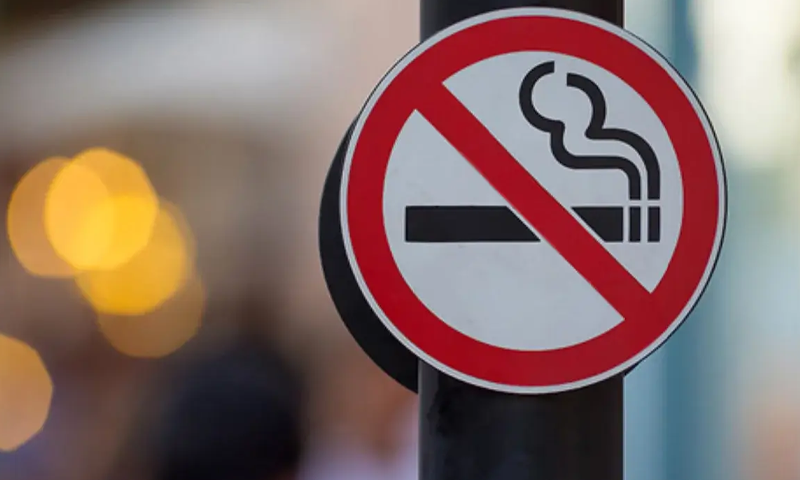
To make the law effective, the government has mandated that all tobacco retailers visibly post the official health warning posters and “No Smoking” signs at their outlets. Inspectors will patrol schools, buses, hospitals, and restaurants looking for infractions, and any sale of hookah, e-liquids, or nicotine pouches in restricted areas will draw heavy penalties. The 50-meter buffer zone around schools is being enforced in full: any shop violating it faces immediate action. Transport authorities will stamp every public bus and taxi with a “No Smoking” sticker and ticket smokers on the spot. In effect, anyone who tries to light up in a banned area will be caught and punished. Emphasizing educational institutions is crucial, since studies show most adult smokers first tried nicotine as teens, often on school or college grounds.
This step by the Punjab government is therefore extremely praiseworthy and long overdue. Health experts estimate that tobacco causes heart disease, lung cancer, and other illnesses, which kill well over one hundred thousand Pakistanis each year. Protecting students and non-smokers from these risks is vital. Many countries long ago enacted similar laws: for example, in Ireland, the UK, and dozens of other nations, smoking is banned in all schools, workplaces and restaurants, and violations are strictly penalized. Punjab is now joining that global trend by finally acting on its own and the federal laws. The provincial leadership and education officials should be lauded for this resolve.
Of course, the tobacco and vape industries will not take this lightly. The legal challenges around vaping illustrate this well. When Punjab announced its vape ban and ordered shops closed, dozens of retailers petitioned Lahore’s High Court. In late June 2025, the court issued an interim order allowing vape stores to reopen pending further review. Ultimately, the judges noted that without an explicit ban against e-cigarettes and vapes, the administration’s action had no firm legal basis. This episode underscores a basic point: declaring a policy is one thing, but it must be backed by clear legislation. Punjab’s assembly should therefore codify bans on all new nicotine products so that future court rulings cannot undermine public health.
It is also heartening that Punjab is not acting alone in this fight. Other provinces and cities have taken bold anti-tobacco steps that complement this crackdown. Khyber Pakhtunkhwa, for instance, recently used emergency powers to impose a 60-day ban on vape sales near schools and to anyone under 21 years of age. KP is moving to enact comprehensive laws covering hookah, naswar, and other smokeless tobacco products. Sindh province has banned indoor hookah lounges and requires graphic warning signs in public areas, besides a stringent ban on Gutka. Even in Islamabad, licenses are mandatory for every tobacco vendor, and the city conducts frequent raids, showing that strict enforcement works in our cities as well. Together, these efforts show that Pakistan as a whole is moving toward international standards of tobacco control.
Punjab’s approach aligns with international benchmarks. The WHO recommends that all public places be smoke-free, combined with public education campaigns and support for quitting. Many countries pair smoking bans with steep taxes and plain-packaging rules to discourage use. For example, Australia and the UK now require plain cigarette packaging with large graphic warnings; Pakistan already has pictorial warning stickers covering 60% of each pack’s surface, although, following Nepal’s good example, this needs to be increased to 100%. Some nations are even phasing down nicotine levels to aim for a smoke-free generation. Others, like Singapore and India, ban e-cigarettes entirely. These measures show how a comprehensive, multi-pronged policy can reduce smoking. Punjab’s current actions fit well within this proven strategy.
To make this crackdown lasting, the government must keep up the pressure. Enforcement cannot be a one-time blitz. Police, health officials, tobacco control advocates, and excise officers should continue regular inspections of shops near every school, college, and bus terminal. Teachers, students, and parents can help by reporting any violations they see. The government could launch a hotline or mobile app for citizens to alert authorities about illegal sales or public smoking. On the policy front, lawmakers must explicitly ban e-cigarettes, nicotine pouches, and heated tobacco products. That will prevent future court cases from rolling back these bans. In the meantime, the health department should expand smoking-cessation programs so that addicted smokers have help to quit.
The WHO recommends that all public places be smoke-free, combined with public education campaigns and support for quitting.
Punjab’s firm enforcement of the anti-smoking law is an exemplary step that deserves high praise. By reclaiming our schools, offices, buses, and parks from tobacco smoke, the government is putting people’s health first. Citizens, especially parents, teachers, and young people, should support this campaign and help keep violators in check. If this momentum is sustained, fewer youngsters will ever pick up smoking or vaping, and over time, we should see a drop in cancer, heart disease, and other smoking-related ailments. The message is clear: Punjab will no longer tolerate a culture of smoking in public. The government deserves our congratulations for taking this bold step, and we must ensure the effort continues until our province is truly smoke-free.
You May Also Like