- Alishba Khattak | Waqas Buneri
- October 7, 2026
Rubio says Iran cannot charge transit fee in Strait of Hormuz
-

- Zafar Ali
- June 25, 2026
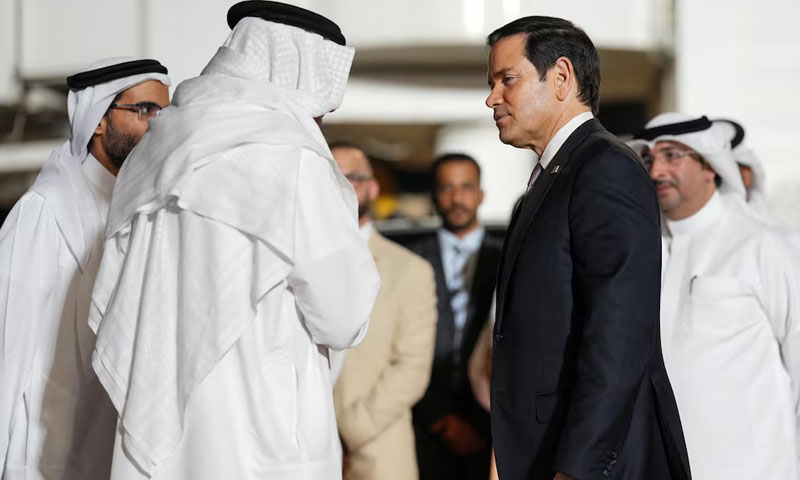
MANAMA: US Secretary of State Marco Rubio said on Thursday that the Strait of Hormuz is an international waterway that does not belong to any single nation, flatly rejecting proposals by Tehran to levy transit fees on commercial shipping through the vital global energy chokepoint.
Speaking to reporters in Bahrain at the conclusion of a high-stakes Middle East diplomatic tour, Rubio emphasised that the proposal to impose tolls on vessels transiting the strait lacks any backing from Gulf Arab nations.
He said that the Sultanate of Oman has also explicitly aligned with Washington, confirming that no transit fees will be enforced.
“The US president’s stance on the Strait of Hormuz is clear,” Rubio stated, warning that Washington will not tolerate any violations of the preliminary maritime agreements by Iran.
“If Iran wants a good deal, the United States is ready, but we expect Tehran to fulfill its promises.”
The secretary of state’s media briefing highlighted several critical updates on regional security and global diplomacy.
Rubio clarified that his constructive meetings with Gulf Cooperation Council (GCC) leaders did not include any discussions regarding regional financial contributions toward a proposed Iranian reconstruction fund.
Rubio said that Thursday marks the third consecutive day of ongoing peace negotiations between Israel and Lebanon, backed by American efforts to secure lasting peace.
Aid Dispatched to Venezuela
Rubio announced that the US has dispatched specialised search, rescue, and humanitarian assistance teams to Venezuela during its current crisis after the two earthquakes left more than 160 people dead and hundreds others injured .
On broader Western security alliances, he said that US President Donald Trump is scheduled to attend the upcoming NATO summit, while also hailing Washington’s robust bilateral relations with Italy.
Reassuring Sceptical Gulf Partners
Rubio’s remarks in Manama — the headquarters of the US Navy’s Fifth Fleet — concluded a grueling three-day tour through Kuwait, the United Arab Emirates and Bahrain.
The mission was explicitly aimed at selling the Trump administration’s preliminary framework agreement with Iran to deeply skeptical regional allies.
Gulf monarchies have openly feared that the draft accord — which lacks restrictions on Iran’s ballistic missile programmes —would leave them vulnerable to a financially liberated Tehran, especially after several GCC states suffered direct Iranian airstrikes during the recent war.
Following a high-level meeting with the King of Bahrain, Rubio sought to douse these persistent anxieties, reiterating that Washington places the highest premium on its traditional partnerships.
“Our meetings with Gulf leaders were highly positive and focused extensively on mutual cooperation and regional stability,” Rubio said. “We are not going to do anything that undermines the security of our long-standing allies in this region.”
Navigating Flaws in the Peace Accord
The diplomatic offensive comes as the US-Iran framework faces intense domestic and international scrutiny due to conflicting accounts emerging from Washington and Tehran.
While President Trump asserted that Iran had agreed to indefinite nuclear inspections, Tehran has publicly denied making such a concession.
Further friction surrounds a proposed $300 billion reconstruction fund hinted at in the draft memorandum of understanding (MoU).
While the preliminary text suggested regional states might help shoulder the financial burden, Rubio utilised his final press briefing to formally insulate Gulf allies from those costs for the time being.
With parallel Israel-Lebanon negotiations advancing into their third day, Rubio maintained that the overarching goal of US foreign policy is to establish an enduring regional equilibrium, but warned that any future normalized relationship with Iran remains contingent on absolute compliance with international maritime laws.