- Web Desk
- Mar 24, 2026
Russian embassy accuses Frontier Post of pushing ‘Western propaganda’
-

- Web Desk
- Nov 07, 2025
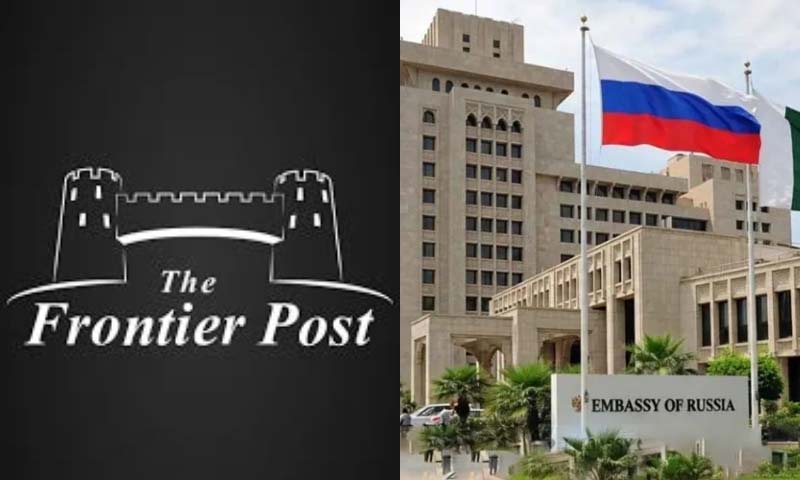
ISLAMABAD: The Russian Embassy in Pakistan has accused the English-language newspaper The Frontier Post of promoting Western propaganda, describing its articles as “anti-Russia and biased.”
Criticising the newspaper’s management, the embassy said that “a team coloured in American hues is responsible for selecting international news and consistently favours writers who hold anti-Russian views and are critical of Russia’s foreign policy and President Vladimir Putin.”
“We have taken note of a series of anti-Russian articles published in the English-language Pakistani newspaper *The Frontier Post*. To start with, we would like to emphasise that this periodical can hardly be called ‘Pakistani,’ given that its global news service is headquartered in Washington. This Americanised team is responsible for selecting articles on the international agenda and invariably gives preference to ardent Russophobes and critics of Russian foreign policy and President Vladimir Putin,” the statement said.
It added: “Recently, it has been impossible to find a single article in the international section of the newspaper that portrays Russia or its leadership in a positive or even neutral light. We respect freedom of speech and the editorial board’s right to publish authors with different points of view. However, the current barrage of anti-Russian articles containing standard Western propaganda and lacking any alternative viewpoint makes one wonder whether the editorial board’s policy is based on a political agenda promoted by anti-Russian forces rather than on freedom of speech.”
According to the Russian Embassy, “It is bewildering that the newspaper, which devotes an entire section to news about Afghanistan, completely ignored the Moscow Format of Consultations (October 7, 2025) — an event that received decent coverage in the local media. This approach further highlights the Russophobic nature of the Westernised editorial office and demonstrates its disregard for Pakistan’s efforts to promote its approach to regional issues on leading specialised platforms.”
It further stated: “As for the anti-Russian theses in the newspaper, the editorial staff shows little originality, mindlessly copying standard Western propaganda such as ‘weak economy,’ ‘vulnerability to sanctions,’ and ‘military superiority of the West.’ Washington-based *Frontier Post* journalists manipulate facts to portray Russia as a vulnerable country on the brink of economic collapse, thereby justifying new Western sanctions that ultimately harm the economies of the countries imposing them.”
The embassy added: “Despite facing enormous external pressure, which is unprecedented in the history of any country, the Russian economy has demonstrated steady progress. In 2024, Russia’s GDP increased by 4.1 per cent, with certain sectors, such as manufacturing, growing by up to 8.5 per cent. Russia’s unemployment rate stands at 2.5 per cent, and the expected average annual inflation rate for 2025 is 6.5–7 per cent. These are strange indicators for a country with an ‘economy vulnerable to collapse.’”
The statement continued: “Furthermore, the recent successful testing of Russia’s “Burevestnik” unlimited-range cruise missile and “Poseidon” unmanned multipurpose underwater vehicle hardly suggests Western dominance in the military sphere. We urge the Pakistani public to seek information from various sources and not rely on publications that serve the dubious interests of foreign sponsors.”
Frontier Post issues rebuttal
The Frontier Post responded to the Russian Embassy’s statement with a detailed editorial titled “Freedom of Expression is Not Russophobia.”
In the editorial, the newspaper wrote: “The purpose of journalism is not to please embassies or echo official narratives, but to keep the public informed, question those in power, and challenge the forces that seek to monopolise the truth.”
It added that “the Russian diplomatic circles seem unable to understand the role of journalism in the modern era. Their statement reflects intolerance toward independent reporting — especially reporting that does not serve the interests of powerful governments, whether in Moscow, Washington, or any other capital.”
The paper further stated: “It is important to place on record that The Frontier Post is a Pakistani newspaper that has been proudly operating out of Washington DC for nearly a decade. This allows our readers to receive direct, credible, and on-the-ground coverage from the world’s most influential political capital. Our Managing Editor, Jalil Afridi, has been the paper’s sole representative in Washington for the past ten years, covering the White House, the Pentagon, and the US Department of State. His journalism has consistently highlighted issues of democracy, human rights, and regional security in South and Central Asia — often asking questions that others find easier to ignore.”
“If this independence and autonomy make us ‘Westernised,’ we have no objection,” the editorial said.
Responding to the embassy’s claim about Afghanistan coverage, the newspaper wrote: “The claim that The Frontier Post ignored the ‘Moscow Format’ meeting on Afghanistan is entirely misleading and a form of negative propaganda.”
The paper also shared a link to its earlier report on the subject.
It went on to state: “As far as Afghanistan is concerned, we wish to make it clear that, as in the past four decades, we will continue to play our role in reducing misunderstandings between Pakistan and Afghanistan. We will also keep urging superpowers such as the United States, China, and Russia to help improve the lives of Pashtun communities on both sides of the border.”
The editorial continued: “Ironically, the tone of the Russian Embassy’s statement reminds us of certain officials at the US Department of State who display similar intolerance when journalists ask uncomfortable questions. In fact, our Managing Editor Jalil Afridi’s case against the US State Department and the current administration — currently pending before the US District Court — centres on nearly identical issues: viewpoint discrimination, selective enforcement of laws, and retaliation against independent journalists. Whether the pressure comes from Washington or Moscow, The Frontier Post will remain steadfast in its independence.”
The paper concluded: “We wish to tell our readers that no one — whether Russian, American, or Pakistani — should dictate what truth you can or cannot read. Seek the truth, compare sources, and form your own opinion. Freedom of expression is not Russophobia.”
Background
Founded during General Zia-ul-Haq’s military rule, The Frontier Post was once among Pakistan’s most independent and outspoken English-language newspapers. Despite strict censorship during the 1980s and 1990s, it earned international recognition for its bold journalism and investigative reporting.
The paper’s editorial policy was known for criticising Pakistan’s establishment and allied politics, with several prominent progressive journalists and columnists contributing regularly.
The newspaper’s decline began after its owner Rehmat Shah Afridi was arrested in a controversial drug-trafficking case, which he claimed was fabricated to silence his paper. Its downfall deepened in 2001 after it published a letter deemed blasphemous, leading to violent attacks on its offices, the burning of its press, and temporary suspension of publication.
You May Also Like