
- Web Desk
- 1 Hour ago
Saudi Arabia and Somalia sign defense agreement amid rising tensions in Horn of Africa
-

- Web Desk
- Feb 10, 2026
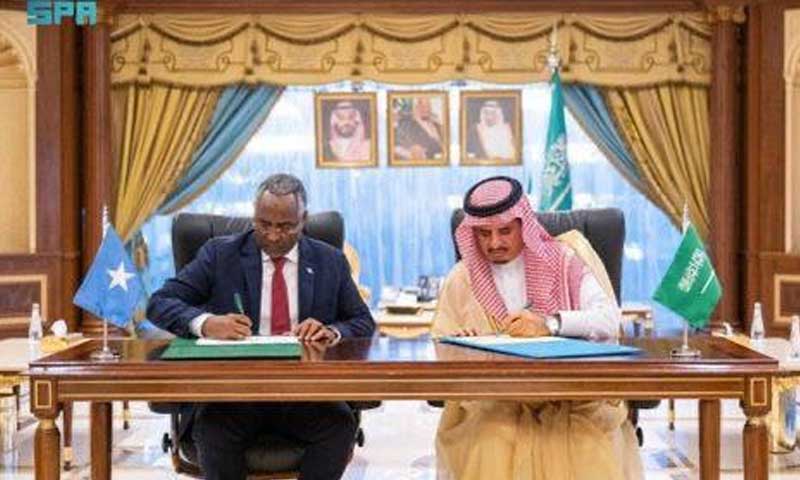
WEB DESK: Somalia and Saudi Arabia have formalised a new military cooperation agreement, strengthening defence ties at a time when the Horn of Africa is increasingly entangled in geopolitical competition among Gulf states.
The memorandum of understanding (MoU) on defence and military cooperation was signed on 9 February 2026 on the sidelines of the World Defense Show in Riyadh. The agreement was inked by Somalia’s Minister of Defence, Ahmed Moallim Fiqi, and Saudi Arabia’s Minister of Defence, Prince Khalid bin Salman.
According to Somalia’s Ministry of Defence, the MoU is intended to “further strengthen defence and military cooperation between the two nations”, covering a range of areas of mutual interest. These reportedly include military training, technical assistance, defence support, and capacity-building for the Somali National Armed Forces, as well as enhanced protection of Somalia’s airspace and territorial integrity. Some sources also point to potential cooperation in counterterrorism, intelligence sharing, and broader security coordination in the Red Sea region.
Prince Khalid bin Salman confirmed the signing on social media, stating that he had “signed and witnessed the signing” of several agreements during the exhibition, though he did not provide further details.
Defence pact signed amid intensifying Gulf rivalries
The agreement comes amid intensifying proxy dynamics in the Horn of Africa, where Gulf powers — notably Saudi Arabia and the United Arab Emirates (UAE), have competed for influence. The region’s strategic position along key Red Sea shipping lanes and near the Bab el-Mandeb strait has drawn heightened international attention, driven by concerns over maritime trade security, militant threats such as al-Shabab, and disputes involving the self-declared breakaway region of Somaliland.
Relations between Riyadh and Abu Dhabi have shown signs of strain in recent months, including over Yemen and wider regional influence. Somalia has accused the UAE of undermining its sovereignty, particularly through its economic and political engagement in Somaliland, which declared independence in 1991 but lacks international recognition. Emirati firm DP World has made substantial investments in Somaliland’s Berbera port, including facilities reportedly under strong Emirati control. More recent developments such as Israel’s recognition of Somaliland have further complicated the regional landscape, with Mogadishu viewing such moves as a threat to its territorial integrity.
Horn of Africa emerges as strategic battleground
Analysts interpret the Saudi–Somali agreement as part of Riyadh’s effort to counterbalance Emirati influence in Mogadishu and across the wider Horn of Africa, potentially signalling a recalibration of alliances. For Somalia, the pact offers an opportunity to bolster its military capabilities amid persistent internal security challenges and mounting external pressures.
While major US outlets have reported extensively on Gulf rivalries and Red Sea security dynamics, coverage of this specific bilateral agreement has so far been largely confined to regional and international wire services, defence-focused publications, and media outlets in South Asia, the Middle East and Africa.
The agreement underscores the Horn of Africa’s growing role as a theatre of Gulf competition, with significant implications for regional stability, Red Sea security, and the balance of power in one of the world’s most strategically important corridors.