- Web Desk
- Mar 31, 2026
SC reserves verdict in lifetime disqualification case
-

- Web Desk
- Jan 05, 2024
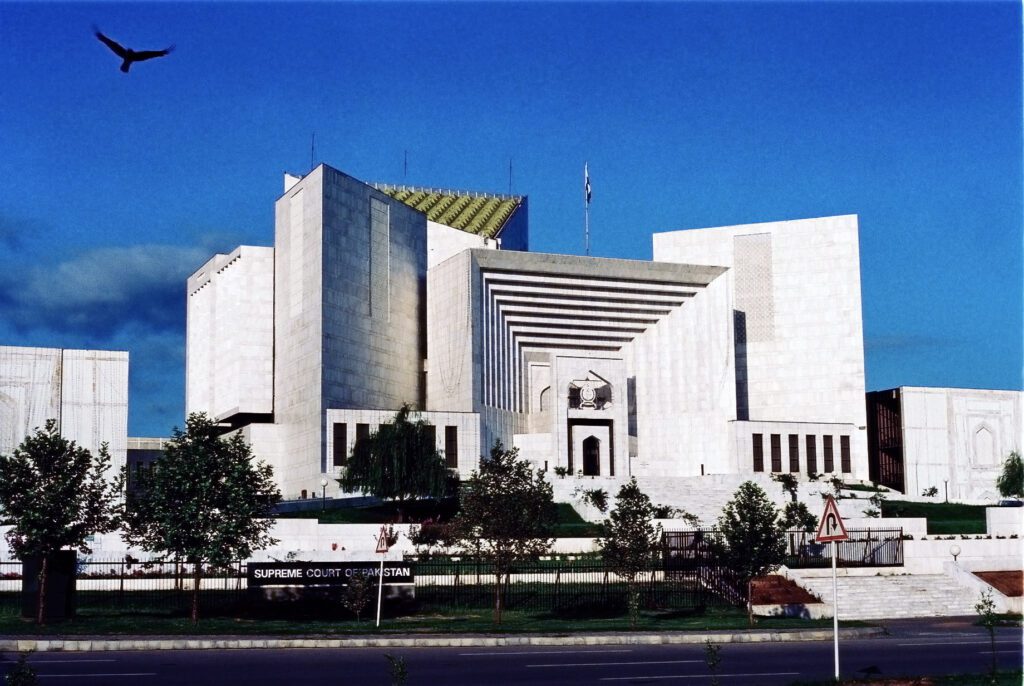
ISLAMABAD: The Supreme Court, after hearing arguments from lawyers in the lifetime disqualification case requiring the interpretation of article 62(1)(f) of the Constitution, has reserved its verdict.
The hearing of the case explaining Article 62 was conducted by a seven-member bench of the Supreme Court, headed by Chief Justice Qazi Faez Isa. The larger bench includes Justice Mansoor Ali Shah, Justice Yahya Afridi, Justice Amin-ud-Din Khan, Justice Jamal Mandokhail, Justice Muhammad Ali Mazhar, and Justice Masarat Hilali.
Upon the commencement of the case hearing, Chief Justice Qazi Faez Isa remarked that they have decided not to hear individual cases related to elections, but rather cases related to constitutional interpretation. Individual cases related to elections will be heard by another bench next week.
Justice Qazi Faez Isa stated that in the disqualification case, public notices were issued, but no political party came forward. The people of Pakistan have no concern; the country does not suffer any harm if someone is disqualified. A mistake in the nomination papers ruins nothing.
He questioned why they are limiting themselves to only a specific part of the Constitution and its language. Why are they overlooking constitutional history and fundamental rights? Will entering specific new clauses take away the remaining rights? If one general adds a clause to Article 62, are we all bound by it?
Justice Qazi Faez Isa asked if such a test exists for politicians in any other country. Does any country in the world have such a challenging test before elections?
Lawyer Makhdoom Ali Khan said that there is no such test for politicians in any other country, on which the chief justice said, “Are our politicians different from the politicians of the whole world? Give personal information in nomination papers and become eligible for election.”
The Chief Justice said that the mention of the society’s debt in the Samiullah Baloch case is ridiculous. “If the settlement with the relatives of the murder ends, where does the society’s debt go? If something goes wrong in the nomination papers, how will it be disqualified for life? Nomination papers ask how much gold do you have? If not told correctly about holding gold, disqualifies for life. There should be some logic for disqualification for life.”
Justice Jamal Mandukhel said that if a person is punished for fraud, can he contest elections after the punishment? On which lawyer Makhdoom Ali Khan said that one can participate in the elections after serving the sentence for fraud. “The election tribunal can also declare the entire election null and void.”
Lawyer Makhdoom Ali Khan said that the punishment for corrupt practices in elections is 2 years. The Chief Justice of Pakistan said that in the NAB law, the punishment is 10 years. “The constitution is not for lawyers but for the people of Pakistan. Make the constitution simple. Don’t make it difficult to lose people’s trust. Talk simple instead of philosophizing.”
Justice Jamal Khan Mandukhel remarked that the people should decide who is Sadiq and Amin, while the Chief Justice said that a larger bench was formed to answer the questions, but the matter is getting confusing. “Let’s wait, do you know the answers to the questions are bigger than that? Come off the bench.”
Justice Musarat Hilali said, “Can the entire constituency be affected by the mistake of one person? Why should the people of the constituency be deprived of their representative because of a specific case? How is it possible that a specific case is made against a person and the whole constituency suffers the consequences? If the court declares someone dishonest but the society considers him honest, what will happen to the decision?”
Justice Muhammad Ali Mazhar said, “Can the court declare Section 232 of the Election Act null and void?” On which lawyer Makhdoom Ali Khan said that Section 232 has not been challenged before the court, it cannot be annulled. “The court should limit itself only to the decision of Samiullah Baloch. It is necessary to file an application against it for a decision on the amendment of the Election Act.”
Justice Mansoor Ali Shah inquired, “Should the court see its own decision, so should there be lifetime disqualification under 62(1)(F)?” Chief Justice Qazi Faiz Isa said that general legislation can pave the way for constitutional amendment. “What does it mean that we can make whatever decision we want? Are the people sitting in our parliament very sensible?”
Justice Mohammad Ali Mazhar asked, “If someone lies in the documents, can he give a declaration after seeing the contents?” On which lawyer Makhdoom Ali Khan said that absolutely not. “The returning officer is not the court of law to issue the declaration.” Justice Muhammad Ali Mazhar inquired, “Can the High Court issue the declaration?” Lawyer Makhdoom Ali Khan said, “I think the High Court can give a declaration under Article 199.”
The Chief Justice said, “Parliament fixed the period of disqualification, then it became an academic question that what will be the period of disqualification?” While Justice Mansoor Ali Shah said, “If Samiullah Baloch cancels the decision, how much will the punishment be?” Chief Justice Qazi Faizaisa said, “The Parliament has said that the disqualification will be for 5 years. Was the Attorney General notified in the Samiullah Baloch case?”
Makhdoom Ali Khan said that the Supreme Court should only look at the Samiullah Baloch decision. Section 232 was not challenged, and the concept of repentance was discussed in the Supreme Court. “Samiullah Baloch should overturn the judgment because fundamental rights were denied in this case.”
Justice Mansoor Ali Shah asked, “Is there any example of a disqualified and convicted person coming to contest elections after the cooling period?” While Justice Muhammad Ali Mazhar inquired, “Can the court declare that the decision of lifelong disqualification itself has become ineffective due to the introduction of Section 232 of the Election Act?”
Justice Mansoor Ali Shah asked, “Is it possible to change the constitution through sub-constitutional legislation?” On which the Chief Justice said, “We have given the answer to this question in the Supreme Court Practice and Procedure decision. The constitution can be changed by legislation.”
The Chief Justice Supreme Court directed lawyer Makhdoom Ali Khan to submit his written submissions today. “The whole of Pakistan is happy with the 5-year disqualification law. No one has challenged the 5-year disqualification law.”
Arguments of Attorney General Mansoor Usman
When the hearing of the case resumed after the break, Attorney General Mansoor Usman referred to the Ishaq Khakwani case of 2015 in his arguments and said that the Ishaq Khakwani case was not discussed in the Samiullah Baloch case.
The Chief Justice of Pakistan said, “It is very strange that the Khakwani case was not discussed in the Samiullah Baloch case.” Justice Mansoor Ali Shah asked the Attorney General, “What was actually the Khakwani case?”
The Attorney General said that the Khakwani case was related to disqualification. “What will the Court of Law do? In 2015, a 7-member bench raised this issue. The Samiullah Baloch case did not answer the question of the Court of Law. Is there a reference to the Ishaq Khakwani case?”
The Attorney General said that the Khakwani case was not discussed in the Samiullah Baloch case. Justice Jawad S. Khawaja had written that he would see the matter in the relevant case, but after that the matter was never seen.
Justice Qazi Faiz Isa said, “No one said that this matter is under the jurisdiction of the Federal Shariat Court. Jurisdiction over Islamic matters belongs to the Shariat Court.” The Attorney General said that the decision of lifelong disqualification in the Samiullah Baloch case is not correct. “The Supreme Court has misinterpreted the constitution in the case of lifelong disqualification. The Supreme Court should determine the eligibility of politicians. Who has to give the declaration?”
Justice Amin asked, “Do you want us to decide the questions raised in the Ishaq Khakwani case?” On which Mansoor Usman said, “The court has to determine various constitutional questions. The court should decide who should give the declaration of disqualification. The court should decide what the court of law is.”
After hearing the arguments of the petitioner, the Attorney General and the judicial assistants, the Supreme Court reserved its decision on the petition regarding the interpretation of Article 62 1F of the Constitution on lifelong disqualification.
It should be remembered that yesterday, in the hearing of the case related to lifetime disqualification of politicians, the petitioner’s lawyer Khurram Raza and judicial assistant Uzair Bhandari presented arguments.
The Chief Justice of Pakistan had remarked during the hearing that the elections are being held on February 8. “No confusion should be spread. No obstacles should be created in the way of the elections by filing applications every day. How can the wisdom of 5 gentlemen prevail over the parliament of 326? The decision of the parliament should not be looked down upon. Where is it written in the constitution that the penalty of disqualification shall be for life? It should not be the case that when the mode is ‘ban for life if I am’ and ‘disqualify if not mod’.”
You May Also Like