
- Web Desk
- 20 Minutes ago
Sealed away: iPhone 17 Pro Max buried in US time capsule until 2276
-

- Web Desk
- 2 Hours ago
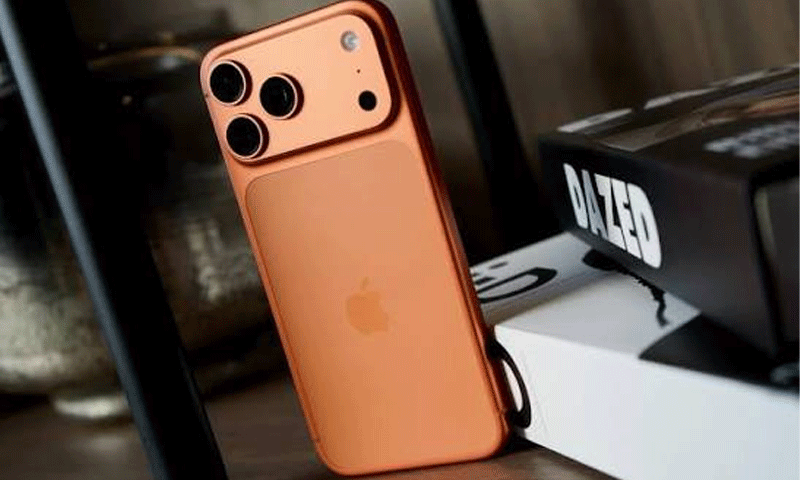
WEB DESK: A ‘Cosmic Orange’ iPhone 17 Pro Max has been sealed inside a historic time capsule to mark the 250th anniversary of the United States. Designed to preserve a snapshot of contemporary life for future generations, the device will remain buried for two and a half centuries until the capsule is officially opened in the year 2276.
According to Forbes, the symbolic gesture is part of America’s semiquincentennial celebrations. Organisers placed the flagship smartphone inside a one-ton stainless-steel capsule engineered by the National Institute of Standards and Technology (NIST).
Alongside contributions from all 50 states, Washington, DC, and US territories, the device was selected to represent the pinnacle of early 21st-century consumer technology and digital culture.
A curated portrait of 2026
The time capsule holds a diverse array of historic relics, cultural artefacts, and modern items meant to reflect the current state of human achievement and daily life.
Among the buried items are a American Civil War eagle feather, fabric from the historic Wright Flyer, a classic Coca-Cola bottle, and traditional Native American artwork. In a nod to the digital age, the capsule also includes student essays and printed responses from artificial intelligence chatbots.
The iPhone 17 Pro Max itself serves as a digital archive, pre-loaded with curated notes, photographs, and multimedia intended to provide future Americans with a first-hand look at life in 2026.
Experts note that the device encapsulates not just modern communication, but the very fabric of social interaction and documentation in the current era.
Doubts over future functionality
While the gesture has drawn public attention, it has also prompted debate among technology experts and social media users over the lifespan of modern hardware. Analysts expect the phone’s lithium-ion battery to degrade and fail well before the 250-year mark, making it unlikely that the device will power on when it is unearthed.
Archivists say that if future engineers are able to bypass or replace the degraded battery, the data stored on the device could still be recovered using future technology. The uncertainty highlights the challenges of preserving digital information over long periods compared with physical artefacts.
The project also raises questions about the course of technological development. Experts have speculated whether people in the 23rd century will view the smartphone as an early stage in technological progress or as a device that marked a turning point. Some believe handheld devices may no longer exist, having been replaced by neural implants or other forms of technology.
For now, the buried iPhone serves as a reference point against which technological progress over the next 250 years may be assessed.
You May Also Like