- WEB DESK
- October 25, 2026
Sindh presents Rs3.56tr budget with focus on green energy, infrastructure
-

- Atif Hussain
- June 17, 2026
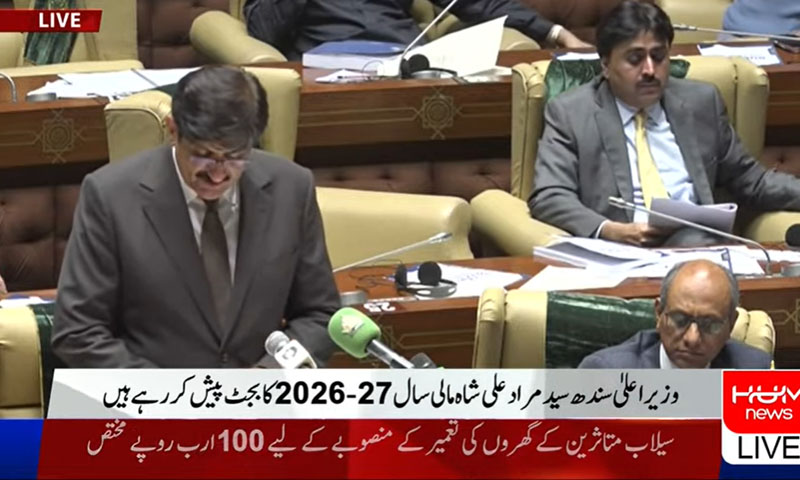
KARACHI: The Sindh on Wednesday unveiled a Rs3.562 trillion budget for the fiscal year 2026-27, introducing a slew of green energy initiatives, high-tech infrastructure plans, and strategic transport corridors without levying any new taxes on businesses or citizens.
Sindh Chief Minister Murad Ali Shah, who also holds the portfolio of the finance minister, presented the budget in the provincial assembly as opposition members boycotted the proceedings amid sloganeering and protests.
Sindh Assembly Speaker Awais Qadir Shah is chairing the budget session.
Shah described the economic blueprint as a transition from basic welfare to regional economic leadership.
He said that the province rationalised its development portfolio in cooperation with the federal government, reducing its shared development slate from Rs575 billion to Rs400 billion while “successfully protecting” its core provincial share under the National Finance Commission Award.
To offset national inflationary pressures, Shah announced a 7 per cent salary and pension hike for government employees and pensioners alongside the consolidation of older ad-hoc relief allowances.
He said that the province also raised its minimum wage from Rs40,000 to Rs43,000 per month.
Financial and Coastal Mega-Projects
In a bid to turn the provincial capital of Karachi into a regional financial hub, the government announced the establishment of the Sindh International Financial Centre.
The chief minister said that the planned institution will focus on infrastructure finance, Islamic banking, and climate-focused investment across three potential sites within the metropolis.
He said that the provincial government has unveiled a long-term maritime strategy to transform the historic coastal town of Keti Bandar into a deep-sea port, logistics hub, and industrial zone.
Shah noted the project is designed to link directly with the Thar coal fields and the Dhabeji Special Economic Zone, establishing a second major maritime gateway for Pakistan alongside Port Qasim.
Green Energy and Digital Infrastructure
Shah said that the budget has prioritised a massive transition toward renewable energy by allocating Rs18 billion under the “solar home deployment programme”.
He said that under the initiative, 275,000 free solar energy systems will be distributed among impoverished households with a subsidised solar financing programme to assist middle-class families.
The chief minister also announced to launch the Sindh Green Data Infrastructure Initiative, aimed at attracting global investment into data centers and artificial intelligence computing grids powered entirely by renewable energy.
The project intends to build out a clean energy corridor linking the wind and solar parks of Jhampir, Thatta, and Karachi to supply green power to major manufacturing sectors including the Karachi and Korangi industrial areas.
Sectoral Allocations and Urban Transit
He said that the annual development programme has been structured around critical local governance and municipal infrastructure, which will receive Rs121.6 billion.
The government has allocated Rs40.9 billion for public health engineering, Rs39.5 billion for transport and communications, Rs30.9 billion for irrigation, Rs25.9 billion for education and Rs17.4 billion for healthcare infrastructure.
For Karachi’s urban transit system, the government has allocated Rs4.8 billion for the purchase of 50 modern double-decker buses, with the first batch of 25 vehicles scheduled to hit the roads within three months.
He said that the province will also inject 100 new electric buses into the fleet and expand its dedicated Pink Bus service for women along the Green Line corridor, standardising all routes under a new automated fare collection system.
Flood Rehabilitation and Social Safety Nets
Reviewing ongoing climate rehabilitation from previous disasters, Shah said that the Sindh Peoples Housing Programme has completed the construction of 1 million homes for victims of the 2022 floods. The province has successfully locked down an additional $1.675 billion in international funding to construct another 1.7 million housing units, a process that grants formal land titles directly to affected women.
For agriculture and social protection, the government has allocated Rs13.2 billion under the Benazir Hari Card and the Benazir Women Agriculture Workers programmes, which support small-scale tenant farmers and widows.
To lower operational costs for the services sector, the provincial government has decreased the sales tax on educational support services to 5 per cent and extended existing tax relief for point-of-sale integrated beauty salons, overseas recruitment agencies, and insurance brokers.
Shah said that the provincial government has also eased the agricultural super tax by raising the exemption threshold from Rs150 million to Rs500 million, while shaving the top tax rate down from 10 per cent to 8 per cent.
Shah said that crime rates in Karachi had fallen sharply due to enhanced surveillance and policing measures, while outlining an ambitious plan to transform the provincial capital into a regional hub for finance, technology and renewable energy.
Presenting the Sindh government’s development vision during his budget speech, Shah said incidents of vehicle theft and snatching in Karachi had declined by 67 per cent, while street crime had fallen by 54 per cent.
He said the crime detection and investigation rate had reached 81 per cent, attributing the improvement to investments in digital monitoring and law enforcement infrastructure.
Shah said the provincial government was committed to strengthening Karachi’s economic future and announced plans to establish the Sindh International Financial Center (SIFC) in the city.
The proposed financial centre aims to position Karachi as a regional hub for finance, investment and financial technology, while attracting global capital and expanding the role of Islamic finance. The chief minister said three potential sites had been identified for the project.
He said the initiative would create new opportunities for investment in technology, artificial intelligence and cloud computing, helping integrate Karachi more closely into global financial and digital networks.
Shah also unveiled a broader energy strategy aimed at transforming Sindh into Pakistan’s first comprehensive energy hub under the vision of PPP Chairman Bilawal Bhutto Zardari.
He said the province was already playing a central role in meeting Pakistan’s energy needs and would eventually become an exporter of energy. The strategy combines existing coal resources in Thar with expanding investments in solar and wind power projects.
“Sindh’s coal helped power Pakistan, and green energy will now help power its future,” Shah said.
The chief minister said work was underway on a green data infrastructure project around Karachi and Hyderabad, supported by renewable energy sources.
He said Thar, Jhampir, Dhabeji, Thatta and Karachi were emerging as a new energy corridor that would support data centres, technology zones and industrial development powered by clean energy.
Under the plan, renewable energy generated through solar projects, wind corridors and green energy parks would be supplied to major industrial zones, including SITE Karachi, the Korangi Industrial Area and Port Qasim, to support sustainable economic growth and enhance energy security.
Earlier, the Sindh cabinet had approved the provincial budget under the chairmanship of Shah during a meeting.
According to details, the cabinet formally gave approval to the budget, while participants also appreciated the chief minister’s efforts for record development work across the province.
Speaking on the occasion, Chief Minister Murad Ali Shah said the government would continue serving the public under the guidance of the leadership. “We will continue to serve the people,” he said, adding that more development work would be carried out in the coming fiscal year as well.
He said the upcoming budget has been designed keeping all segments of society in view. “In the new budget, every class has been taken care of,” he said.
The chief minister said the provincial government is taking special measures for poverty alleviation and improving living standards. “We are implementing special steps for the eradication of poverty,” he noted.
He further said that a decision regarding minimum wages for labourers has also been included in the budget, adding that workers’ welfare remains a key priority for the provincial government.
Budget 2026-27
Sindh’s provincial budget for the new fiscal year, amounting to over Rs3.5 trillion, will be presented today in the provincial assembly. According to official proposals, the development budget is expected to face a cut of Rs298 billion, while the non-development expenditure is proposed to increase by Rs418 billion. The district development budget is also suggested to be reduced sharply from Rs55 billion to Rs15 billion. In contrast, overall non-development spending is proposed to rise from Rs2,142 billion to Rs2,560 billion.
The budget documents show notable reallocations across key sectors. Funds for education and health development programmes have also been reduced, while Rs99.76 billion has been proposed for municipal services and major development projects in Karachi.
The Sindh Public Health Engineering Department is allocated Rs40.86 billion, while the Works and Services Department is proposed to receive Rs31.59 billion. The irrigation sector is expected to get Rs30.80 billion, and various education-related departments are proposed to receive Rs25.86 billion. The health sector has been allocated Rs17.43 billion, while the transport sector is set to receive Rs7.94 billion.
Under the Annual Development Programme, 3,715 schemes have been included across the province. Of these, Rs36.18 billion has been earmarked for 731 Public Health Engineering schemes, Rs31.59 billion for 297 Works and Services projects, and Rs30.94 billion for 186 irrigation schemes.
The education sector includes 655 schemes with Rs25.86 billion proposed, including Rs13.95 billion for 404 school education projects, Rs4 billion for 41 higher education and board initiatives, and Rs3.5 billion for 104 college education schemes.
Additional allocations have been proposed for 63 projects under the special persons department, Rs14.11 billion for 25 major Karachi development projects, around Rs29.5 billion for SDG-based mega schemes, and Rs1 billion for basic facilities in the province’s riverine (katcha) areas.
Shah said that energy self-sufficiency would form the foundation of Sindh’s economic independence, arguing that investments in renewable energy, industrial connectivity and digital infrastructure would strengthen the province’s long-term growth prospects.
He described the provincial budget as a roadmap focused on public safety, human development and building a more prosperous future for residents.
The chief minister said the Pakistan People’s Party’s vision was to ensure access to education for every child, healthcare for every citizen and economic opportunities for every young person.
He added that the budget was designed to spread the benefits of economic growth and development across all districts of Sindh, with targeted investments in infrastructure, social services and local governance.
The Sindh Assembly on Wednesday approved the Sindh Finance Bill 2026 after it was presented in the House.
You May Also Like