- Web Desk
- Feb 24, 2026
Snow leopard dies of natural causes in Chitral, autopsy finds
-

- Web Desk
- Jan 21, 2026
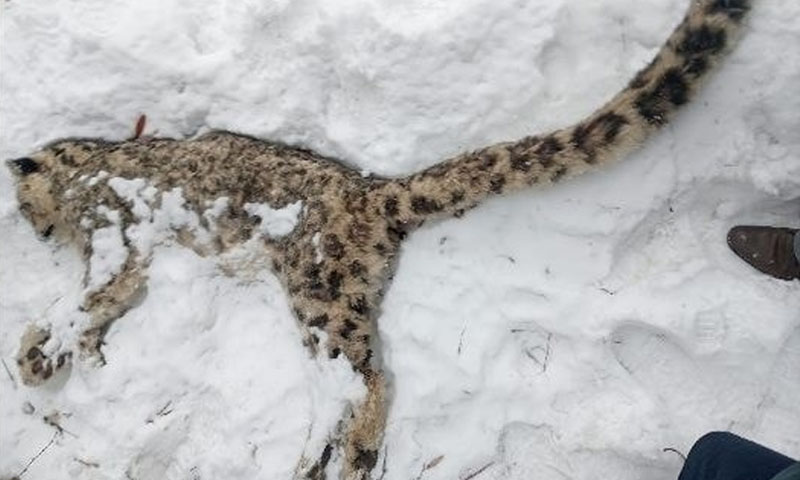
ISLAMABAD: The natural death of an elderly snow leopard in the Garam Chashma area of Chitral has been confirmed following a joint field assessment and post-mortem/autopsy conducted by the Khyber Pakhtunkhwa Wildlife and Livestock Department and the Snow Leopard Foundation Pakistan (SLF).
According to officials and experts, the incident reflects improving coexistence between local communities and snow leopards, driven by effective conservation and conflict-mitigation measures.
On January 19, the carcass of a male snow leopard was found in a high-altitude grazing area above the village of Wakht in Garam Chashma.
A post-mortem carried out by an experienced veterinary doctor revealed that the approximately 12-year-old snow leopard died due to severe diarrhoea and dehydration, linked to old age and prolonged food scarcity.
“No evidence of hunting, poisoning, violence or human-induced harm was found during the examination,” it said.
A rare but meaningful indicator
In most parts of the world, large carnivores are often killed by humans before reaching old age.
In this global context, the natural death of the snow leopard is being viewed as a positive and rare ecological indicator, suggesting that the animal successfully survived the most dangerous phases of its life in human-dominated landscapes.
Minister of State for Climate Change and Environmental Coordination Dr Shizra Mansab Kharal linked the incident to the importance of science-based conservation and community engagement. She said that “This incident proves that when local communities are encouraged, informed and included in conservation efforts, coexistence with rare species like the snow leopard is possible. The natural death of such a valuable animal reflects improved protection, responsible governance and growing public awareness.”
Community response and immediate actions
In recent months, the Garam Chashma area had drawn attention after videos of a snow leopard roaming near villages went viral on social media, spreading fear among local residents.
In response, the KP Wildlife and Livestock Department and SLF organised community awareness sessions, engaged with local people and promoted precautionary measures to protect livestock.
Rather than demanding compensation for livestock losses, the local community called for sustainable, long-term solutions.
The SLF immediately provided livestock vaccination and reaffirmed its commitment to extending conflict-mitigation measures — such as predator-proof corrals, livestock insurance schemes and conservation education — to the area, as has been done in other parts of Chitral.
Highlighting the regional significance of the incident, Jamal Leghari, Ambassador of the Global Snow Leopard and Ecosystem Protection Programme (GSLEP), said: “In snow leopard range areas, most deaths are often caused by humans. When a snow leopard lives long enough to die a natural death, it sends a clear message that coexistence is genuinely working in that landscape. Chitral is demonstrating that community-based solutions can change outcomes for both people and wildlife.”
Effective conservation on the ground
The Khyber Pakhtunkhwa Wildlife Department confirmed that the response to the incident was swift and transparent.
Divisional Forest Officer (Wildlife) Chitral, Farooq Nabi, said: “Our field teams thoroughly inspected the site and found no signs of conflict or illegal activity. The post-mortem report clearly points to natural causes. This outcome is the result of regular patrolling, community cooperation and close coordination with partners like the Snow Leopard Foundation.”
From a conservation perspective
SLF Director Dr Muhammad Ali Nawaz said the incident should be viewed in a broader conservation context: “In landscapes where large carnivores usually die due to human causes, a natural death is not just a biological event but a symbol of coexistence. It shows that this snow leopard avoided violence and conflict throughout its life. The trust built through livestock vaccination, insurance, predator-proof corrals and conservation education is clearly delivering positive results.”
He said that while the loss of any snow leopard is tragic, the circumstances of this case demonstrate that community-based, preventive conservation measures are proving effective.
Authorities and the SLF have reaffirmed their commitment to further strengthening community-based conflict-mitigation measures; expanding livestock insurance schemes and secure infrastructure; continuing awareness and education programmes and maintaining effective monitoring and protection of snow leopard habitat in Chitral.
You May Also Like