- Web
- 1 Hour ago
Strategic ambiguity: Trump administration refuses to rule out Iran ground invasion
-

- Web Desk
- Mar 05, 2026
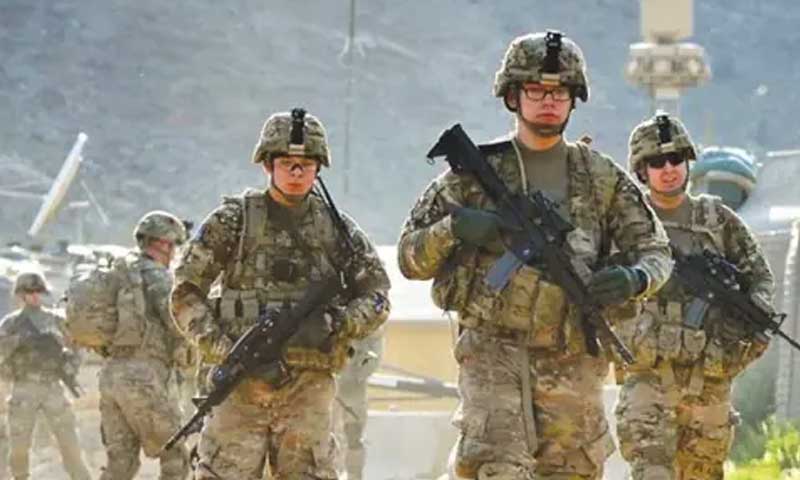
WEB DESK: The White House has signalled a shift towards “maximum latitude” in its military strategy against Iran, deliberately avoiding a categorical rejection of a ground campaign. As the conflict enters a volatile new phase, officials have made it clear that while “boots on the ground” are not currently part of the operational plan, the President intends to keep every tactical card on the table.
According to Dawn News, the first since the commencement of Operation Epic Fury White House Press Secretary Karoline Leavitt confirmed that a land invasion is not the immediate priority. However, she pointedly refused to dismiss the possibility for the future.
“It’s not part of the current plan, but I’m not going to remove an option for the president that is on the table,” Leavitt told reporters. She suggested that previous US administrations had hampered their own effectiveness by “prematurely dismissing” actions before the full scope of a crisis was understood.
Operation epic fury: Air supremacy and high-value targets
The administration’s refusal to blink comes in the wake of a massive joint US-Israeli offensive launched on 28 February. The campaign has seen a relentless barrage of air and naval strikes aimed at dismantling the core of the Iranian state’s military apparatus.
The recent strikes have reportedly resulted in the deaths of Supreme Leader Ayatollah Ali Khamenei and several senior military commanders. According to Leavitt, the United States is rapidly approaching “complete and total control” of Iranian airspace, having engaged nearly 2,000 targets so far. The operation is focused on four primary objectives: neutralising Iran’s ballistic missile threat, annihilating its naval capabilities, dismantling drone and missile manufacturing facilities, and permanently obstructing Tehran’s path to developing a nuclear weapon.
Despite this progress, President Trump has broken with the traditional presidential rhetoric of promising no ground troops. Speaking to The New York Post, he remarked: “Like every president says, ‘There will be no boots on the ground’. I don’t say it. I say ‘probably don’t need them,’ [or] ‘if they were necessary’.”
Capitol hill braces for potential escalation
The lack of a definitive “no” has sparked a firestorm of anxiety in Congress. Following a classified briefing this week, several Democratic senators expressed grave concerns that the US is being steered toward a protracted land war.
Senator Richard Blumenthal described himself as “more fearful than ever” regarding the administration’s long-term objectives. He questioned whether the ultimate goal was nuclear disarmament or a broader pursuit of regime change. Meanwhile, Senator Chris Murphy issued a stark warning to the public, stating: “They told us in that room that there are going to be more Americans that are going to die.”
Even amongst Republicans, there is a burgeoning acknowledgment of the risks. Representative James Comer noted that while a ground presence is ideally avoided, it may become “unavoidable,” comparing the potential duration to previous interventions.
As the Pentagon remains tight-lipped with General Dan Caine insisting that troop deployment remains a matter for “policymakers” the world watches to see if the administration’s “calibrated ambiguity” will act as a deterrent or a precursor to the largest ground conflict in the region for decades.
You May Also Like