- Web Desk
- 47 Minutes ago
Succession battle looms as Iran forms interim ruling council
-

- Web Desk
- Mar 01, 2026
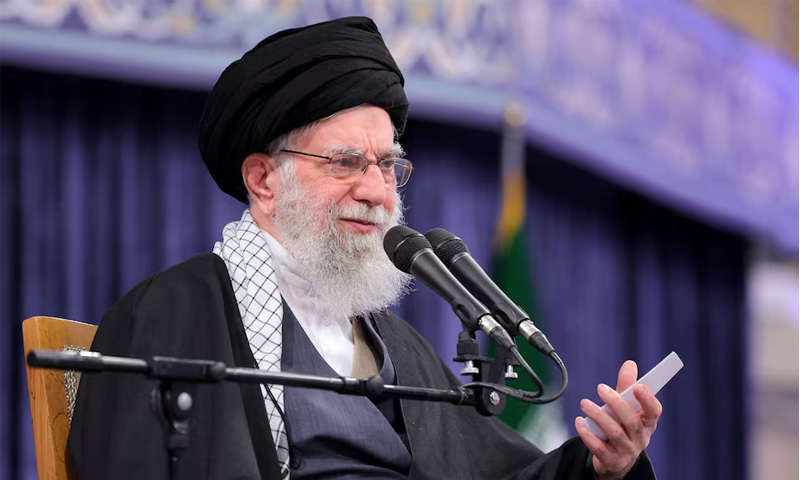
TEHRAN: Iran has begun a constitutional transition of power following the assassination of Supreme Leader Ali Khamenei, ending nearly 37 years of his rule and plunging the Islamic Republic into a pivotal moment for its political future.
The day after Khamenei’s death, authorities moved to implement procedures outlined in the constitution to ensure continuity of leadership. An interim leadership council was formally established on Sunday to assume control of state affairs until a permanent successor is chosen.
Under Iran’s constitution, the temporary council is composed of the sitting president, the head of the judiciary and a clerical member of the Guardian Council selected by the Expediency Council – a powerful body tasked with advising the supreme leader and resolving disputes between parliament and oversight institutions.
The interim council includes reformist President Masoud Pezeshkian and hardline Chief Justice Gholamhossein Mohseni-Ejei, who will temporarily assume the sweeping powers of the supreme leader. Their authority, however, is limited to the transitional period.
ASSEMBLY OF EXPERTS TO CHOOSE SUCCESSOR
Iranian law requires the 88-member Assembly of Experts to appoint a new supreme leader “as soon as possible.” The body, composed exclusively of Shiite clerics, is elected by popular vote every eight years, though candidates must first be approved by the Guardian Council.
The Guardian Council has previously barred numerous candidates from running in national elections. In March 2024, it disqualified former President Hassan Rouhani from seeking election to the Assembly of Experts, underscoring the body’s tight control over Iran’s political landscape.
Deliberations within the Assembly of Experts are traditionally conducted behind closed doors, and speculation about potential successors remains largely unofficial.
SUCCESSION SPECULATION INTENSIFIES
Attention has increasingly focused on Khamenei’s 56-year-old son, Mojtaba Khamenei, as a possible candidate despite his lack of formal government office. Analysts note that a transfer of power from father to son could provoke backlash from both regime critics and segments of the political establishment wary of dynastic succession in a system born out of the 1979 Islamic Revolution.
Previously, hardline President Ebrahim Raisi had been widely viewed as a leading contender to succeed Khamenei, but he died in a helicopter crash in May 2024, reshaping the succession landscape.
The current transition marks only the second time Iran has selected a supreme leader. Khamenei himself assumed the role in 1989 following the death of Ruhollah Khomeini, the architect of the Islamic Republic.
REGIONAL TENSIONS HEIGHTEN STAKES
The leadership transition comes amid heightened regional instability. Iran and Israel fought a 12-day war in June 2025, intensifying concerns about security and continuity within the country’s leadership structure.
As supreme leader, Khamenei served as the ultimate authority over Iran’s political and religious institutions, including command of the armed forces and oversight of the influential Islamic Revolutionary Guard Corps (IRGC). The IRGC was designated a terrorist organization by the United States in 2019 and has played a central role in leading Iran’s so-called “axis of resistance” – a network of allied groups across the Middle East – while also maintaining significant economic influence within Iran.
With the interim council now in place, attention turns to the Assembly of Experts and how swiftly it will move to appoint Khamenei’s successor – a decision likely to shape the trajectory of the Islamic Republic for years to come.
You May Also Like