- Web
- Mar 02, 2026
Tarique Rahman poised for premiership as BNP returns to power after nearly 20 years
-

- Web Desk
- Feb 13, 2026
DHAKA: Bangladesh’s opposition Bangladesh Nationalist Party (BNP) secured a landslide victory in Friday’s parliamentary elections, returning to power after nearly two decades and positioning party leader Tarique Rahman to become prime minister.
Rahman, 60, son of former premier Khaleda Zia and assassinated former president Ziaur Rahman, inherits a country emerging from months of political unrest and economic disruption following the collapse of former Prime Minister Sheikh Hasina’s government in 2024. An interim administration led by Nobel laureate Muhammad Yunus has been in charge since then.
The official count from the Election Commission gave the BNP and its allies 212 of 299 seats in the Jatiya Sangsad, or House of the Nation, while the opposition Jamaat-e-Islami and its allies won 77 seats. Results for two constituencies are still pending.
The National Citizen Party (NCP), formed by youth activists who played a key role in toppling Hasina and allied with Jamaat-e-Islami, won just six of the 30 seats it contested, showing the challenge of turning protest momentum into votes.
Victory signals desire for stability
The BNP called for restraint, urging supporters to avoid celebratory rallies and instead offer special prayers. In its manifesto, the party pledged to focus on job creation, support low-income households, ensure fair prices for farmers, and revive key industries, including the country’s vital garment sector.
Garment worker Josna Begum, 28, told HUM News: “If the factories run regularly and we get our wages on time, that’s what matters. We just want stability so more orders come to Bangladesh and we can survive.”
Economists say the BNP’s strong majority will allow the government to pass reforms efficiently, offering short-term political stability after years of turbulence.
International reaction
Indian Prime Minister Narendra Modi, Pakistan Prime Minister Shehbaz Sharif, and U.S. Ambassador Brent T. Christensen were among the first to congratulate Rahman. Modi personally called Rahman to commend his “remarkable” victory.
The result comes at a time when India, China, and the U.S. are all vying for influence in Bangladesh. Thomas Kean, senior consultant at the International Crisis Group, said: “It is both an opportunity and a challenge for Bangladesh, with major powers seeking influence. Managing these relationships will be key.”
Relations between New Delhi and Dhaka had deteriorated after Hasina’s exit, affecting everything from visa services to cricket ties.
High voter turnout
Voter turnout reached nearly 60%, up from 42% in the 2024 election. More than 50 parties and over 2,000 candidates, many independents, contested the polls.
Alongside the election, a constitutional referendum was held, with around 48 million voters approving changes, including two-term limits for prime ministers, stronger judicial independence, increased women’s representation, provisions for neutral interim governments during elections, and the creation of a second house in the 300-seat parliament.
The BNP victory surpasses its 2001 record of 193 seats, marking a major comeback after nearly 20 years in opposition, while Hasina’s Awami League, barred from contesting this election, had previously secured 230 seats in 2008.
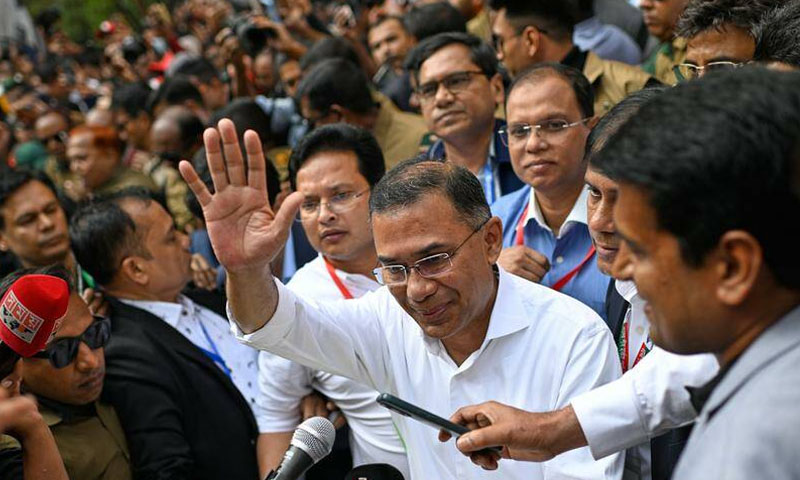
Rahman has yet to make a formal statement, though he was seen waving to supporters outside his Dhaka residence. The party has asked citizens to mark the day with prayers instead of celebrations, signalling a cautious start to its return to power.
You May Also Like