- Reuters
- November 7, 2026
The bumpy road to COP31: Can Pakistan turn climate promises into action?
-

- Zoya Anwer
- November 8, 2026

Pakistan heads to COP31 with ambitious climate targets and a much larger climate-policy toolkit than it had four years ago. The difficult part now is turning those plans into finance, bankable projects and action on the ground.
When the 31st Conference of the Parties (COP31) to the United Nations Framework Convention on Climate Change opens in Antalya on November 9, Pakistan will arrive with plans to cut emissions, strengthen adaptation and attract climate investment.
The Conference of the Parties is the annual decision-making meeting of countries that are parties to the UN climate convention, where governments negotiate issues ranging from emissions reductions and adaptation to climate finance, technology and support for countries already suffering climate-related losses. Turkiye will host this year’s conference at the Antalya EXPO Center from November 9 to 20.
For Pakistan, however, the questions heading into Antalya are increasingly practical: who will finance its climate ambitions, which projects are ready for investment, whether institutions can deliver them and how quickly national commitments can translate into provincial and local action.
Those questions have been building since the catastrophic floods of 2022 transformed the country’s climate diplomacy.
From the 2022 floods to COP30
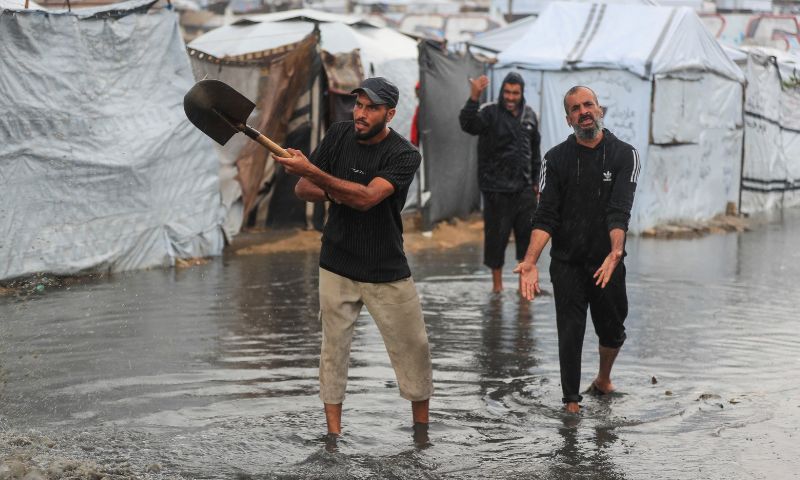
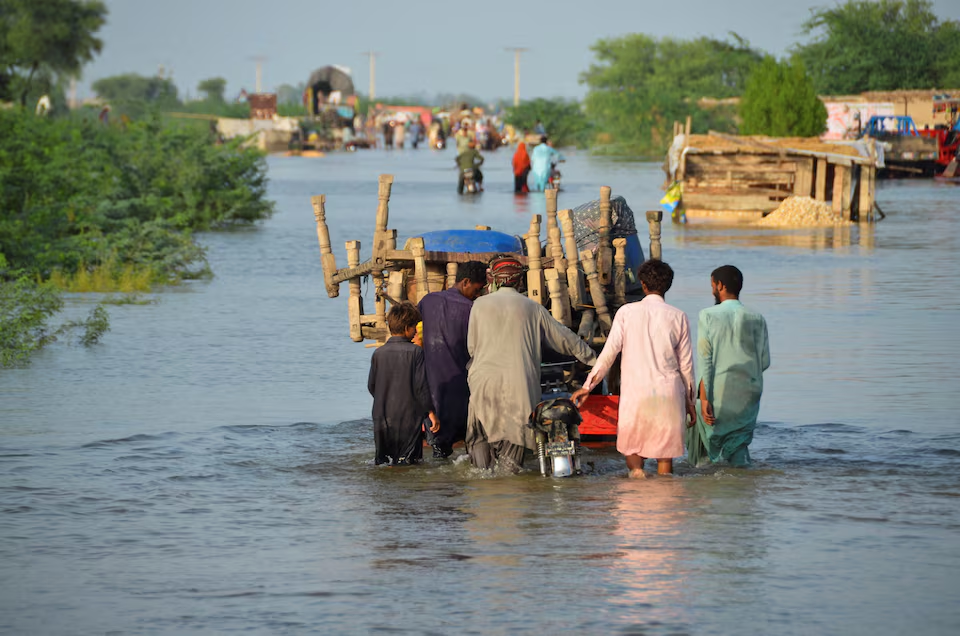
The 2022 floods affected around 33 million people and caused an estimated $14.9 billion in physical damage and $15.2 billion in economic losses, according to a post-disaster assessment by the government and international development partners.
The disaster struck as Pakistan was chairing the Group of 77 and China, giving Islamabad a prominent role in climate negotiations ahead of COP27.
In September 2022, then-foreign minister Bilawal Bhutto Zardari, speaking as G77 and China chair, called for loss-and-damage finance to be placed formally on the COP27 agenda. Pakistan also argued that climate disasters should not simply force vulnerable countries into greater debt.
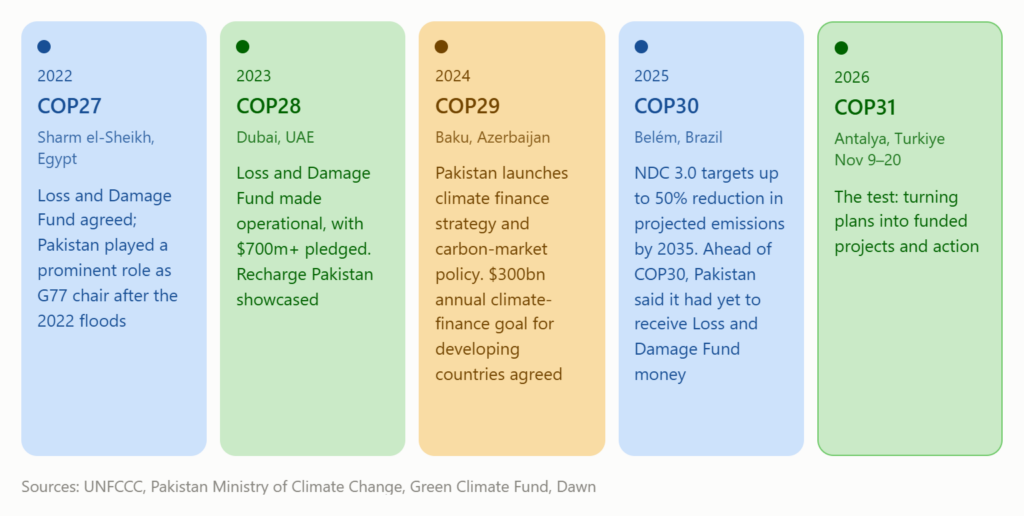
At COP27 in Sharm el-Sheikh, governments subsequently agreed to establish a dedicated fund for vulnerable developing countries suffering climate-related loss and damage. The UN climate body described the decision as a breakthrough after decades of demands from developing countries.
Pakistan did not originate that campaign, but its Foreign Office said the country, as G77 chair, had helped get the issue onto the formal agenda and worked towards consensus on establishing the fund.
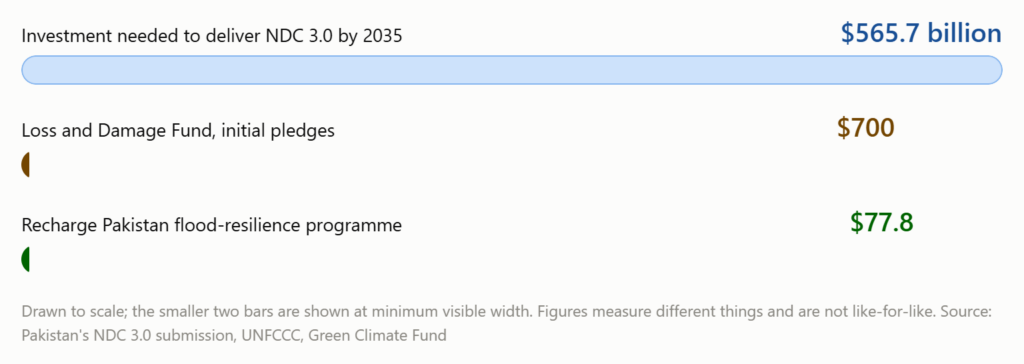
The following year, COP28 in Dubai moved the discussion from creating the fund to making it operational. Governments approved its operating arrangements and, according to the UNFCCC, initial commitments eventually exceeded $700 million.
Pakistan was also beginning to build its domestic adaptation framework. It adopted its first National Adaptation Plan in 2023 and used COP28 to showcase Recharge Pakistan, a $77.8 million nature-based adaptation programme, including a $66 million Green Climate Fund grant, aimed at improving flood resilience in the Indus Basin. The Green Climate Fund describes the project as combining ecosystem-based adaptation with green infrastructure for integrated flood-risk management.
By COP29 in Baku, Pakistan’s emphasis had shifted more clearly towards financing implementation.
The government launched its National Climate Finance Strategy, setting out how Pakistan could mobilise domestic and international finance, increase private-sector participation and improve coordination between federal and provincial governments.
Pakistan also unveiled its national carbon-market policy at COP29, presenting carbon trading as another potential route for attracting green investment.
COP29 itself ended with governments agreeing that developed countries would take the lead in raising climate finance for developing countries to at least $300 billion annually by 2035, alongside an effort to scale total public and private flows to $1.3 trillion a year.
By COP30 in Belém, Pakistan’s focus had increasingly moved from creating financial mechanisms to actually accessing them.
Its latest climate plan, NDC 3.0, set an indicative target of reducing projected greenhouse gas emissions by 50 per cent by 2035. According to the official submission to the UNFCCC, only 17 percentage points are unconditional, while another 33 depend on international finance, technology transfer and capacity building.
Pakistan estimates that delivering the plan will require $565.7 billion in investment by 2035.
At COP30, Pakistani officials also called for adaptation to be treated on an equal footing with mitigation and pressed for additional grant-based finance.
But one problem remained stark. Ahead of the summit, Minister for Climate Change Musadik Malik told Dawn that Pakistan had yet to receive money from the Loss and Damage Fund.
The mechanism Pakistan had helped push onto the international agenda now existed. Accessing substantial finance from it remained another matter.
So what is Pakistan taking to COP31?
That trajectory explains why Pakistan’s programme for Antalya looks different from the pitch it made immediately after the 2022 floods.
The case for vulnerability has not disappeared. Adaptation, loss and damage and climate justice remain central to Pakistan’s position.
But the emphasis has increasingly shifted towards implementation: preparing projects, attracting different types of finance and showing how national commitments can be delivered.
According to the Climate Change Ministry’s official COP31 programme, the Pakistan Pavilion is scheduled to host 56 engagements over two weeks, involving more than 30 partners across government, international organisations, research institutions and civil society.
The ministry describes the first week as focused on leaders and thematic discussions and the second as centred on provincial showcases and delivery.
One caveat is that while the ministry advertises 56 engagements from November 9 to 20, the publicly indexed calendar currently provides detailed individual listings mainly through November 14, with the second week described more broadly rather than through a complete publicly visible session-by-session schedule.
Climate finance takes centre stage
Pakistan’s $565.7 billion NDC estimate helps explain why finance runs through much of the COP31 programme.
The government is increasingly trying to present climate action not only as a case for international assistance, but as an investment proposition.
On November 11, the National Disaster and Risk Management Fund is scheduled to present “Pakistan’s Climate Investment Pipeline: From Project Preparation to International Climate Finance”, according to the ministry’s programme.
A COMSATS session the same day will examine private capital for adaptation, including de-risking instruments, blended finance and problems around project bankability.
On November 12, the Overseas Investors Chamber of Commerce and Industry is scheduled to discuss how developing-country NDCs can be turned into investible pipelines.
The language appears revealing. Pakistan’s challenge is no longer solely to demonstrate that it needs climate finance. It must also prepare projects that climate funds, development institutions and private investors can actually finance.
The government has already begun building such a pipeline.
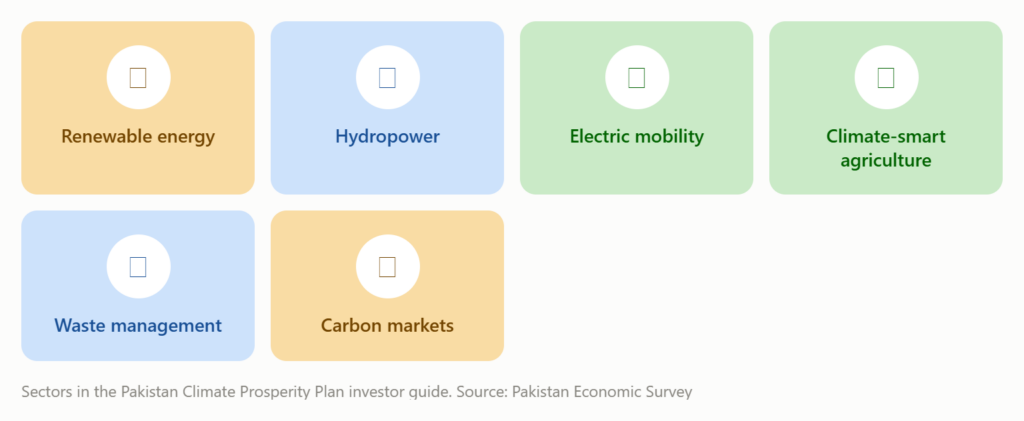
The Pakistan Climate Prosperity Plan is described in the Pakistan Economic Survey as a climate-investment blueprint. Its investor guide contains what the government calls a pipeline of bankable projects in renewable energy, hydropower, electric mobility, climate-smart agriculture, waste management and carbon markets.
Energy transition meets a changing power sector
Energy is likely to be another major part of Pakistan’s pitch in Antalya.
A November 10 pavilion session titled “Pakistan’s People-Led Solar Revolution” will focus on distributed solar, battery storage, grid flexibility and the regulatory and financial reforms needed to manage electrification.
Other scheduled sessions cover transition finance, the energy workforce and institutional capacity needed for a shift towards cleaner energy.
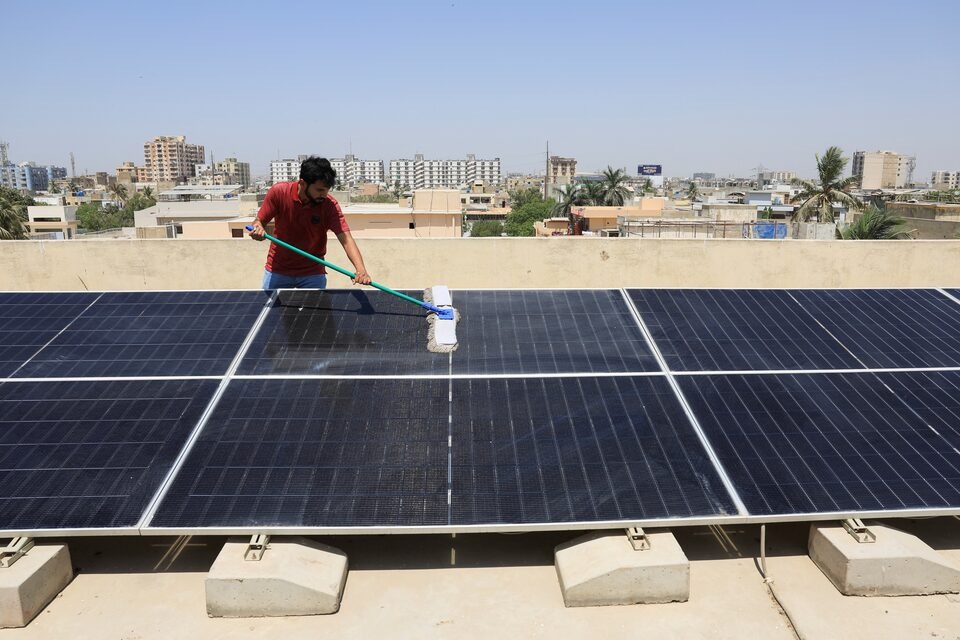
Carbon markets are another piece of the financing strategy.
The Climate Change Ministry says Sweden, Norway, Denmark, South Korea and Singapore have shown interest in Pakistan’s carbon market. Pakistan and Norway also signed the country’s first bilateral agreement under Article 6.2 of the Paris Agreement in April 2026, opening a framework for internationally transferred mitigation outcomes.
The aim is to widen the pool of climate capital available to Pakistan rather than relying solely on grants from multilateral funds.
From Islamabad to the provinces
Even financing, however, does not guarantee delivery.
Many of Pakistan’s most climate-exposed sectors, agriculture, water, cities and disaster preparedness among them, involve provincial and local institutions.
The COP31 programme ‘appears’ to recognise that gap.
A November 10 session is specifically titled “From Policy to Practice: Coordinating Adaptation, Mitigation and Resilience across Federal & Provincial Pakistan.” The ministry also says the second week of the pavilion will focus on provincial showcases and delivery, with Sindh, Balochistan, Gilgit-Baltistan (G-B), Punjab and Khyber Pakhtunkhwa (KP) represented across the wider programme.
Other scheduled events cover the water-food-health nexus, climate-resilient health systems, disaster-management technologies, local adaptation and climate-smart food systems.
The eventual test will therefore be whether national plans translate into changes in infrastructure, energy, farming, water management and preparedness in the places most exposed to climate risks.
From loss and damage to delivery
The progression since the 2022 floods is relatively clear.
Pakistan went to COP27 helping push for a new mechanism to finance climate loss and damage. COP28 operationalised that mechanism and provided a platform for adaptation projects such as Recharge Pakistan. COP29 brought greater focus on climate-finance architecture and carbon markets, while COP30 sharpened the question of whether Pakistan could actually access finance and implement its new climate targets.
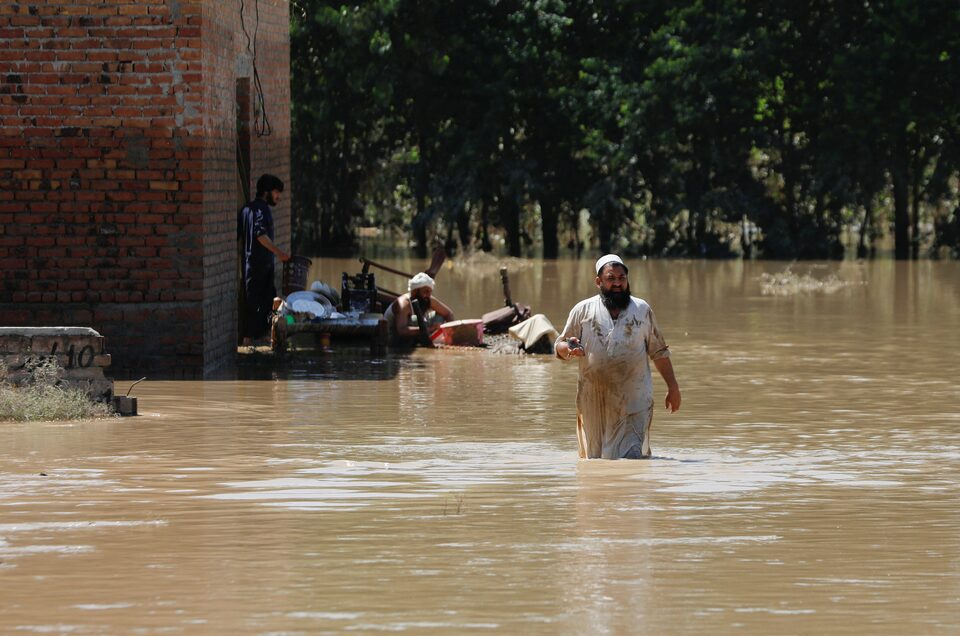
COP31 seems to take that debate a stage further.
Pakistan enters Antalya with more policies, financing frameworks and investment plans than it had when the 2022 floods struck. But its own documents also make clear that much of its ambition remains dependent on international support, while the experience of the Loss and Damage Fund shows how slowly negotiated financial mechanisms can translate into money on the ground.
That is why the road to COP31 has been bumpy.
Four years after the floods made Pakistan one of the world’s most visible examples of climate loss, Islamabad no longer has to establish that climate finance is necessary.
The harder question in Antalya will be whether it can show how that finance can move from international agreements and policy documents into projects that are ready to fund, institutions that can deliver them and climate action that people can actually see.
You May Also Like