- Web Desk
- 12 Minutes ago
The secret of Sialkot: how Pakistan’s mid-sized champions are outrunning rupee volatility
-

- Syeda Masooma
- 1 Minute ago
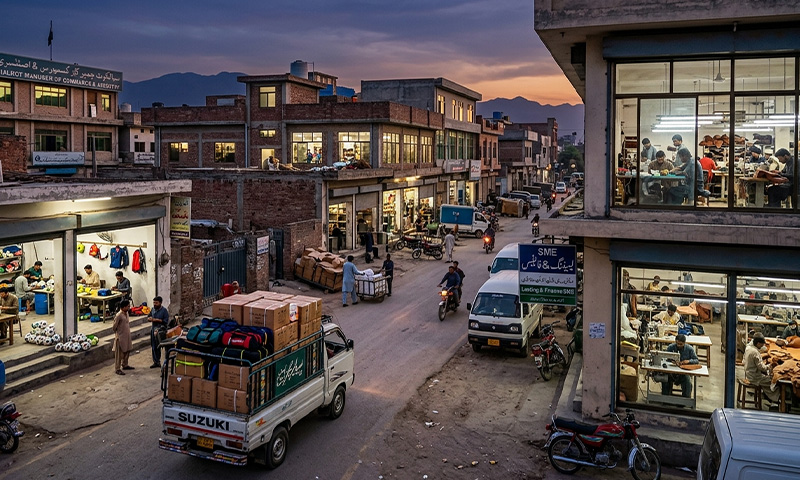
In the sprawling industrial clusters of Sialkot, the hum of stitching machines isn’t just the sound of manufacturing; in 2026, it is the sound of a high-stakes survival race. While the national economy grapples with the ghost of 29% inflation from years prior, a new breed of mid-sized enterprise (SME) is emerging. They aren’t just surviving the Rupee’s “weather”; they’ve built umbrellas made of data, diversification, and dollar-hedging.
THE DEATH OF THE “WAIT AND SEE” STRATEGY
For decades, the Sialkot SME playbook was simple: wait for a stable exchange rate, bag a big contract from a global giant, and repeat. But as the Pakistani Rupee-to-Dollar parity became a moving target, that model broke.
“The firms that scaled in 2025 and 2026 stopped treating volatility as a crisis,” says one local industry veteran. “They started treating it as a fixed operational cost.”
According to recent data, exports in the sports goods sector surged by nearly 16 per cent in the first half of the 2025-26 fiscal year.
The secret? A fundamental shift from being “contract fillers” to “market makers.”
The “Hybrid Engine”: Hedging via Micro-Exports
The most successful mid-sized firms in Sialkot have moved away from total reliance on “whale” clients like Adidas or Nike. Instead, they are leveraging digital platforms to reach boutique gyms and amateur leagues in Europe and the Gulf directly.
The Logic: By selling smaller volumes at higher retail margins in Dollars or Euros, these SMEs create a natural internal hedge.
The Result: When the Rupee dips, their “micro-export” profits swell, covering the rising cost of imported raw materials (like high-tech synthetics or specialized bladders) for their larger, low-margin domestic or bulk contracts.
FROM “GENIUS HANDS” TO “DIGITAL DASHBOARDS”
Sialkot has always boasted “genius hands”, skilled laborers whose craftsmanship is world-renowned. However, 2026’s growth stories are defined by what happens behind the needle.
Forward-thinking SMEs are investing in Compliance and Traceability Software. In a global market obsessed with ESG (Environmental, Social, and Governance) standards, a mid-sized Sialkot firm that can prove its carbon footprint and labor ethics digitally can command a 10-15 per cent premium.
“We used to compete on price. Now we compete on transparency,” says a Sialkot-based manufacturer of wearable tech-integrated sports gear. “Our digital audit trail is as important as our stitching.”
THE “CLUSTER” ADVANTAGE 2.0
The unique Sialkot model, where suppliers, stitchers, and finishers live in a tight geographical radius, has received a tech upgrade. The rise of B2B fintech platforms has allowed these SMEs to digitise their supply chains.
Inventory over Cash: With the Rupee fluctuating, savvy owners are now “warehousing value.” Instead of holding cash that loses value, they are utilizing real-time data to stockpile raw materials during currency plateaus, effectively locking in their production costs for the next two quarters.
THE 2026 SME GROWTH SCORECARD
Data based on manufacturing momentum and export performance trends.
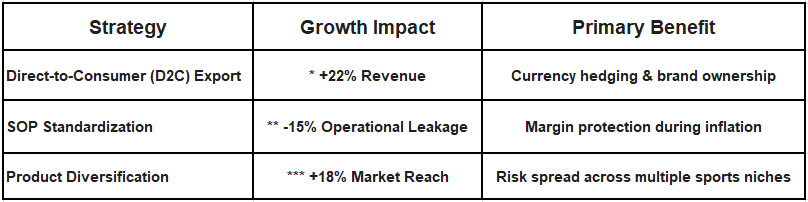
*Export Revenue
The Pakistan Bureau of Statistics (PBS) reported a 17.74 per cent increase in sports goods exports for the July-October period of this fiscal year. However, if a premium is applied for mid-sized firms that bypass traditional intermediaries and sell directly to consumers (D2C) in markets such as China or the UK (where demand for Pakistani sports goods is rising), the premium is estimated at approximately 22 per cent.
**Operational Leakage
Recent systematic reviews on SMEs show that integrating AI and cloud-based supply chain tools typically yields an efficiency gain of 10 per cent to 15 per cent.
***Market Reach
Industrial output in garments and specialised gear has seen a steady six to seven per cent baseline growth in early 2026, according to data by the Ministry of Commerce and the Trade Development Authority of Pakistan (TDAP). However, firms diversifying into “niche” categories (like the tech-integrated wearable gear) are outperforming the baseline by nearly 3x as per industry reports.
THE ROAD AHEAD: INNOVATION OVER CAPACITY
The challenge for Sialkot’s 6,000+ SMEs remains the “innovation trap.” For years, the focus was on expanding the factory floor. In 2026, the focus has shifted to the Testing Lab.
With the Punjab government approving a new 400-acre industrial estate near Sialkot International Airport, the infrastructure is arriving. But the real scaling won’t come from more machines, it will come from the SMEs that can turn “Sialkot Made” into a global brand that stands firm, no matter what the currency markets say.
The takeaway for the Pakistani entrepreneur? Don’t wait for the Rupee to find its footing. Find your own.
You May Also Like