
- Web
- 27 Minutes ago
The silent dart: Iran’s new jet-powered drone takes flight
-

- Web Desk
- Mar 05, 2026
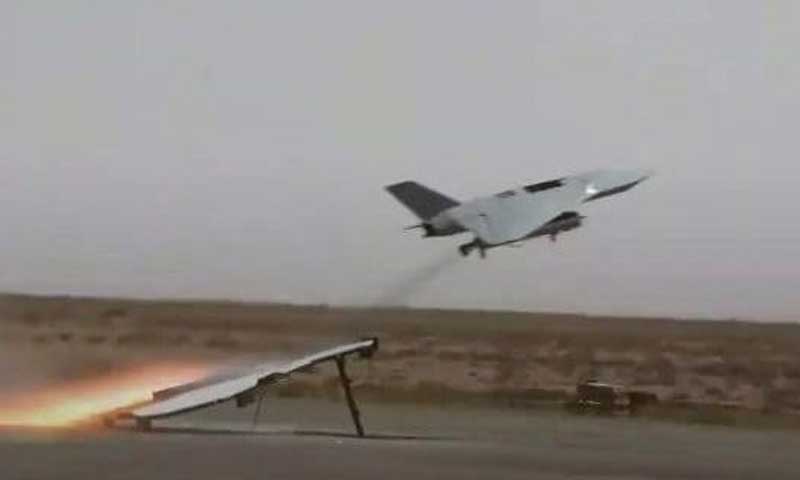
WEB DESK: In a move that has set alarm bells ringing across Western intelligence circles, Iran’s Islamic Revolutionary Guard Corps (IRGC) has officially fielded the Hadid-110 a jet-powered loitering munition that marks a sharp departure from the “lawnmower” drones of the previous decade.
According to CENTCOM, Iran has deployed advanced drones to operational units since late 2025, building on its Shahed series. While some reports suggest faster, jet‑powered variants, the widely used models remain propeller‑driven loitering munitions. These drones compress the “kill chain,” giving air defense operators only seconds to respond to incoming strikes.
A Design Built for the Shadows
The Hadid-110’s most striking feature is its faceted, “stealth-lite” airframe. Constructed largely from composite plastics and carbon fibres, the drone is designed to scatter radar waves rather than reflect them, making it an exceptionally difficult target for traditional long-range sensors to track.
While it carries a respectable 30–50 kg warhead roughly the same as the infamous Shahed-136 it delivers that payload at nearly three times the speed. With an operational range estimated at 350 km, the Hadid-110 is being described by analysts as a “pathfinder” weapon, intended to dart through gaps in air defences to take out high-value targets like radar installations or command centres.
The Cost of Defence in an Asymmetric Age
The deployment of the Hadid-110 has reignited a fierce debate within the United States Department of Defense regarding the economic sustainability of modern warfare. For years, the Pentagon has warned that the “cost-per-intercept” remains dangerously skewed; firing a multi-million-pound Patriot or NASAMS missile to down a drone that costs a fraction of that price is a losing game of attrition. As these low-altitude, high-speed threats become more common, the West is being forced to pivot toward more cost-effective solutions, such as directed-energy lasers and high-capacity electronic warfare systems, to counter a threat that is becoming increasingly difficult to see coming.
You May Also Like