- Web Desk
- 6 Hours ago
The STEM superstars making waves in Pakistan
-

- Web Desk
- Feb 26, 2026
By Atiya Abbas
Pakistan’s gender disparities remain stark. The country ranks at the bottom of the Global Gender Gap Index since the past many years, its health system performance stands at 122 out of 190 countries, and it is placed 147 out of 170 on the Human Development Index, that too within the low human development category. Shrinking health and education budgets continue to widen inequities, limiting access to the skills and opportunities required for upward mobility.
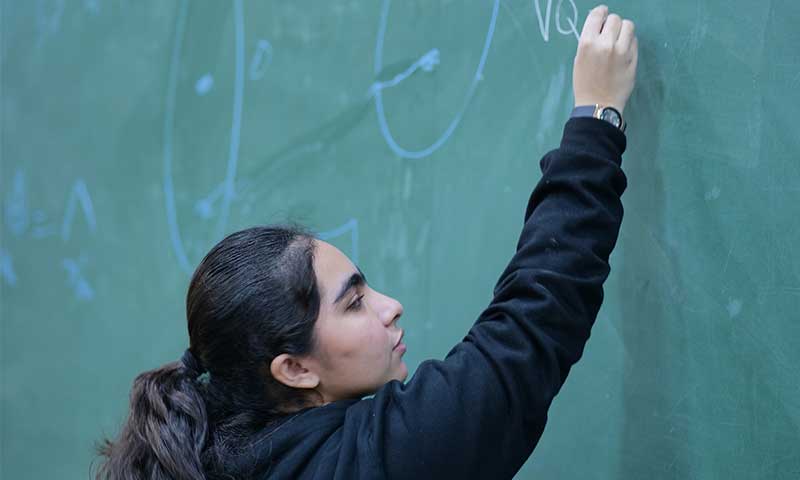
In such an environment, scientific reasoning, critical thinking and research can appear like distant pursuits, accessible only to a privileged few. A 2016 British Council study found that secondary school girls consistently expressed doubts about their “natural ability” to pursue science compared to boys. In a society where gender roles often dictate career paths, many girls internalise these limitations or gravitate towards a narrow set of “acceptable” STEM fields such as medicine and engineering.
Yet across Pakistan, educators and science communicators are working to disrupt that narrative.
Redefining who gets to be a scientist
Founder and CEO of StemX, STEM School for the World, Dr Athar Osama says one of the biggest barriers is the absence of visible women role models.
“There is a dearth of women role models for girls in STEM areas in Pakistan,” he explains. “Through the STEM School, we expose them to scientists, entrepreneurs and AI specialists so that their perception of a scientist goes beyond a doctor or engineer.”
StemX begins with a series of online sessions known as “STEM Waves”, where experts from diverse disciplines share their academic and professional journeys. Participants complete quizzes, and selected students move on to an eight-day residential STEM School hosted at leading universities across the country.
When the programme began, girls made up around 20 per cent of participants. Today, that figure stands at roughly 40pc.
“There is a pervasive ‘permission culture’ in Pakistan,” Dr Osama says. “We had to build trust with parents and demonstrate outcomes, including girls who went on to secure scholarships abroad.”
In December 2025, StemX 2.0 was launched in collaboration with the Aga Khan University’s School of Biology and Biomedical Sciences. The 10-day residential programme provided hands-on laboratory training in DNA identification and epidemiological research. More than half the cohort comprised young women, many pursuing biotechnology and veterinary sciences.
“Even though we are a for-profit company, we run this programme on a not-for-profit model, offering need-based scholarships to most of our cohort,” Dr Osama adds.
Building science capital at an early age
For founder and CEO of Science Fuse, Lalah Rukh Fazal Ur Rehman, the challenge lies in reshaping how children imagine science itself.
Science Fuse works to build what she calls “science capital”, the beliefs, values and knowledge about science that individuals carry with them.
Central to this effort is Gul Rukh, a fictional 12-year-old Pakistani who conducts experiments in her kitchen. She may not wear a lab coat or handle beakers in a laboratory, but she identifies as a scientist. Through illustrated books and interactive workshops designed by local artists, Science Fuse creates accessible entry points for children, especially girls, to see themselves in scientific roles.
Lalah Rukh outlines a three-pronged strategy for sustaining girls’ interest in STEM.
“First, decorate schools with posters of women scientists. If you can imagine it, you can be it,” she says. “Second, connect girls with people in their communities who are studying or working in STEM. Seeing science outside the classroom opens new possibilities. And third, invest in teacher training.”
That final point is critical. Without educators confident in both scientific concepts and pedagogy, curiosity cannot flourish.
From classrooms to systems change
At the public school level, Sana Kazmi, head of partnerships and lead of the STEAM Policy Unit, Sindh, at STEAM Pakistan, an initiative of the Ministry of Federal Education and Professional Training, observes that interest among girls is not the problem.
“In our nationwide STEAM Muqablo competitions, girls participate eagerly and often take the lead in hands-on activities,” she says. “The challenge is that this early engagement does not always translate into continued participation at college and university.”
To address gaps in teaching, Dr Osama’s Holistic Science Teaching Fellowship offers a self-paced online course comprising 15 modules that connect science to ethics, philosophy and history. The aim is to reposition science not as an isolated subject, but as an interdisciplinary way of thinking embedded across society.
Across these initiatives, from storytelling and competitions to laboratory immersion and teacher fellowships, a common thread emerges: expanding the definition of who belongs in science.
If half the population continues to see STEM as inaccessible, the country forfeits an immense reservoir of talent. But if girls are encouraged, mentored and structurally supported, the gains extend far beyond individual careers, shaping a more resilient, inquisitive and innovative society.
You May Also Like