- Web Desk
- 8 Hours ago
The “Zionist blueprint” in the Himalayas: analysing the India-Israel axis
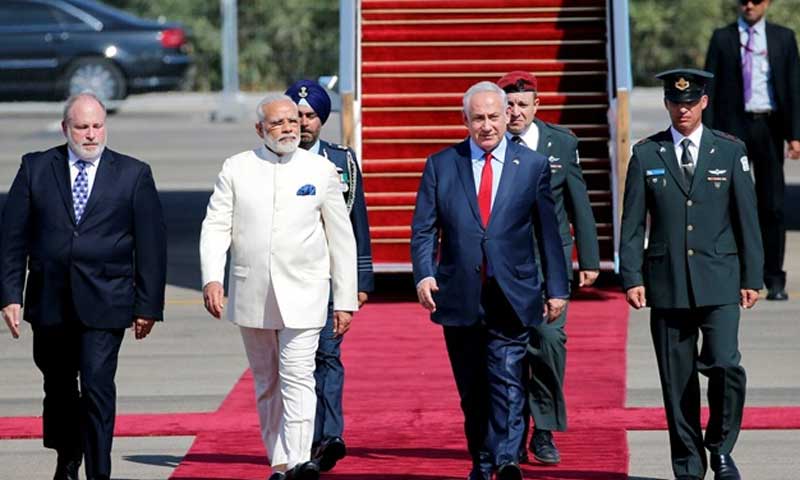
Seven years ago, India’s former consul general, Sandeep Chakravorty, spoke about the “Israeli model” for Kashmir in New York. Back in 2019, he was not only attempting to establish a historical correlation but also hinting at a possible shift in the trend of policy. So when Indian Prime Minister Narendra Modi arrived in Israel for a critical visit this week, the “model” has already moved from being a subject of debate to becoming a reality for millions of people.
The coming together of New Delhi and Tel Aviv has now been expanded from trade and defense agreements; it is also representing a strong coming together of two nations that are redefining the notion of democracy through the prism of ethno-nationalism.
The ideological mirror: Hindutva and Zionism
The ideological similarity between Hindutva and Zionism is based on their shared commitment to “ethnic majoritarianism,” wherein the state is defined solely on the basis of a single religious and cultural identity, which is Jewish in Israel and Hindu in India. By constructing Muslim majorities as “demographic threats” or “internal enemies,” both Hindutva and Zionism attempt to shift the focus of governance from democratic pluralism to the preservation of the “purity” of the nation.
During the ongoing visit, a light exchange about the saffron color in his and Sara Netanyahu’s attire was seen by critics as symbolic of a deeper ideological alignment between Hindutva and Zionism. They mention that saffron, once a spiritual symbol, now symbolises a majoritarian vision redefining India as a Hindu homeland, reflecting what they call a shared shift toward ethno nationalism and securitised governance often labelled as the “Israeli model, moves beyond trade into a partnership of militarised control and the institutionalisation of collective punishment.
This is more than a question of diplomatic understanding; it is a point of convergence, as proven by the widespread surveillance, territorial domination, and dehumanisation of opposition voices. Although these policies are not only against specific religious communities but are also an assault on universal human values, reducing the inherent dignity of the human person and creates a ladder where those who call themselves the “sons of the soil” are treated as more important than other citizens, instead of everyone having equal rights.
One of the most evident concepts lifted from Israel is the destruction of possessions as a form of punishment. Bulldozers in Israel are used to construct settlements and castigate Palestinians collectively. Similarly, India with the present administration headed by Yogi Adityanath, aka “Bulldozer Baba,” bulldozers have become the symbol of state power, mainly targeting Muslim homes and businesses in the name of “demolishing illegal encroachments.”
Even when challenged in court, this approach, called “Bulldozer Justice,” has proven to be versatile.
Regional stability at risk
The India-Israel relationship is not an internal Indian matter but a definite and imminent threat to the strategic balance of the region. The adoption of Israel counter terror model by Israel in Kashmir has been turning the valley into what they describe as an open -air prison, affecting its Muslim population, similar to situation associated with the Gaza strip and the West Bank where more than 70,000 have been killed since the October 7 2023 assault.
Furthermore, the Indian government’s decision in 2019 to abrogate Article 370 has been the first step towards the establishment of a “settler-colonial” demographic in Kashmir, which taken directly from Israeli settlement policies playbook. On the other side of the ledger, the introduction of Israeli spyware like Pegasus and advanced UAVs into the Indian military has led to a technological imbalance that has forced Pakistan into an expensive arms race. Pakistan often draws attention to the glaring irony of the fact that a country that was once the greatest champion of decolonisation is now following the very same footprints of occupation that it once denounced.
Surveillance as statecraft
The tie between the two nations is further strengthened by what has been termed as the development of a “security-industrial complex.” India has turned out to be one of the biggest importers of Israeli military hardware, but the most lethal exports are not tanks and missiles but are intangible and pertain to surveillance. The application of NSO Group’s Pegasus spyware on Indian journalists and activists is a very alarming development that suggests the shrinking of democratic space.
Journalist Siddharth Varadarajan of The Wire has stated that the technology developed to manage a population under occupation is now being used by the Indian state on its own citizens.
A new era of securitized governance
The so-called “Israeli Model” is a revolutionary departure from the original vision of a secular democracy in India, and instead embodies a highly securitized, majoritarian state that prioritizes control over consent. In Kashmir, the agenda is no longer framed in the context of reconciliation and political outreach, but instead in the context of demographic control, surveillance, and forced stability. The message is clear: minorities are to be treated not as interlocutors in politics, but as permanent security threats.
What is happens is week, as the two leaders come together to meet, is more than just business as usual in the world of international diplomacy. Instead, it is the overt consolidation of a political partnership based on militarised governance, digital surveillance, and the institutionalisation of collective punishment. It would appear that both India and Israel are collaborating together in order to refine and export a model of governance that prioritizes ethno-national dominance over pluralism, and security over civil liberties, setting a disturbing precedent for illiberal governance in the twenty-first century.
You May Also Like