- Web
- 46 Minutes ago
Trump escalates global tariffs following Supreme Court ruling
-

- Web Desk
- Feb 24, 2026
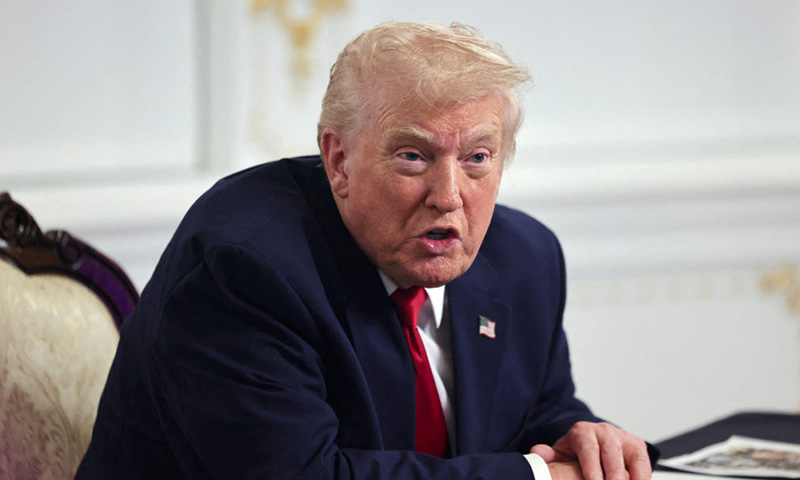
WEB DESK: U.S. President Donald Trump has intensified his trade agenda by raising a recently imposed global import tariff from 10 percent to 15 percent, just days after the Supreme Court struck down most of his previous broad-based tariffs as exceeding presidential authority.
According to RT News. the decision follows the Supreme Court’s 6–3 ruling on 20 February, which determined that the International Emergency Economic Powers Act (IEEPA) of 1977 does not grant the president power to levy tariffs. The court held that such authority rests with Congress under the Constitution’s taxing clause, and that IEEPA’s provisions for regulating “importation” in national emergencies do not extend to imposing duties.
Trump’s original tariffs, introduced early last year, included a baseline 10 percent rate on imports from a wide range of countries, with higher rates on nations such as Canada, Mexico (25 percent), and China (significant levels in some sectors). These measures were justified under IEEPA by citing national emergencies related to trade deficits, drug trafficking, and vulnerabilities in supply chains.
The ruling invalidated these measures, prompting questions over potential refunds for importers and uncertainty surrounding existing trade agreements.
Hours after the decision, Trump invoked Section 122 of the Trade Act of 1974 to introduce a temporary 10% global tariff on most imports, citing “fundamental international payments problems” and the need to rebalance trade. Under this provision, tariffs may be raised to a maximum of 15 percent for up to 150 days without congressional approval, after which any extension requires legislative sanction.
On Saturday, Trump announced via social media that he would increase the rate to the “fully allowed and legally tested 15 percent level”, denouncing the Supreme Court’s opinion as “ridiculous, poorly written, and extraordinarily anti-American.” He praised the dissenting justices, Brett Kavanaugh, Clarence Thomas, and Samuel Alito, claiming they supported efforts to “make America great again.”
The 15 percent tariff has either come into effect or is being formalised, with U.S. Customs and Border Protection commencing collection under the new framework. The administration has indicated plans for further measures, including trade investigations into unfair practices that could lead to more targeted tariffs.
International Reactions
China’s Commerce Ministry condemned the tariffs, urging the U.S. to rescind them as violations of both international rules and domestic law. Beijing noted that the Supreme Court ruling strengthens its position ahead of planned trade talks during Trump’s state visit to Beijing in late March.
The European Union demanded “full clarity” from the United States and has paused progress on a key trade agreement, insisting that Washington honour prior commitments capping tariffs. India delayed a trade delegation to Washington, citing renewed uncertainty. Other partners, including the UK and South Korea, now face questions over deals negotiated under earlier tariff pressure.
Economic and legal implications
Analysts note that the new tariffs are temporary and capped at 15 percent, potentially generating significant revenue but also risking higher consumer prices, supply chain disruptions, and retaliatory measures. The average effective U.S. tariff rate is estimated at around 13–14.5% under the current framework.
Experts suggest that the Section 122 measure could face legal challenges, though it has not been widely tested in court. The administration is exploring other authorities for longer-term tariff implementation. Trump has vowed to pursue “new and legally permissible” options, maintaining that the United States has broad rights to protect its economy.
This rapid pivot highlights ongoing tensions in global trade under the Trump administration, with the Supreme Court ruling representing a rare check on executive power while leaving scope for alternative strategies. The coming months will test whether Congress intervenes or if further escalations unfold.
You May Also Like