- AFP
- October 17, 2026
Trump pauses ‘Project Freedom’ following Pakistan mediation push
-

- Reuters
- May 6, 2026
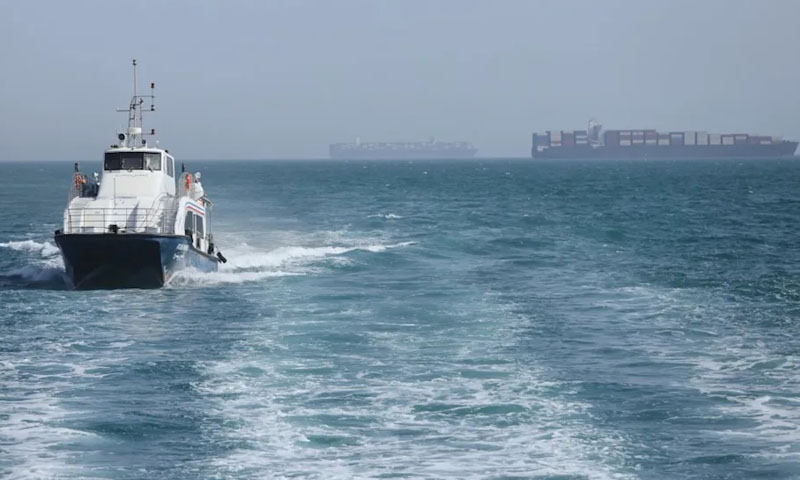
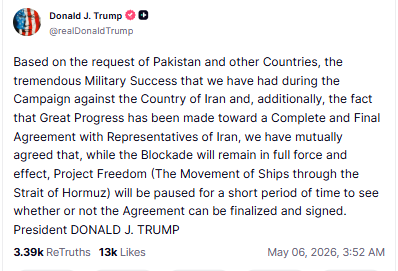
WASHINGTON/CAIRO: US President Donald Trump said on Tuesday that Washington would temporarily halt its naval effort to escort commercial vessels through the Strait of Hormuz, citing significant headway in negotiations with Iran, with Pakistan playing a mediating role in the talks.
In a Truth Social post, Trump said both sides had agreed to pause the initiative, referred to as “Project Freedom”, to allow time for a potential agreement to be finalised, even as a broader blockade would remain in place. There was no immediate response from Tehran.
Earlier in the day, US Secretary of State Marco Rubio had outlined the escort operation, which began a day earlier to guide stranded oil tankers through the critical shipping lane. The strait has been largely inaccessible since the conflict erupted, disrupting roughly a fifth of global oil flows and fuelling a surge in energy prices.
Following Trump’s remarks, US crude prices dropped sharply, falling below the $100-per-barrel mark for the first time in weeks.
Washington has accused Iran of effectively blocking the waterway by threatening the use of mines, drones, missiles and fast-moving attack boats. In response, US forces have imposed restrictions on Iranian ports while providing military escorts to selected commercial vessels.
The US military said it had recently destroyed several Iranian drones, cruise missiles and small naval craft. Rubio later told reporters that the primary phase of Washington’s military campaign, launched jointly with Israel in late February, had concluded.
“We’ve achieved our core objectives,” Rubio said, referring to the operation known as Operation Epic Fury. He added that the US was not seeking further escalation.
US Defence Secretary Pete Hegseth said a navigational corridor through the strait had been secured, with hundreds of vessels preparing to transit. He stressed that a fragile ceasefire with Iran remained in place but warned it was being closely monitored.
Meanwhile, Dan Caine said recent Iranian actions against US forces had not crossed the threshold that would trigger renewed large-scale combat.
Tensions remained high elsewhere in the region. The United Arab Emirates reported a second consecutive day of missile and drone threats it attributed to Iran, calling the situation a serious escalation and reserving the right to respond. Tehran denied launching any such attacks, saying its military actions were limited to countering US aggression.
The conflict has disrupted global shipping and caused heavy casualties across multiple countries, including Lebanon and Gulf states. The head of the International Monetary Fund warned that even if hostilities ended immediately, the economic fallout could take months to stabilise.
Rubio also highlighted the humanitarian toll, saying civilian sailors had been killed and that crews stranded in the strait were facing severe shortages of food and supplies.
Diplomatic efforts to end the crisis are ongoing but have yet to produce a breakthrough. US and Iranian officials have held limited direct talks, while Pakistan continues to play a mediating role. Iranian Foreign Minister Abbas Araqchi said discussions were still underway, even as he travelled to Beijing for further consultations on regional developments.