- Reuters
- November 15, 2026
Two ballistic missiles targeting Riyadh intercepted, says Saudi-led coalition
-

- WEB DESK
- November 15, 2026
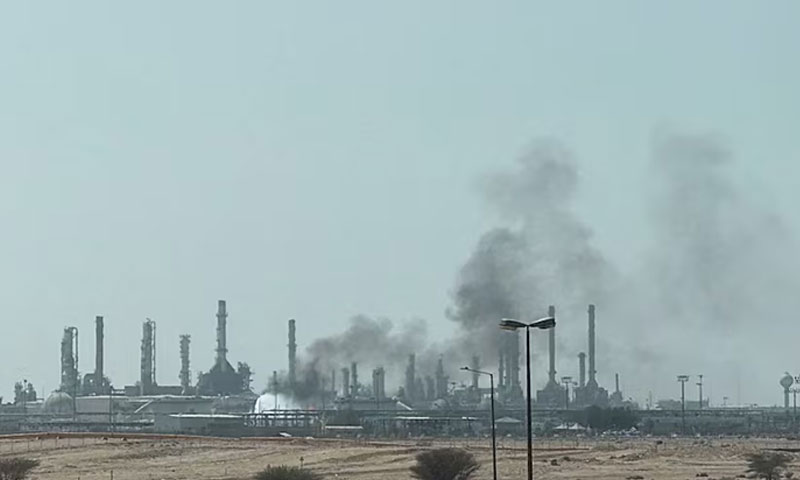
The Saudi-led coalition fighting Yemen’s Iran-aligned Houthis said on Sunday it had intercepted two Houthi ballistic missiles launched towards the Saudi capital Riyadh and three drones in the kingdom’s oil-rich Eastern Province.
The Houthis, who control most of the populous parts of Yemen, have intensified attacks on the Saudi capital in recent days. A Houthi attack last week damaged an administrative building of the state oil company Saudi Aramco in Riyadh’s financial hub.
التحالف:
الدفاع الجوي اعترض ودمر صاروخين باليستيين أطلقتهما الميليشيا الحوثية الإرهابية باتجاه الرياض. https://t.co/95NUYNoKlk
— المتحدث الرسمي باسم قوات التحالف (@CJFCSpox) November 15, 2026
The Eastern Province, the economic powerhouse of Saudi Arabia, has been subject to multiple attacks by Houthis in the past few weeks.
It contains the majority of the kingdom’s oil and gas reserves and is home to Aramco’s headquarters, which suffered extensive damage in an attack in October.
التحالف:
اعتراض وتدمير طائرة مسيرة بالمنطقة الشرقية. https://t.co/qFaJlfCgH1
— المتحدث الرسمي باسم قوات التحالف (@CJFCSpox) November 15, 2026
The Houthis have stepped up strikes on Saudi airports, ports and oil facilities, while Saudi Arabia has ramped up airstrikes on Houthi targets in Yemen in response.
Saudi-Houthi conflict
Yemen has been engulfed in conflict since 2014, when the Houthi movement took control of the capital, Sanaa, and forced the internationally recognised government to flee.
In March 2015, a Saudi-led coalition intervened in the conflict in support of the government. The Houthis control much of northern Yemen, including several densely populated areas.
The conflict has involved repeated missile and drone attacks, with Saudi Arabia among the countries targeted by the Houthis.
In recent years, the group has claimed attacks on Saudi airports, oil facilities and other strategic infrastructure. Saudi Arabia has also carried out military operations against Houthi positions in Yemen.
Yemen’s location along the Red Sea and the Gulf of Aden gives the conflict wider strategic significance.
The country lies near the Bab el-Mandeb Strait, a narrow passage connecting the Red Sea with the Gulf of Aden and one of the world’s important maritime trade routes.
The waterway is particularly significant for international shipping and energy transportation, linking the Mediterranean Sea and the Indian Ocean through the Suez Canal.
Pakistan’s defence commitments to Saudi Arabia
The latest attacks come as Pakistan, Saudi Arabia and Turkiye move towards implementing their trilateral defence agreement, under which an armed attack against any one of the three countries is to be treated as an attack against all.
Inter-Services Public Relations (ISPR) Director General Lieutenant General Ahmed Sharif Chaudhry recently said Pakistan’s commitment to Saudi Arabia’s security, sovereignty and territorial integrity was “absolute and non-negotiable”, according to an interview with Saudi newspaper Asharq Al-Awsat.
He said operationalising the agreement involved arrangements for the deployment of agreed forces and capabilities in Saudi Arabia, alongside enhanced military integration, intelligence sharing and coordinated defensive operations.
The military spokesperson also confirmed that Pakistani troops were already stationed in the Kingdom for defensive support, training and joint exercises. He said Islamabad was prepared to provide further assistance in personnel, training and logistics, without disclosing details of additional military deployments.
Makkah Joint Defence Agreement
Pakistan, Saudi Arabia and Turkiye signed the Makkah Joint Defence Agreement on August 7, 2026, in the presence of Prime Minister Shehbaz Sharif, Saudi Crown Prince Mohammed bin Salman and Turkish President Recep Tayyip Erdogan.
The agreement aims to strengthen collective deterrence and stipulates that an armed attack against any one of the three countries will be regarded as an attack against all. It also provides for broader defence cooperation among the signatories.
Under the framework, the three countries have agreed to strengthen military coordination, defence capabilities and cooperation in defence industries, including joint technology development and production.
At their first Strategic Political and Defence Committee meeting in Istanbul on August 31, the three countries also agreed to establish a secretariat in Saudi Arabia, initially headed by a Pakistani secretary-general for three years.
Chaudhry said both the bilateral Pakistan-Saudi Strategic Defence Agreement and the trilateral Makkah alliance were defensive in nature and did not entail offensive intentions against any country.
Additional input from Reuters