- Web
- 21 Minutes ago
UK changes border rules; dual citizens at risk of being stranded
-

- Web Desk
- Feb 19, 2026
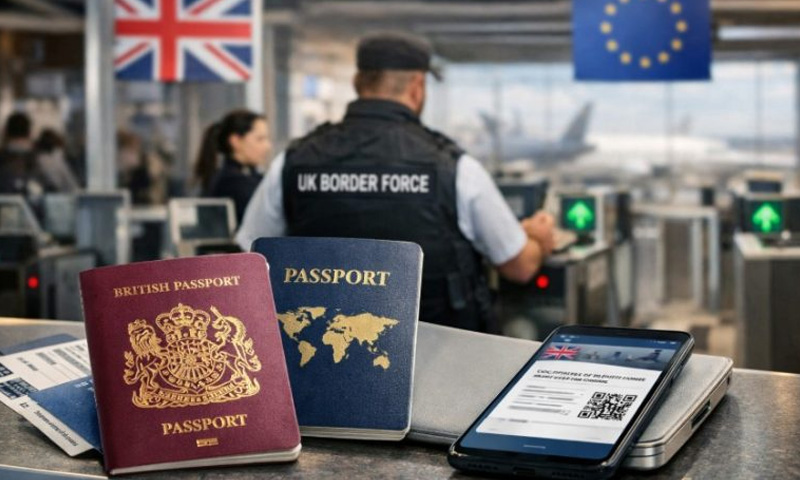
Thousands of dual nationals are rushing to secure British travel documents ahead of sweeping border changes that take effect on 25 February, as the government tightens entry requirements in line with wider immigration reforms.
Under the new system, British citizens who also hold another nationality will no longer be permitted to enter the UK using only their non-British passport, even if that country is visa-free for other travellers. An article by BBC said on Wednesday that from 25 February, they must present either a valid British passport or a digital certificate of entitlement linked to their foreign passport. Without one of these, airlines may refuse boarding and entry to the UK could be denied.
WHAT IS CHANGING?
Previously, dual nationals whose second nationality came from a visa-exempt country could travel to the UK on that passport alone. That exemption is ending.
The new requirement forms part of the rollout of the government’s Electronic Travel Authorisation (ETA) scheme, which will require most visa-free visitors to obtain digital pre-clearance before travel. The ETA currently costs £16, with plans to increase the fee to £20.
However, British dual nationals are not eligible to apply for an ETA. Instead, they must prove their British citizenship through official documentation. Airlines will carry out checks before departure.
Irish passport holders are exempt from the changes, but dual nationals with EU passports and other visa-free nationalities will be affected.
COSTS AND PROCESSING DELAYS
A British passport costs around £100 for adults. The alternative certificate of entitlement – a digital confirmation of British citizenship attached to a foreign passport – costs £589.
Neither document is issued automatically when someone becomes a British citizen. Many dual nationals who naturalised years ago never applied for a British passport, as it was not required for travel.
Both documents can take several weeks to process, creating a time pressure for those currently abroad or with upcoming travel plans.
According to 2021 census data, more than 1.2 million UK residents are dual nationals – including around 587,600 UK-born residents and 648,700 residents born overseas.
AIRLINE ENFORCEMENT AND RISK OF BEING STRANDED
Under the new regime, airlines will be responsible for checking that British dual nationals have appropriate documentation before boarding flights to the UK. Those without the required proof risk being prevented from travelling.
Critics say this enforcement mechanism is creating anxiety for people who are already outside the country and may not be able to obtain documents quickly.
Several dual nationals have reported learning of the change only recently, with some discovering it through social media rather than official channels. Others say applying from overseas has proven complicated, requiring in-person appointments or original paperwork stored in the UK.
Campaign group the3million, which represents EU citizens in Britain, has accused the government of failing to communicate the implications clearly and has urged ministers to introduce a temporary, low-cost travel authorisation for affected dual nationals.
GOVERNMENT POSITION
A Home Office spokesperson said information about the requirement has been publicly available since October 2024 and that a broader communications campaign around the ETA scheme has been underway since 2023.
Officials argue that the policy aligns the UK with countries such as the United States, Canada and Australia, where citizens are expected to enter and leave using their national passport.
The government maintains that the rule applies equally to all British citizens, regardless of any additional nationality.
A NARROW WINDOW BEFORE ENFORCEMENT BEGINS
With the 25 February deadline approaching, dual nationals who do not already hold a British passport face a limited window to apply. Processing times and the need to submit original documents, sometimes from overseas, have added to the urgency.
Immigration lawyers say the key message is clear: from late February onward, British citizenship alone will not be sufficient for travel unless it can be demonstrated with the correct documentation.
For many dual nationals, the practical consequence of the reform is straightforward: no British passport, no boarding.
You May Also Like




- Web
- 2 Hours ago
Commanders sign RB Jerome Ford to 1‑year deal
